Aquarium Photography under LED Light: Color Fidelity, White Balance, and Honest Images
Aquarium photographs are often treated as proof of lighting performance, yet the camera, water, glass, room, editing, and display screen all sit between the fixture and the viewer. Automatic white balance can neutralize a blue reef scene or warm a tannin-rich tank. Phone software may lift shadows, combine exposures, sharpen details, and increase saturation without asking. A beautiful image can be legitimate marketing, but it becomes misleading when it is presented as an objective record of how the aquarium looks to the eye.
Start by deciding the photographic purpose. A hero image may intentionally create mood. A livestock health record should favor consistency. A color-comparison test requires fixed exposure, white balance, lens, camera position, light settings, and editing. A product listing needs disclosure if fluorescence, filters, or substantial color grading changes expected appearance. Mixing these purposes creates arguments that no technical specification can resolve. The image protocol should be written before the shoot, particularly when comparing two fixtures or production batches.
Color rendering cannot be reduced to correlated color temperature or CRI alone. The U.S. Department of Energy explains that ANSI/IES TM-30 uses several measures and graphics to describe fidelity and gamut more fully. Even these metrics characterize a light source under defined calculations; they do not predict a camera's proprietary processing. For aquarium work, spectral power distribution, reference color targets, and controlled captures provide a clearer audit trail than a single high-CRI badge.
Use manual or locked settings whenever repeatability matters. Select a shutter speed that avoids motion blur and does not interact badly with LED modulation. Set aperture and ISO deliberately, lock focus, and use a tripod when possible. Photograph a neutral gray or color reference in the same light field, through the same glass and water path. If the reference is placed outside the aquarium, it cannot correct the spectral and color changes introduced by water, tannins, blue-heavy light, and glazing.
Reflections are best solved physically before editing. Darken the room, move bright clothing and screens away, use a lens hood near the glass, and clean both sides of the viewing panel. Slight camera-angle changes can remove a reflection but may introduce distortion, especially through thick acrylic. Polarizing filters can help in some arrangements, yet they may alter exposure and cannot remove every reflection from layered glass and water surfaces. Record their use when the result serves as product evidence.
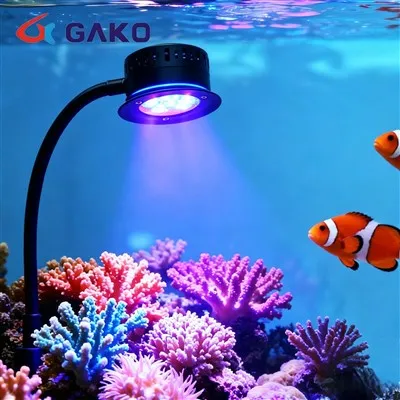
Fluorescence photography requires special honesty. Violet or blue excitation can make coral pigments emit striking visible colors, especially when an orange or yellow filter suppresses the excitation light. This is a valid way to document fluorescence, but it is not a normal white-light view and does not measure coral growth or health. Publish a labeled fluorescence image alongside a balanced-light reference when appearance expectations matter. Avoid cloning tissue, hiding algae, or changing individual animal colors during retouching.
Video adds another layer because frame rate and shutter timing can reveal bands or pulses that are invisible in a still photograph. A phone video showing no bands does not prove that temporal light modulation is absent; the camera may simply be synchronized with it. Conversely, banding can arise from the interaction between camera scanning and a modulated driver. Use appropriate measurement equipment for an engineering claim, while using video as a practical screening tool and a way to compare visible motion rendering.
A trustworthy imaging checklist records fixture model and firmware, channel percentages, schedule phase, mounting height, water clarity, camera model, lens, exposure, white balance, filter, file format, and editing steps. Keep the original RAW or unedited file. For ecommerce, state whether the image represents visual white light, fluorescence, or a creative scene. Honest photographs may be less dramatic than heavily processed ones, but they reduce returns, protect the brand, and help customers distinguish lighting capability from camera interpretation.
Brands can formalize three export files from every shoot: an untouched reference capture, a corrected documentary image, and a creative marketing image. Store the lighting and camera metadata with each. Approval should check that labels match the treatment and that the product itself has not been altered. This workflow gives designers freedom while preserving evidence. It also makes future localization easier because teams can replace text or crops without repeatedly re-editing colors until the fish, plants, or fixture no longer resemble the photographed product.
For batch comparison, create a small photographic station with fixed camera and target positions, black surrounds, a clean reference panel, and saved exposure settings. Let each fixture warm up, verify its channel program, and include a frame that shows the serial number or test identifier. Histogram matching alone is insufficient because two spectra can create similar overall brightness while rendering particular reds, greens, or fluorescent pigments differently. When images are compressed for marketplaces, check the exported file on several ordinary screens, but keep a color-managed master. Marketplace algorithms may further compress or alter images, so the source archive is essential for resolving disputes. If generative tools remove cables, reflections, algae, or background objects, they must not alter the product's LED count, housing geometry, control display, connector, emitted color, or demonstrated coverage. Visual cleanup should not manufacture a capability that the photographed unit did not have.
Good aquarium photography separates creative expression from technical evidence. Once settings and edits are documented, images can remain attractive while giving customers a truthful basis for judging color, fluorescence, and fixture performance. Preserve original files and publish enough capture context for the image's purpose. A disclosed fluorescence portrait, a neutral documentary frame, and a creative hero image can coexist without being confused.