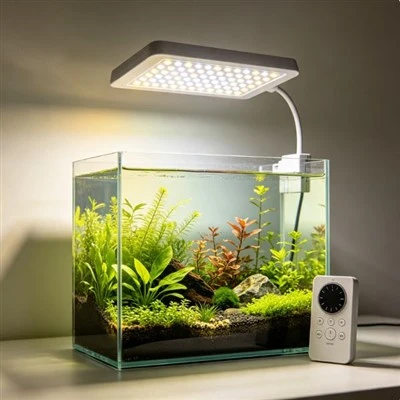
An optical test is sometimes performed in a room that cannot be made completely dark. Daylight enters through a curtain, emergency lighting stays on, or neighbouring equipment contributes a low background. The meter therefore reads light from the aquarium fixture plus light from the surroundings. Taking a lamp-off reading and subtracting it from the lamp-on reading can be useful in some controlled situations, but subtraction is not a magic cleaning tool. It works only when the two measurements are truly comparable and the instrument responds appropriately.
Fix the geometry before collecting any numbers. Mark the sensor position and orientation, fixture position, mounting height, operating setting, and relevant reflecting surfaces. A centimetre of sensor movement can change a local reading under a narrow beam. The aquarium, test bench, walls, and covers should remain in the same state for the off and on measurements. Record the unit and the exact instrument. If the meter changes range automatically, understand whether that affects resolution, response time, or comparability.
Ambient light must remain stable during the pair of readings. Take the lamp-off and lamp-on values close enough together that daylight, room lamps, doors, screens, and moving people do not change the background. If a cloud passes between readings, the numerical difference may describe the window as much as the fixture. Repeating several off-on pairs can reveal drift. When background variation is large relative to the fixture contribution, improving the room or shielding the measurement is usually better than performing increasingly elaborate arithmetic.
The instrument should be within its specified operating and linear range for both readings. Subtracting an overloaded lamp-on value or a background value near the meter's noise limit does not create accuracy. Allow the fixture and instrument to stabilise as required by the method, and use consistent timing. For a dimming test, background may represent a large share of the low-level reading, making uncertainty especially important. A small positive difference should not be reported with more digits than the method can support.
Consider a simple example. A fixed sensor reads 120 units with the lamp off and 820 with it on, so the calculated fixture contribution is 700 units under the stated conditions. Ten minutes later, the off value has climbed to 200 because sunlight reached the wall. Pairing that later background with the earlier lamp-on reading would give 620, although the fixture may not have changed. Raw readings and timestamps expose the mismatch; a report that stores only "700" or "620" conceals it.
Reflections complicate the picture in a different way. The room background may illuminate the aquarium and be reflected into the sensor, while the fixture may also illuminate surfaces that then contribute to the reading. In a linear system under stable geometry, the off-on difference can still be meaningful for the defined setup, but it is not necessarily a pure direct-beam value. State whether the test includes an aquarium, water, lid, reflector, or room surfaces. Do not compare the result with data taken in a different geometry without explaining the difference.
The calculation should be transparent. Preserve each raw lamp-off and lamp-on value, the pairing rule, time, setting, sensor position, distance, units, instrument identity, and any averaging. Report the subtraction explicitly and describe background stability. If uncertainty is estimated, include the main contributors rather than presenting the difference as exact. Never mix lux with PPFD, or subtract readings from different sensor types as though the numbers shared a physical meaning.
Good practice includes a reasonableness check. Repeat the sequence, reverse the order where appropriate, or temporarily improve shielding to see whether the conclusion holds. If the background changes unpredictably, postpone the measurement or use a more suitable space. The aim is to answer a defined question, such as comparing two settings at one fixed point, not to manufacture a number that looks laboratory-grade. A photograph of the setup and position marks often makes later review far easier.
Spatial measurements require particular care. Background taken at the centre cannot automatically be subtracted from every point if daylight or room lighting varies across the grid. Either measure the relevant background at each point under stable conditions or demonstrate that one background value represents the area within the method's uncertainty. Keep the order of points and elapsed time visible so drift can be recognised. If an aquarium contains moving water, surface patterns may add short-term fluctuation; repeated readings or defined averaging should follow the selected method.
Subtraction can also distort percentages. Suppose a low setting produces a small net value after a large background is removed. Dividing that difference by the high-setting result may suggest a precise dimming ratio even though uncertainty in the two raw readings dominates the low value. Report enough information for the reader to judge this limitation. Negative calculated values, when background rises between readings, should trigger investigation rather than being silently changed to zero. The arithmetic must remain subordinate to the quality of the observations.
Name the result carefully. "Ambient-corrected reading at the marked point" is clearer than "true lamp output," because the test may still include reflections, instrument response, and geometric limits. If the value is used in a brochure or customer report, carry the conditions with it. Removing the background number from the arithmetic must not remove the background method from the explanation.
Ambient subtraction is most credible when its limitations are visible. It can help a factory, laboratory, or service team work with an unavoidable low background, provided stability, linearity, range, geometry, and timing are controlled. It cannot repair moved sensors, changing daylight, saturated instruments, or mixed measurement quantities. The final report should let another person reconstruct both readings and decide whether the difference is useful. That is how a simple subtraction becomes evidence rather than decoration.