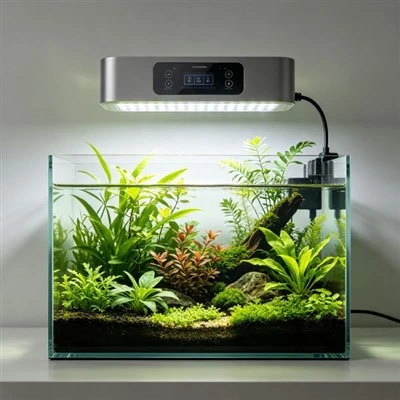
Why Planted Tank Keepers Ask This Question
Walk into any aquarium shop and you'll find LED lights marketed as "plant lights," "full-spectrum," or "suitable for live plants." Some of these claims are accurate; many are not. The problem is that human eyes and aquatic plant chlorophyll respond to different parts of the light spectrum, and a light that looks perfectly bright to us might be delivering very little of the wavelengths plants actually need.
At the same time, even with the right light, plants can fail if CO2 is insufficient, nutrients are depleted, or water circulation is poor. Light is necessary but not sufficient on its own - it's one leg of a three-legged stool, and pulling on just one leg doesn't make the stool stand.
Understanding how aquatic plant photosynthesis actually works gives you a framework for diagnosing what's going wrong and fixing it systematically rather than guessing.
How Photosynthesis Works in Aquatic Plants
Photosynthesis is the process by which plants convert light energy into chemical energy (glucose), releasing oxygen as a byproduct. The chemical equation is straightforward:
6CO₂ + 6H₂O + light energy → C₆H₁₂O₆ + 6O₂
But the "light energy" part is not one-size-fits-all. Chlorophyll - the pigment that captures light in plant cells - has two primary absorption peaks:
Red light at approximately 650–680nm: This is the most efficiently used wavelength for the light-dependent reactions of photosynthesis. It drives the most energy production per photon absorbed.
Blue light at approximately 430–450nm: Also efficiently absorbed by chlorophyll, and particularly important for chlorophyll synthesis and regulation of growth patterns.
Wavelengths in between - the green range around 500–570nm - are largely reflected by chlorophyll, which is why most plants look green. This also means that a light which appears very green-white to human eyes may be delivering relatively little photosynthetically effective radiation.
Light-Dependent and Light-Independent Reactions
The light-dependent reactions (occurring in the thylakoid membranes of chloroplasts) capture photon energy and use it to split water molecules, releasing oxygen and generating ATP and NADPH - the energy carriers that power the rest of photosynthesis. This stage is directly driven by light quality and intensity.
The light-independent reactions (the Calvin cycle, in the stroma of chloroplasts) use that ATP and NADPH to fix CO₂ into glucose. This stage doesn't require light directly - but it is rate-limited by the products of the light reactions and by CO₂ availability.
The practical implication: increasing light intensity increases photosynthesis rate up to a point, but only if CO₂ and nutrients are also available. Beyond that point - called the light saturation point - more light doesn't produce more photosynthesis. It just generates heat and encourages algae.
Actual indicators for predicting plant growth
PAR - Photosynthetically Active Radiation
PAR measures the total amount of light in the 400–700nm wavelength range - the range that plants can use for photosynthesis - in units of micromoles of photons per square metre per second (µmol/m²/s, also written as µE/m²/s). A PAR meter placed at the substrate level gives you the most useful single number for assessing whether your aquarium light is delivering enough photosynthetically relevant light.
Useful PAR targets for planted aquariums:
|
Plant category |
PAR at substrate (µmol/m²/s) |
|
Low-light species (Java fern, Anubias, mosses) |
20–50 |
|
Medium-light species (most stem plants, crypts) |
50–150 |
|
High-light species (carpeting plants, red stems) |
150–300+ |
Many budget aquarium LED lights deliver only 15–30 µmol/m²/s at the substrate in a standard 40cm-deep tank - adequate for low-light plants, but insufficient for anything more demanding.
PUR - Photosynthetically Usable Radiation
PUR is a refinement of PAR that weights the measurement by how efficiently different wavelengths are actually absorbed by aquatic plant chlorophyll. A light with a high proportion of red (650–680nm) and blue (430–450nm) output will have a higher PUR-to-PAR ratio than a light heavy in green-yellow output. PUR meters are less common and more expensive than PAR meters, but PUR is the more meaningful metric for plant growth.
The practical takeaway: when comparing two lights with similar PAR readings, the one with spectral peaks closer to chlorophyll absorption maxima will support better plant growth. Full-spectrum LEDs with dedicated red and blue channels outperform broad-spectrum white LEDs at the same PAR level.
Lux - What It Measures and Why It's Not Enough
Lux measures illuminance as perceived by the human eye - it weights green-yellow light most heavily because that's where human vision is most sensitive. Plants don't care about this weighting. A lux reading from a greenish light source will look high but may correspond to relatively low PAR and PUR. Lux is useful for assessing whether a space is bright enough for human work or aesthetics; it's not a reliable predictor of plant photosynthesis rates.
The CO2 and Nutrient ConnectionWhy Light Alone Isn't Enough
Aquatic plant photosynthesis operates according to what agronomists call Liebig's Law of the Minimum: the rate of a biological process is limited by whatever resource is in shortest supply, regardless of how abundant the others are. In a planted aquarium, the most common limiting resources are CO₂, light, and macronutrients (nitrogen, phosphorus, potassium).
If CO₂ is deficient, increasing light doesn't increase growth - the light-independent reactions simply run out of raw material. If nitrogen or potassium is depleted, glucose produced by photosynthesis can't be assembled into proteins and structural compounds needed for new growth.
This creates a practical hierarchy for planted tank troubleshooting:
Is the light delivering adequate PAR at the substrate for the plants you're keeping?
Is CO₂ sufficient - either through injection or natural production from fish and biological processes?
Are macronutrients (N, P, K) and micronutrients (iron, trace elements) available at adequate levels?
Is water circulating well enough to deliver CO₂ and nutrients to all plants?
The Role of Water Circulation
This is where a 12V Aquarium Pump enters the picture. In a planted tank, water circulation does more than oxygenate - it distributes dissolved CO₂ and nutrients throughout the water column, ensuring that plants at the back of the tank and at the substrate level have access to the same resources as plants near the filter return.
A 2020 study in Frontiers in Plant Science found that aquatic plants in stagnant conditions showed photosynthesis rates up to 38% lower than identical plants in gently circulating water - even when CO₂ and nutrient concentrations in the bulk water were equal. The limiting factor was diffusion: without flow, CO₂ and nutrients could not reach plant surfaces fast enough to keep pace with the plant's metabolic demand.
A gentle, non-turbulent circulation pattern - achievable with a well-positioned 12V Aquarium Pump - is therefore part of the photosynthesis support system, not separate from it. Turbulent surface agitation, by contrast, off-gases CO₂ rapidly and is counterproductive in a planted tank during the light period.
How Long Should Your Aquarium Light Run
The 8–10 Hour Rule
Most planted aquarium experts and published research converge on 8–10 hours as the optimal daily photoperiod for planted tanks. This mirrors the approximate light period in most tropical aquatic habitats and provides sufficient time for meaningful photosynthesis without the extended exposure that promotes algae.
The counterintuitive point: plants do not grow proportionally more with more hours of light. Once the plant has stored sufficient energy through photosynthesis, additional light hours mainly fuel algae growth - which has a lower light saturation point and benefits disproportionately from extended exposure.
Why Consistency Matters as Much as Duration
A planted tank with 10 hours of light every day performs significantly better than one averaging 10 hours but with variation from 6 to 14 hours day to day. Plant metabolism is regulated by photoperiod signals - consistent light cycles allow plants to entrain their internal biochemical rhythms, optimising enzyme activity and resource allocation around the predictable light period.
This is precisely why an Aquarium Lamp Timer is not a convenience item for planted tanks - it's a meaningful contributor to plant health. By delivering the same photoperiod at the same time every day, a timer enables plants to synchronise their metabolic cycles and use the light period more efficiently.
Avoiding the Algae Trap
Extended photoperiods - 12 hours or more - combined with moderate to high light intensity are the single most reliable recipe for algae problems. Algae are photosynthetically efficient at lower light intensities and saturate later than most vascular aquatic plants, meaning they benefit disproportionately from extra light hours. The 8–10 hour window, consistently applied, keeps plants in a productive metabolic state without providing the extended exposure that triggers algae blooms.
What Published Research Shows
Several published studies provide direct data points for planted aquarium management:
A 2019 study in Aquatic Botany examining different LED spectra on the growth of Egeria densa (a common aquarium plant) found that lights with peaks at 450nm (blue) and 660nm (red) produced 47% more dry-weight biomass over four weeks compared to broad-spectrum white LED of equivalent PAR - demonstrating that spectrum quality at equivalent intensity makes a measurable difference.
Research published in Journal of Plant Physiology (2021) documented that Vallisneria spiralis (another common aquarium plant) showed optimal photosynthesis rates at approximately 120 µmol/m²/s PAR - providing a practical mid-light target for commonly kept stem and rosette plants.
A review in Hydrobiologia (2020) on submerged aquatic vegetation and light availability concluded that photoperiod consistency was as important as photoperiod duration for plant growth rate - consistent 8-hour photoperiods produced equivalent or better growth to inconsistent 10-hour photoperiods in all three species studied.
12V Pump and Timer Integration in a Dutch-Style Planted Tank
A planted aquarium enthusiast in the Netherlands was rebuilding a 200-litre Dutch-style display tank after persistent algae problems had overwhelmed the previous setup. The original setup had run lights for 12–14 hours daily without a timer (manually switched) and used a powerful external canister filter for circulation.
The new setup incorporated three specific changes guided by the principles above:
Full-spectrum LED with dedicated red (660nm) and blue (450nm) channels, delivering 130 µmol/m²/s PAR at the substrate
Aquarium Lamp Timer set to a fixed 9-hour photoperiod, with a 20-minute gradual ramp at each end
A 12V Aquarium Pump positioned to create a low-flow circulation pattern at substrate level, supplementing the canister filter return without creating surface turbulence that would off-gas CO₂
Results at eight weeks: the stem plants - including Rotala rotundifolia, Ludwigia palustris, and Bacopa monnieri - were showing consistent upward growth with tight internodal spacing (a sign of appropriate light intensity) and vivid red colouration in the light-demanding varieties. No algae outbreak occurred despite a CO₂ injection system running at 30ppm. The hobbyist reported that the timer alone - eliminating the previous irregular 12–14 hour photoperiod - appeared to be the single most impactful change.
Choosing the Right Light for Your Planted Tank
A practical guide to light selection based on tank depth and plant category:
For low-light tanks (Java fern, Anubias, mosses, crypts in a shaded layout):
Target: 20–50 µmol/m²/s PAR at substrate
Any decent full-spectrum LED at moderate output works; spectrum matters less at this level
No CO₂ injection needed; natural fish respiration and substrate biological activity typically provide sufficient CO₂
For medium-light tanks (most stem plants, easy carpeting plants, coloured crypts):
Target: 50–150 µmol/m²/s PAR at substrate
Good-quality full-spectrum LED with red and blue channels; CRI ≥85
Optional CO₂ injection; liquid carbon supplementation is often sufficient
For high-light tanks (demanding carpeting plants, red stem plants, aquascaping competition-style layouts):
Target: 150–300 µmol/m²/s PAR at substrate
High-output LED with specific red/blue spectral targeting; PAR meter strongly recommended
CO₂ injection essentially required; comprehensive fertilisation programme
12V Aquarium Pump for CO₂ and nutrient distribution without surface agitation
F A Q
Q: Can any aquarium LED light support photosynthesis in live plants?
A: Most modern LED lights produce some light in the photosynthetically active range, but the intensity and spectrum vary enormously. A light delivering only 15–20 µmol/m²/s PAR at the substrate will support only the hardiest low-light plants. For anything more demanding, a purpose-designed plant LED with red and blue channel emphasis and adequate output is needed.
Q: How do I measure PAR in my aquarium without expensive equipment?
A: A basic PAR meter costs £50–150 and is the most reliable tool. If that's not in budget, you can cross-reference the fixture's manufacturer specifications if they publish PAR data, or use online community resources where owners of the same light model have shared measured values. Observational signs - tight internodal spacing in stem plants, active new leaf production, visible pearling - are imperfect but useful indirect indicators of adequate PAR.
Q: How many hours should I run my planted tank light?
A: –10 hours daily is the standard recommendation for most planted aquariums. Use an Aquarium Lamp Timer to make this consistent - variation in timing and duration disrupts plant metabolic rhythms and increases algae risk.
Q: Can I compensate for low light with a longer photoperiod?
A: To a limited extent - but with diminishing returns and increasing algae risk. Plants have a light saturation point beyond which additional photons don't increase growth. Algae, however, can use lower intensities efficiently and benefit from extended exposure. The better approach is to increase light intensity rather than duration.
Q: Does the colour of aquarium light affect plant growth?
A: A: Yes, significantly. Lights with strong peaks at 450nm (blue) and 660nm (red) deliver more photosynthetically usable energy than broad-spectrum or green-heavy lights at the same PAR level. A 2019 study found 47% greater plant biomass growth under targeted red-blue LED compared to equivalent-PAR white LED over four weeks.
Q: Do I need CO₂ injection for a planted tank?
A: Not necessarily - it depends on your light intensity and plant species. Low-light tanks with undemanding plants can thrive on naturally available CO₂. As light intensity and plant species demands increase, CO₂ becomes progressively more limiting. High-light, high-growth planted tanks essentially require CO₂ injection to achieve their potential and prevent algae from dominating.
Give Your Plants What They Actually Need
The key insight in planted aquarium keeping is that light quality, light duration, CO₂, and water circulation are a system - each element supports the others, and weakness in any one limits the whole. A well-spectrified LED delivering adequate PAR, a consistent 8–10 hour photoperiod maintained by an Aquarium Lamp Timer, CO₂ appropriate to the light level, and gentle distribution via a 12V Aquarium Pump is the combination that produces a genuinely thriving planted tank.
At Sunhingstones, we manufacture aquarium pump and timer systems designed to integrate cleanly into planted tank setups - from the gentle circulation of our 12V pump range to the precision scheduling of our programmable timer units