

1. Spectral Composition: From Natural Simulation to Artistic Creation
Basic Control for Spectral Segmentation
The main benefit of aquarium lights is that they have a multi-channel LED chip that lets you tune spectrum very precisely. When shooting movies and TV shows, this feature has to be improved by integrating the colour temperature and the colour rendering index (CRI):
Blue light band (450-480nm): To mimic deep-sea conditions, the amount of blue light must be between 60% and 70% to simulate how water absorbs red light. For instance, when they were filming the real-life extension scene for the animated movie "Deep Sea," they were able to get the green luminescence effect of coral fluorescent protein back by turning up the brightness of the blue light chip to 80% and adding 5% UV-A (380–400nm).
Red light band (620–680 nm): In the play "Water Shape Story," a blend of 20% red light and 80% blue light is utilised to show how underwater creatures feel about temperature. This makes the actors' skin look a little red. A colour rendering index of CRI>90 is also employed to make sure that colours are reproduced correctly.
Technology for full spectrum compensation: To meet the need for colour accuracy in film and TV shooting, high-end aquarium lamps like the Kessil A360X add amber light (590–620nm) and purple light (400–420nm) channels to the spectral coverage range of 380–780nm. This makes the light spectrum more like natural light and makes it much easier to adjust the colour after the fact.
Technology for Dynamic Spectral Switching
Aquarium lights need to be able to swiftly alter spectra because stage acts happen right away. In stage lighting, the idea of "light colour addition" can be used in the following ways:
management the aquarium light using the DMX512 protocol: connect it to the stage lighting management system and use preset programs to cycle between spectral gradients. For instance, in the underwater scene of the musical 'Cats', the lighting engineer employs a 0.5-second spectral transition time to slowly lower the blue light from 70% to 30% and raise the red light to 40%. This makes the fish look like they are changing colours when they are scared.
Control of sensor links: When shooting movies and TV shows, colour temperature sensors are used to keep an eye on changes in the light around the aquarium and automatically change the spectrum of the aquarium lights. For instance, when the outdoor daylight colour temperature drops from 5500K to 4000K, the system reduces the light colour temperature to 3800K at the same time to keep the colour temperature from changing in the image. Light intensity distribution: management of space and picture hierarchy
2.Control of vertical gradient intensity
Light intensity decreases in underwater scenes according to an exponential rule. To get this effect, the following values must be used:
Setting for the PPFD gradient: A 3-meter-deep tank was utilised to make the marine environment for the theme stage play "Finding Nemo." The surface light intensity reached 1200 μ mol/m²/s when the height of the aquarium light array was changed, while the bottom layer light intensity dropped to 300 μ mol/m²/s. This is similar to how light intensity is distributed in tropical coral reefs at depths of 0-30 meters.
Technology for soft light compensation: To meet the need for consistent light quality in film and TV shooting, adding a soft light cover with a 10% transmittance can make the light intensity at the bottom of the aquarium 35% more even. This gets rid of the effect of strong light spots on actors' close-ups. In the underwater scenes of the movie "Life of Pi," for instance, a soft light mask changes the aspect ratio from 4:1 to 2.5:1, which makes dark details much clearer.
Calibration of horizontal light intensity
By making the light distribution curve better:
Adjusting the beam angle: In the stage play "The Little Mermaid," an aquarium light with an adjustable beam angle (15 ° -120 °) is used to narrow the main beam angle to 30 °, focus on the actor's face, and add 60 ° of auxiliary light to the background to create a three-dimensional lighting effect of "main light highlights, auxiliary light transitions."
System for shading by region: When filming movies and TV shows, magnetic shade plates lower the local light intensity from 1500 μ mol/m ²/s to 50 μ mol/m ²/s, which is like the very different light conditions at deep-sea hot springs. For instance, during filming the documentary "Blue Planet II," this method made the bright signal of hot spring critters stand out against the dark background, making the image more visually striking.
3. Dynamic Control: Syncing the time and the scene
Exact control of the cycle of day and night
Stage and film shooting need to recreate the changes in natural light cycles, and the following technical requirements must be met:
Photoperiodic stability: To make sure that zebrafish melatonin secretion rhythms are in sync with the natural environment, laboratory-grade aquarium lamps need to have a timing precision of ± 1 second/24 hours. In the play "Insect Chronicles," the light cycle was tuned to 16 hours of light (with 2 hours of gradual brightness) and 8 hours of darkness. This let fireflies sparkle in sync, which added to the impression of stage technology.
Adjustable gradient duration: High-end aquarium lights can be adjusted to dim or brighten for 1 to 120 minutes. This tool can be used to make sequences that look like sunrise and sunset in movies and TV shows. In the underwater portions of the movie Avatar, for instance, the gradient duration was increased to 45 minutes to match the changes in light and shadow with the plot rhythm, which made the audience feel more like they were in the movie.
Dynamic control that starts with an event
The aquarium lamp can create the following dynamic effects based on what the stage or movie plot needs:
Linking sound effects: Use the MIDI standard to connect the lighting control system to the audio equipment so that the music, light, and shadow all change at the same time. In the underwater scene of the musical "The Phantom of the Opera," for instance, the light flashes faster and more often as the music speeds up. The light's intensity also goes up by 30%, making the mood more tense.
Technology for tracking actors: Using infrared sensors and AI algorithms, the system can figure out where an actor is in real time and change the direction of the aquarium's light beam automatically. This approach preserves the "underwater spider web" effect in the primary light range in the play "Spider Man," which makes the image clear.
4. Quality control of shooting: find a balance between technical details and creative expression.
Technology for stopping strobe lights
The PWM dimming method for aquarium lights might generate flickering problems that make it hard to get good shots when shooting film and TV. To fix the problem, the following steps need to be taken:
High frequency dimming technology: this uses PWM dimming with a frequency of more than 20kHz to get rid of flicker that people can see. The AI Prime HD aquarium light, for instance, meets the needs of film and television filming by raising the dimming frequency to 24kHz, which lowers the Flicker Percent in the filmed image to less than 0.5%.
Mode for dimming DC: Some high-end aquarium lights let you lower the lights by changing the voltage in a straight line. This makes the lights flicker-free. The DC dimming mode makes the transition of light and shadow smoother in the slow motion cinematography of the stage production "Phantom of the Opera." This stops the flicker from ripping the image.
Control of the colour temperature consistency
When more than one light fixture is used, changes in colour temperature might make the image less consistent. To keep the colour temperature consistent, you need to do the following:
Colour temperature calibration system: Use a spectrophotometer to find out the colour temperature of each aquarium lamp. Then, use the control system to change the RGB channel ratio so that the colour temperature deviance stays within ± 50K. This technology lets a lot of aquarium lights work together to make the colour temperature in the image look even when shooting movies and TV shows.
Protocol for synchronising colour temperature: Aquarium lights that work with Art Net or sACN may sync colour temperature across the network. To make sure that the colours in the picture stayed the same, 32 aquarium lights were set to 5600K using this protocol in the underwater scene of the big stage production "The Lion King."
5. Examples of how the industry is used and what will happen in the future
A case study of lighting design for the stage play "Twenty Thousand Leagues Under the Sea"
The drama uses the following technologies to make underwater scenes look real:
The primary light employs a blended spectrum of 60% blue light, 30% white light, and 10% purple light to make the scene look like it's in the deep sea. The extra light uses 50% red light and 50% white light to make the actors' faces stand out.
Light intensity distribution: Adjustable beam angle aquarium lamps create a vertical gradient in light intensity. The surface light intensity is 800 lux and the bottom light intensity is 200 lux, which follows the rule of deep-sea light attenuation.
Dynamic control: Using the DMX512 protocol to make changes to lighting, music, and actor movements happen at the same time, like in the scene where the "giant squid attacks," where the lights flash quickly (4Hz) and the intensity of the light varies suddenly (± 50%).
Trends in Technology for the Future
As LED technology and smart control improve, aquarium lights will be used more and more in movies and on stage. Here are some of the trends that will happen:
Quantum dot spectrum modulation: CdSe/ZnS core-shell shaped quantum dots can accurately modulate the position of spectral peaks to within ± 5nm. This allows them to reproduce the spectral features of marine areas at different latitudes.
Biofeedback system: uses high-speed cameras and AI algorithms to look at how actors or organisms act in real time, automatically change the area where the light is most intense, and cause certain behaviours.
Self-cleaning coating technology: by utilising superhydrophobic nanostructures (contact angle >150 °), the cleaning cycle for lampshades is prolonged from 2 weeks to 6 months. This lowers the costs of operating and maintaining stage and film shooting.
How to adjust the spectrum and intensity of aquarium lights in stage/film shooting to achieve the desired visual effect without affecting the shooting quality?
Popular Products
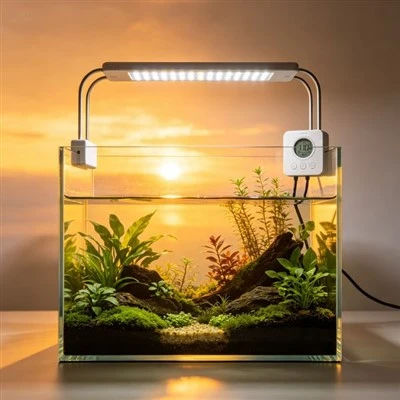
LED Aquarium Light With Sunrise And Sunset Timer
The LED Aquarium Light with Sunrise and Sunset Timer is a 24-hour programmable aquatic lighting fixture equipped with a
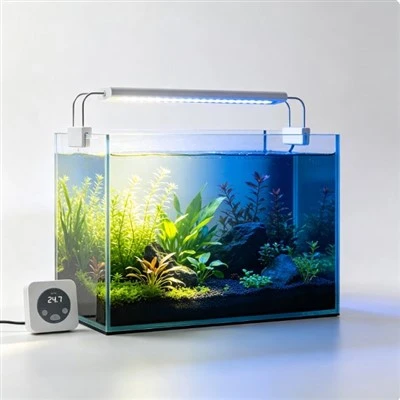
24/7 LED Aquarium Light With Timer
The 24/7 LED Aquarium Light with Integrated Timer provides automated full-spectrum lighting for freshwater
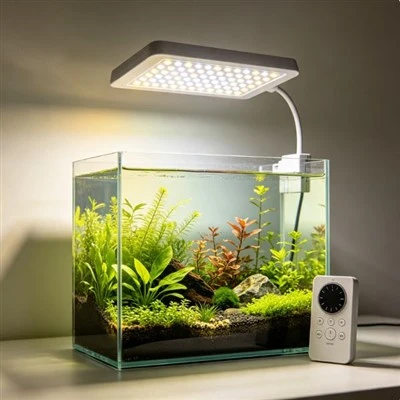
Dimmable LED Aquarium Light With Timer
The Dimmable LED Aquarium Light with Built-in Timer is an engineered freshwater LED fixture that combines full-spectrum
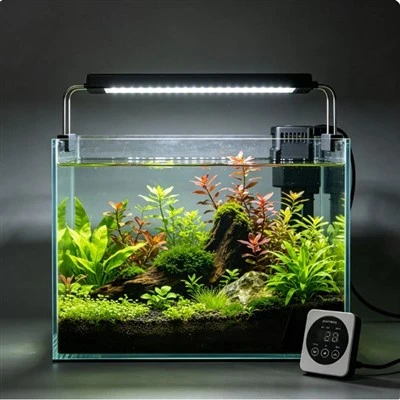
LED Aquarium Light With Memory Timer
This full-spectrum LED fixture provides controlled illumination for freshwater planted systems and fish-only aquariums.
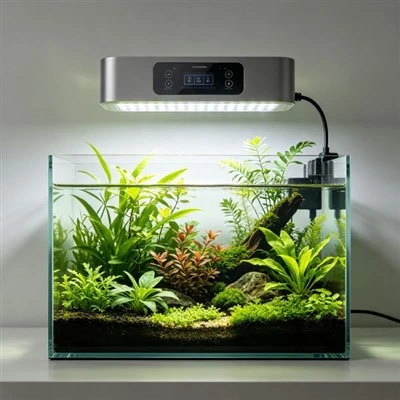
Programmable LED Aquarium Light With Timer
This series provides full-spectrum lighting for freshwater environments, featuring an integrated digital controller for

LED Aquarium Light With Digital Timer
This fresh-water LED aquarium light combines full-spectrum diodes with an integrated digital timer to simplify aquatic