

一, Packaging materials: a balance between thermodynamic characteristics and long-term stability
1. The material of the substrate: Replacing plastic with ceramic substrate has become common.
Traditional plastic substrates (such FR-4) have a thermal conductivity of only 0.3–0.5W/(m · K), which means that lights with more than 50W of power can easily get hot spots. The thermal conductivity of aluminium nitride (AlN) ceramic substrate can be as high as 170–230W/(m · K), and the thermal conductivity of aluminium oxide (Al ₂ O3) ceramic substrate can be as low as 24–35W/(m · K). Both of these materials can greatly lower thermal resistance. Dinghongrun Company, for instance, employs LED chips with ceramic substrates made of aluminium nitride. The junction temperature is 25 degrees Celsius lower than that of plastic substrate products after 1000 hours of continuous use, and the light degradation rate drops from 15% to 5%.
2. Fluorescent powder and encapsulating adhesive: work together to make things resistant to high temperatures and stable in light
High-power LEDs have blue light excitation intensities that are 3 to 5 times higher than those of regular products. When the temperature goes above 150 °C, traditional silicone packaging might turn yellow, which makes it less effective at letting light through. The contemporary industry uses an organic silicon inorganic composite encapsulating glue that can handle temperatures from -60 °C to 250 °C. After 1000 hours of continuous use at 200 °C, it still lets more than 90% of light through. When it comes to choosing phosphors, nitride phosphors (such β - SiAlON: Eu ² ⁺) are the best choice for high-temperature situations like car headlights since their quantum efficiency decay rate is 40% lower than that of standard YAG phosphors.
3. Solid crystal material: silver adhesive with strong thermal conductivity and eutectic welding technology
Traditional thermal paste has a thermal resistance of 0.1–0.3 °C·cm²/W. After nano silver paste hardens, the thermal resistance can be lowered to 0.02 °C·cm²/W. A certain automobile headlight maker employs low-temperature eutectic welding to directly connect LED chips to copper substrates. This lowers the contact thermal resistance from 0.5 °C·cm²/W to 0.05 °C·cm²/W and the chip junction temperature by 18 °C.
二, The way heat is released: a low-impedance conduit from the chip to the outside world
1. Heat absorption lining plate: microstructure reinforced transverse thermal conductivity
The heat-absorbing lining plate must have both a high flatness and a high transverse heat transfer rate. The milling machine processed aluminium alloy heat-absorbing liner plates with a surface roughness of Ra ≤ 0.8 μm. The contact thermal resistance with LED chips can be kept below 0.01 °C·cm²/W. A certain company that makes industrial lighting produced a microchannel structure inside the heat-absorbing lining plate. This made the coolant flow 30% easier and the heat dissipation 25% better by using a biomimetic lotus leaf surface treatment.
2. Heat dissipation fins: a design that mimics nature and improves airflow
When there is natural convection, traditional parallel fins don't dissipate heat as well. On the other hand, biomimetic shark skin structure fins can cut the thickness of the thermal boundary layer by 40%. One company that makes outdoor displays uses a trapezoidal fin design and changes the spacing between the fins from 5mm to 3mm. The area for heat dissipation grows by 22% and the thermal resistance drops by 18% when the wind speed is 2m/s. Heat pipe technology has become an important solution for use in small spaces. Sintered heat pipes, which have a thermal conductivity of 5000W/(m · K), are used by one projector maker. This is more than 1000 times better than pure copper.
3. Overall structure: modular design and integrated die-casting
The integrated aluminium alloy die-casting process can do rid of the thermal resistance that comes from contact in typical assembly systems. A certain street lamp maker uses the AA1070 aluminium alloy integral die-casting method to combine the light source room, electrical room, and heat dissipation shell. This lowers the system's thermal resistance from 1.2 °C/W to 0.8 °C/W. For high-power modules, modular design has become a trend. A certain company that makes automobile headlights divides the 300W LED module into three 100W submodules. Each submodule has its own heat dissipation channel, which lowers the maximum junction temperature from 150 ℃ to 120 ℃.
三, System reliability: checking the connectivity of multiple physical fields
1. Thermal mechanical coupling analysis: stopping materials from breaking
During the temperature cycling test from -40 to 125 degrees Celsius, solder joint fatigue might happen when the thermal expansion coefficients (CTE) of different materials don't match. A certain company that makes aviation lights employed finite element analysis (FEA) to improve the architecture of the PCB. This brought the CTE difference between the copper foil and the ceramic substrate down from 15ppm/℃ to 5ppm/℃ and the life of the solder union up from 2000 cycles to 10000 cycles.
2. Thermal optical coupling test: managing changes in colour temperature and light loss
The colour temperature drift of high-power LEDs is directly proportional to the junction temperature. A specific display screen maker set up a testing platform for thermal optical coupling and found that the colour temperature drift went from 200K to 500K when the junction temperature went from 85 °C to 125 °C. The colour temperature drift was kept within ± 100K by improving the way the phosphor coating was done.
3. Long-term accelerated ageing: using the LM-80 and TM-21 standards
The LM-80 testing standard says that the lamp must run continuously for 6000 hours at three different temperatures: 55 °C, 85 °C, and 105 °C. Then, the TM-21 algorithm is used to figure out how long it will last. Test data from a certain industrial lighting company shows that their ceramic substrate lamps take 8000 hours to decay to 70% at 105 °C. This is far longer than the norm for the industry, which is 50000 hours.
4. The most important technical trends in the industry
Heat dissipation using liquid metal: Gallium-based liquid metal has a thermal conductivity of 30W/(m · K), which is 60 times that of water. A company that makes laser projectors uses liquid metal microchannels to cool down the junction temperature of a 3000W light source to less than 80 °C.
Film for graphene heat dissipation: The thermal conductivity of single-layer graphene is 5300W/(m · K). A certain company that makes mobile phone flashes has put graphene coating on LED backplates, which makes the heat spread three times faster.
Phase change material (PCM): An outdoor lighting company puts paraffin-based PCM between the heat dissipation fins. This material absorbs heat during the day and melts, then releases heat at night and solidifies. This lowers the range of daytime junction temperature changes by 15 °C.
What are the key requirements for packaging and heat dissipation design of high-strength lamps to prevent overheating and affect their lifespan?
How to optimize the combination of aquarium lights and plant growth in greenhouses, hydroponics, or micro landscapes (where water and plants are cHow to optimize the combination of aquarium lights and plant growth in greenhouses, hydroponics, or micro landscapes (where water and plants are combined)? What are the key points such as red/blue light ratio and lighting time?ombined)? What are the key points such as red/blue light ratio and lighting time?
How to adjust the spectrum and intensity of aquarium lights in stage/film shooting to achieve the desired visual effect without affecting the shooting quality?
Popular Products
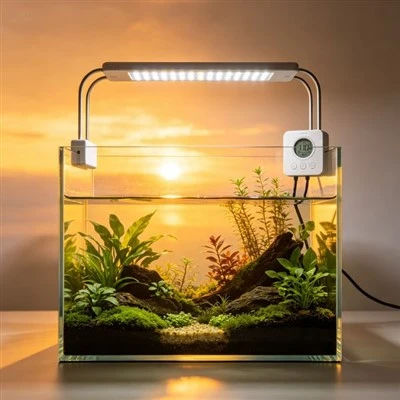
LED Aquarium Light With Sunrise And Sunset Timer
The LED Aquarium Light with Sunrise and Sunset Timer is a 24-hour programmable aquatic lighting fixture equipped with a
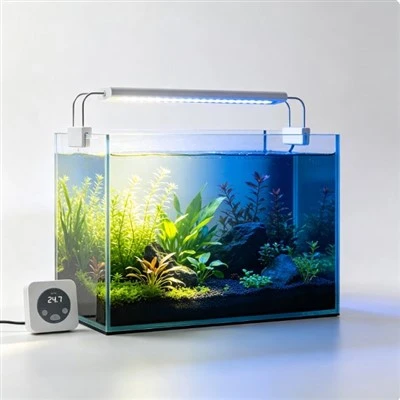
24/7 LED Aquarium Light With Timer
The 24/7 LED Aquarium Light with Integrated Timer provides automated full-spectrum lighting for freshwater
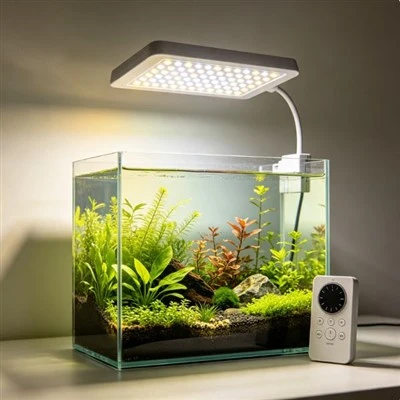
Dimmable LED Aquarium Light With Timer
The Dimmable LED Aquarium Light with Built-in Timer is an engineered freshwater LED fixture that combines full-spectrum
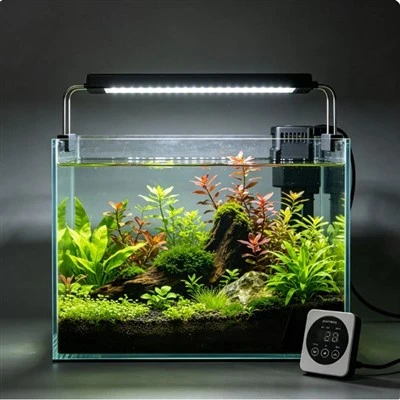
LED Aquarium Light With Memory Timer
This full-spectrum LED fixture provides controlled illumination for freshwater planted systems and fish-only aquariums.
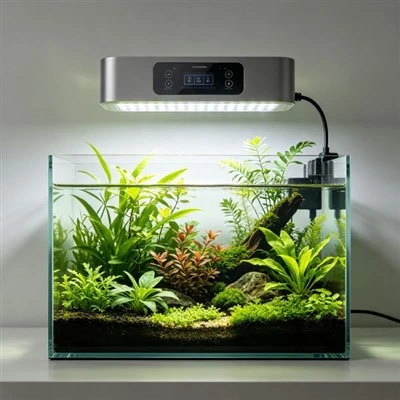
Programmable LED Aquarium Light With Timer
This series provides full-spectrum lighting for freshwater environments, featuring an integrated digital controller for

LED Aquarium Light With Digital Timer
This fresh-water LED aquarium light combines full-spectrum diodes with an integrated digital timer to simplify aquatic