

一, The main parts of lighting uniformity control
1. Optimising the shape of the lighting layout
The distance between the lighting and the water body must follow the "distance to height ratio" rule. For instance, if you have a 10-meter-deep aquaculture pond and use a 200W LED underwater light with a beam angle of 120 °, you need keep the distance between the lights between 3 and 5 meters to make sure that the overlap rate of neighbouring light spots is at least 30%. A prawn farming factory in Qingdao used 3D modelling software to show how light would spread. Researchers discovered that when the lights were stacked in a staggered "plum blossom pile" design, the uniformity of the bottom light could be enhanced to over 85%, which is 22% higher than the typical matrix configuration.
2. Compensation for light attenuation and dynamic control
Different wavelengths of light are absorbed differently by water bodies. For example, red light is absorbed 0.3/m in freshwater, while blue light is absorbed 0.1/m. To make up for this, multispectral LEDs need to be used. The Hainan Lingshui deep-sea aquaculture platform has an intelligent dimming system that automatically changes the power ratio of red light (660nm) and blue light (450nm) based on real-time data on water turbidity (NTU value), chlorophyll concentration (μ g/L), and depth. For instance, when the turbidity goes beyond 15NTU, the system boosts the red light output power by 40% to make up for scattering losses and keep the PUR value in deep water consistent within the range that organisms need.
3. Working together to design reflecting borders
The amount of light that is used is directly affected by how reflective the inside wall of the aquaculture pond is. According to a study by Shanghai Ocean University, aquaculture ponds with white high-density polyethylene (HDPE) sides may reflect up to 85% of light, which is 60% more than concrete ponds. They can also make the bottom light 1.8 times brighter. Also, putting mirror stainless steel plates (with a reflectivity of 92%) at the bottom of the pool can do rid of even more light blind spots. After implementing this approach, the consistency of bottom light in a grouper breeding base in Sanya rose from 62% to 91%, and the fish population's feeding activity greatly improved.
二, Ways to find and count dead zones when there is light
1. Technology for modelling 3D lighting
Using software like LumenRT or Dialux to make a digital twin model of the aquaculture pond, you can find the dead zone of light by entering the lamp parameters (luminous flux, beam angle, installation height), the water's optical properties (absorption coefficient, scattering coefficient), and the biological demand thresholds (for example, the optimal PAR for algae is 50-200 μ mol/m ²/s). Using this technique, a shrimp farm in Zhanjiang, Guangdong Province found that there is a low-light area with a diameter of 2 meters (PAR<30 μ mol/m ²/s) in the middle of the pool bottom under the old arrangement. The dead zone area was cut down to a diameter range of 0.5 meters after changing the space between the lights.
2. Portable spectrometer for testing in the field
Use a handheld spectrometer like the Ocean Optics USB2000+ to grid sample the aquaculture pond (with a spacing of 0.5 to 1 metre) and write down the PAR levels and spectral distribution at each spot. It is possible to create a correlation model between light intensity and biological distribution by looking at biological behaviours such fish aggregation and algal adhesion. In a deep-water net cage aquaculture experiment, it was observed that when PAR<40 μ mol/m²/s, the aggregation density of young golden carp diminished by 70%, concurrently, the proportion of detrimental dinoflagellates, such as Tremella, escalated twofold.
3. Diagnosis with the help of biomarkers
By looking at physiological signs of aquatic creatures, including the chlorophyll fluorescence metrics Fv/Fm and the cortisol levels in fish serum, we can get an idea of how good the light environment is. For instance, stony corals normally don't get enough light when their Zooxanthellae density is less than 1 × 10 ⁶ cells/cm ². Also, if the blood cortisol concentration in fish is more than 20ng/mL, it could cause stress because of the dead zone of light exposure.
三, A complete plan for managing the light dead zone
1. Design of a layered lighting system
For deepwater aquaculture tanks, the illumination is arranged in layers, with "surface strong light+middle supplementary light+bottom weak light." In a 20-meter-deep aquaculture cabin, for instance, a 500W LED spotlight (PAR>300 μ mol/m ²/s) is placed on the surface (0-5 meters), a 200W LED floodlight (PAR=100-200 μ mol/m ²/s) is placed in the middle layer (5-15 meters), and a 50W red fill light (660nm, PAR=50-100 μ mol/m ²/s) is placed on the bottom layer (15-20 meters). This plan can get the lighting to be more than 80% uniform in each depth layer.
2. Working together to manage the flow field and light field
By integrating the water circulation system, you may get rid of dead zones that are caused by exposure to light. A bottom thruster creates a rotating water flow (flow rate of 0.2–0.5 m/s) in a circular aquaculture pond to equally spread out suspended particles and lessen the effects of local shading. The experiment performed by Dalian Ocean University demonstrates that this measure can decrease the fluctuation range of bottom light intensity from ± 60% to ± 20%, concurrently enhancing the uniformity of dissolved oxygen by 15%.
3. Linking intelligent shading and extra lighting
A system of adjustable blackout curtains and LED fill lights is used to join together outdoor deepwater cages. When the sunlight is stronger than 1000W/m², the sunshade will automatically open up to 50% transmittance to keep the light from being too strong. When the sunlight is weaker than 200W/m² or the water is deeper than 10 meters, the LED fill light will start to meet the basic lighting needs. After the technique was put to use on a deep and offshore aquaculture platform in Lianjiang, Fujian, the growth cycle of Pseudosciaena crocea was cut by 15% and the feed coefficient was cut by 0.2.
4. Support from industry case studies and data
Farm for Norwegian Salmon: By putting an optical fibre light guide system at the bottom of the cage, sunlight can reach the deep water area. When combined with LED fill lights, the PAR value at a depth of 15 meters stays between 80 and 120 μ mol/m ²/s. This increases the growth rate of salmon by 20% and lowers the deformity rate to less than 3%.
Shrimp Breeding Base in Jiangsu Rudong: Along the pool wall, there are full-spectrum LED light strips (power density 8W/m²) arranged in a circle. There is also a programmed dimming program that gives 100% power from 6:00 to 18:00 during the day and 30% power from 6:00 to 6:00 at night. This makes the bottom light uniformity 88%. The shrimp breeding density is raised to 500 shrimp/m², and the unit production is more than 15 kg/m³.
Singapore Vertical Farm Aquarium: By using a combination of multi-layer reflector groups and adjustable focus LED arrays, a 30-meter-high vertical aquaculture column was able to achieve a light uniformity of 92%. The coral coverage rate went from 65% to 90%, and there were no algae outbreaks caused by dead zones of light.
How to ensure the uniformity of lighting in large aquaculture ponds or deep water aquaculture tanks? How to identify and solve dead zones in lighting?
Initial investment vs operating costs: What is the cost payback period for choosing high-quality aquarium lamps? How to calculate and estimate the saved electricity and maintenance costs?
How to optimize the combination of aquarium lights and plant growth in greenhouses, hydroponics, or micro landscapes (where water and plants are cHow to optimize the combination of aquarium lights and plant growth in greenhouses, hydroponics, or micro landscapes (where water and plants are combined)? What are the key points such as red/blue light ratio and lighting time?ombined)? What are the key points such as red/blue light ratio and lighting time?
Popular Products
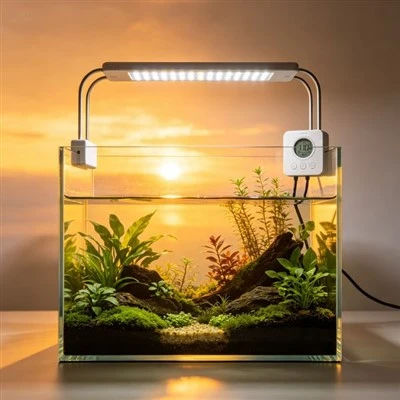
LED Aquarium Light With Sunrise And Sunset Timer
The LED Aquarium Light with Sunrise and Sunset Timer is a 24-hour programmable aquatic lighting fixture equipped with a
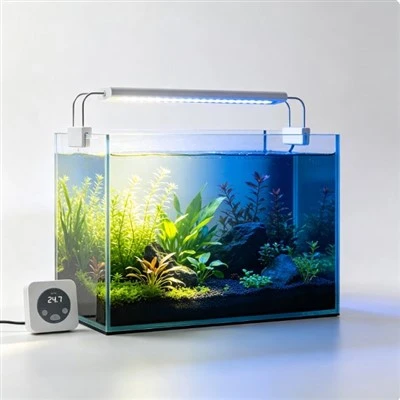
24/7 LED Aquarium Light With Timer
The 24/7 LED Aquarium Light with Integrated Timer provides automated full-spectrum lighting for freshwater
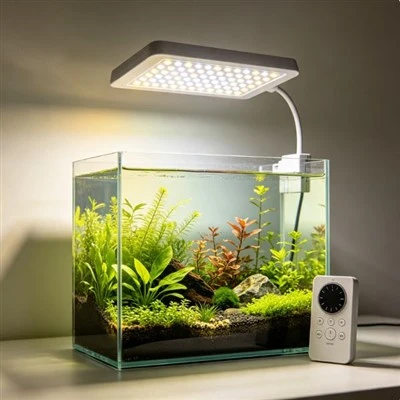
Dimmable LED Aquarium Light With Timer
The Dimmable LED Aquarium Light with Built-in Timer is an engineered freshwater LED fixture that combines full-spectrum
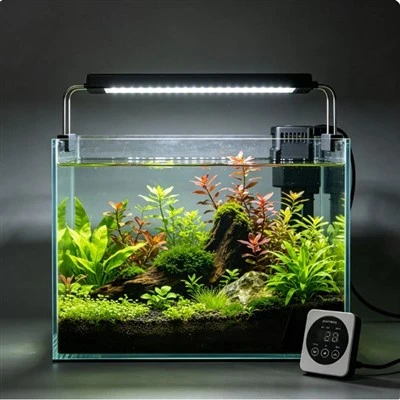
LED Aquarium Light With Memory Timer
This full-spectrum LED fixture provides controlled illumination for freshwater planted systems and fish-only aquariums.
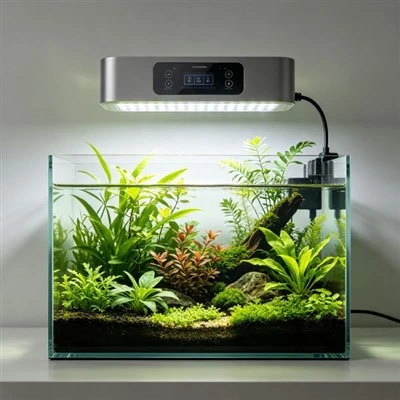
Programmable LED Aquarium Light With Timer
This series provides full-spectrum lighting for freshwater environments, featuring an integrated digital controller for

LED Aquarium Light With Digital Timer
This fresh-water LED aquarium light combines full-spectrum diodes with an integrated digital timer to simplify aquatic