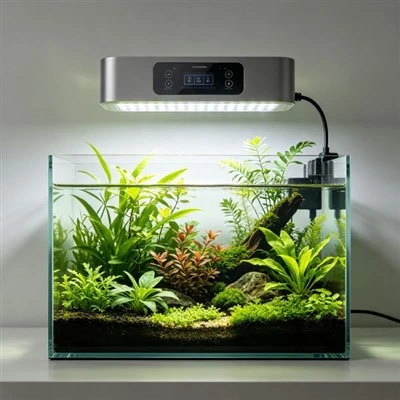
Leaving Service Space above the Tank
Leaving Service Space above the Tank begins with a fixture that must move for feeding and cleaning. The relevant physical or operational link is that good illumination can still create poor access if the mount blocks lids, tools, or hands. This does not mean every visible change comes from the lamp. It means the stated link is the first cause worth checking under controlled conditions. Describe what a person can see, when it occurs, and what changed recently. Keep conclusions proportional to the evidence, especially when plants, corals, fish behaviour, electrical safety, or product performance are involved.
Maintenance can change delivered light without any electronic adjustment. Dust on a heat sink, salt on a lens, mineral film on a cover, or a shifted bracket may develop slowly enough to escape notice. For leaving service space above the tank, inspect the cool, disconnected fixture from several angles. Use non-abrasive materials approved for the optical surface. Photograph deposits or corrosion before cleaning when a warranty question is possible. After reassembly, verify that mounts, cables, covers, and ventilation have returned to their intended positions. Here, that point helps evaluate the documented mechanism: good illumination can still create poor access if the mount blocks lids, tools, or hands.
The first observation for this case is specific: perform a dry rehearsal of routine maintenance. Make that observation before opening an app or moving the fixture. Note the clock time, room light, water condition, current programme, mounting position, and any recent cleaning or equipment change. A fixed photograph may support the notes when exposure and position remain constant. The objective is a reliable starting point that another person could recognise, not a dramatic before image.
Product labels and manuals are evidence for the exact unit, not decoration. Match the model on the fixture, adapter, carton, app, and instructions. Check input voltage range, output rating, polarity where shown, and regional plug configuration. A plug that physically fits does not establish electrical compatibility. When a fixture that must move for feeding and cleaning involves imported or replacement equipment, keep photographs of every label. Contact the supplier if information conflicts, and do not energise a combination merely to see whether it works. For this scenario, the key observation is to perform a dry rehearsal of routine maintenance.
Use this controlled check: measure the largest lid opening and tool path. Change no other major variable during the comparison. If measurement equipment is involved, record its model, orientation, position, and whether it is designed or corrected for underwater use. If the test depends on human viewing, use the normal seat or working position rather than an ideal angle chosen for the test. Repeat the result before accepting it as the explanation for leaving service space above the tank.
Define success for leaving service space above the tank before moving a control. A viewing complaint is solved when the normal seat has no distracting glare. A maintenance check succeeds when the keeper can see the relevant surface clearly. A biological decision needs a longer observation tied to the actual species and system. These are different outcomes, so they should not share one vague target such as brighter or better. For this situation, write one visible result that would show the adjustment worked and one sign that would make you stop. The controlled check remains practical: measure the largest lid opening and tool path.
The practical response is to choose a mount position that supports safe service. Apply it in the smallest reversible step that can answer the question. A viewing or control issue may become clear in minutes, while biological responses require appropriate time and species-specific interpretation. Avoid increasing intensity simply because the first change was subtle. Large simultaneous adjustments erase the baseline and can create a new problem that looks like confirmation of the old one.
A support request about leaving service space above the tank should make the fault reproducible. Provide the model, serial or batch information, purchase date, controller and firmware details, clear photographs, and a numbered sequence that produces the observation. State what was expected and what happened instead. Include measure the largest lid opening and tool path as the controlled comparison. Avoid opening sealed housings or making unapproved repairs before the supplier responds. Good evidence helps separate product failure, compatibility, installation, and misunderstanding of the controls. Any adjustment should support the decision to choose a mount position that supports safe service.
One limit must remain visible throughout the process: never rest an energised fixture on a wet lid during maintenance. Check the manual for the exact model, and keep plugs, adapters, external connectors, vents, and mounts in their intended environment. Disconnect equipment before cleaning or mechanical inspection. When damage, liquid entry, unstable mounting, unusual odour, or severe heat is present, stop the experiment and seek manufacturer or qualified electrical support.
Compare alternatives with the same question and conditions. Carry out the stated check: measure the largest lid opening and tool path. Keep the fixture, room, camera or meter, and observation point unchanged. If two products must be compared, match mounting geometry and document power and settings separately. Do not rank them from percentage values alone. Summarise the result in terms of the original purpose: visibility, coverage, control reliability, service access, or a measured quantity. This keeps leaving service space above the tank tied to a real decision instead of a collection of attractive numbers. The stated limit also applies: never rest an energised fixture on a wet lid during maintenance.
A short written result closes the loop. Use the title Leaving Service Space above the Tank in the log, followed by the starting condition, the controlled change, the observation period, and the outcome. State whether the result was measured, photographed, or judged by eye. If the explanation remains uncertain, restore the known stable arrangement and test another cause later. This record prevents the same question from being answered with a different guess each time it appears.
Thermal conditions matter because an LED product is a system of emitters, optics, driver electronics, housing, and controls. The U.S. Department of Energy notes that operating temperature affects LED output, colour, and reliability. Do not block passive vents or wrap a working fixture to protect it from dust or spray. In a fixture that must move for feeding and cleaning, check whether room temperature, enclosure, mounting clearance, or nearby equipment has changed. A housing that feels warmer than expected deserves comparison with the manual and supplier guidance, not improvised cooling. This evidence belongs in the written record for Leaving Service Space above the Tank.