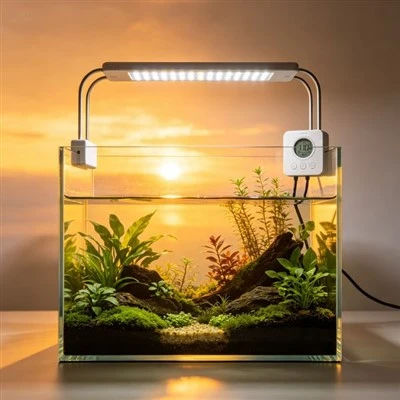
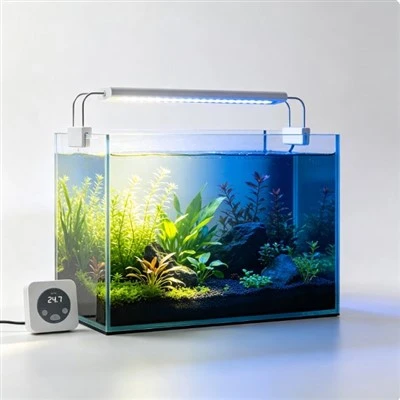
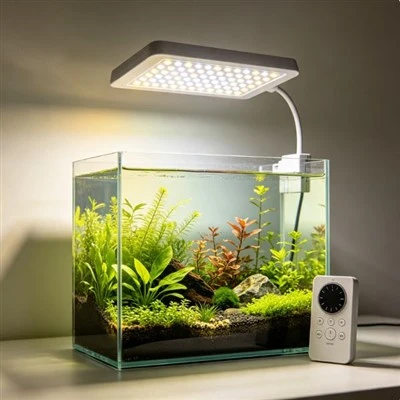
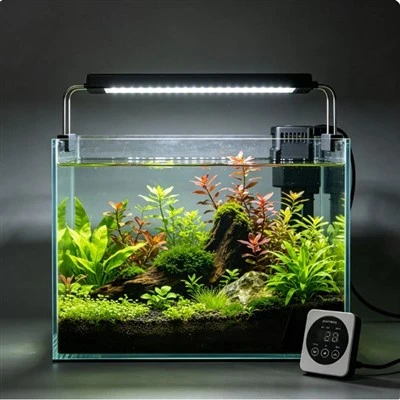
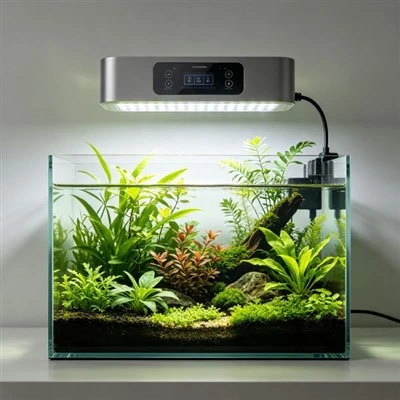
Clear lenses direct light, while diffusers blend and spread it before it reaches the water. Small changes are easier to understand when the starting condition is written down. In lenses and diffusers, the first aim is not to find the most impressive colour or the highest percentage. It is to understand what the aquarium needs at that moment, what the people in the room need, and which parts of the situation can actually be controlled. A light can change visibility, timing, colour appearance, and the distribution of brightness. It cannot replace suitable water conditions, compatible livestock, good feeding, filtration, temperature control, or careful maintenance.
The central principle is that optical parts trade peak intensity, uniformity, colour mixing, glare, and visual texture. This makes context essential. Advice copied from another aquarium may come from a different species, tank depth, room, fixture, mounting height, spectrum, or maintenance level. Even two lights that show the same percentage may not produce the same output. Percentages are controller positions, not universal units. The reliable approach is to begin with the current stable setup, describe it clearly, and make a limited change whose result can be observed.
Before adjusting the lamp, write down the variables that belong to this particular problem: LED spacing, mounting height, water depth, diffuser transmission, and the viewer's sensitivity to visible colour points. Each one can change what the owner sees. For example, LED spacing may affect the immediate visual result, while and the viewer's sensitivity to visible colour points may explain why the same program behaves differently over time. A short record of the fixture model, schedule, room daylight, water depth, and recent changes is usually enough. Photographs can help if they are taken from the same position with similar camera settings.
A sensible sequence is to look for colour separation. Next, compare centre and edges. After that, inspect the fixture from seated eye level. Finally, clean optics only as instructed. The order matters because it separates preparation from adjustment and observation. If several settings are changed together, a better or worse result cannot be linked confidently to one cause. Keep the system at the last known safe condition when something is unclear. Use the manufacturer's instructions for mounting, cleaning, electrical connections, water exposure, controller reset, and replacement parts.
A diffuser can soften red, green, and blue dots on pale sand, although it may reduce the highest centre reading. This everyday example is useful because it does not depend on an invented biological promise. The owner can see whether the routine is easy to repeat, whether animals have access to shade, whether the tank can be inspected, and whether the installation remains dry and secure. Observation should include feeding, hiding, resting, swimming, plant posture, visible algae location, water temperature, and any sign of equipment damage. None of these observations alone proves that light caused a health or growth change.
This article belongs to the practical area of fixture shape and white-light appearance. Light bars, spotlights, lenses, diffusers, and white-light formulations change distribution and appearance in different ways. Beam shape controls where photons travel; spectrum and colour rendering influence what the eye and camera perceive. One specification cannot substitute for the others. For lenses and diffusers, that background explains why the result must be read in context rather than converted into one universal setting. The visible lamp percentage is only a control position, and any measurement needs its location and operating conditions.
A focused check for lenses and diffusers should follow this approach: Evaluate the fixture at its intended mounting height. Check the tank, the room, direct view of the LEDs, colour blending on pale objects, and the edge of the illuminated area. Keep camera exposure fixed when recording comparisons. The main warning is equally specific: do not remove a factory optic if it is part of the safety or moisture design. Keep dry-rated electrical parts dry, use approved components, and stop using equipment that is damaged, unusually hot, wet inside, smoking, or producing a burning smell.
From a product and buying perspective, replaceable, documented optics let one platform serve different layouts without misleading performance claims. Manufacturers should publish beam conditions, spectral information, and honest photographs rather than presenting watts as a complete description. The exact model, ratings, mounting limits, water-exposure boundary, and approved replacement path should remain easy to find. Claims about performance or durability are credible only when they refer to the actual product and stated test conditions.
An uncomplicated seven-day check can make lenses and diffusers easier to understand. On the first day, record LED spacing and the complete light timeline without changing it. During the next several days, note mounting height at the same time and from the same viewing position. If a change is justified, adjust only one main item and keep feeding, cleaning, and other routine work as consistent as practical. At the end of the week, compare the notes rather than relying on memory. The result may show that the original concern came from the room, layout, water, control method, or maintenance routine instead of the lamp itself. If the pattern remains uncertain, the record still gives a retailer, manufacturer, aquatic professional, or veterinarian better information than a description such as too bright, too dark, or not working well.
The best conclusion for lenses and diffusers is therefore practical. Keep the light schedule understandable, preserve a dependable period of darkness unless a justified species protocol says otherwise, and let animals move between brighter and darker areas when the habitat allows. Change one major variable at a time and give the aquarium enough stability to show a pattern. A good aquarium light is not simply bright or feature-rich. It is safe to install, predictable to operate, realistic to maintain, honest to describe, and suitable for the living system and household routine in which it is used.