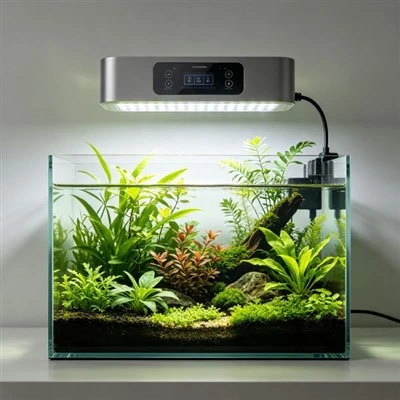
Public aquarium lighting serves several audiences at once. Animals experience the field throughout the cycle. Visitors need enough contrast to see without severe reflections or glare. Keepers need temporary inspection light for feeding, health checks, diving, and maintenance. Educators and photographers want accurate presentation. Facilities teams need safe access, reliability, spare parts, and energy control. Treating the fixture as a decorative object misses the coordination required among husbandry, veterinary, exhibit, electrical, life-support, interpretation, and operations teams.
Begin with species and habitat zones. A review of fish welfare in public aquariums emphasizes species-specific environments and the use of behavioural, performance, and physiological indicators. Lighting should therefore provide appropriate day-night timing and, where relevant, spatial choice rather than applying one brightness target across every exhibit. Map open water, cave, substrate, surface, feeding, nesting, and retreat areas. Confirm that visitors cannot force animals into light simply by crowding the only dark refuge.
Visitor viewing is an optical design problem. Reflections increase when the gallery is bright relative to the exhibit or when light strikes glazing and visitors at poor angles. Coordinate ceiling, signage, handrail, emergency, and tank lighting. Shield sources from direct sight lines and test at child and wheelchair eye heights. Dark galleries can improve contrast but create trip, accessibility, and adaptation concerns, so the solution must be developed with safety and visitor-experience specialists.
Keeper modes should be distinct from daily programs. A high-output white setting may reveal lesions, appetite, waste, or equipment condition, but leaving it active changes the animal environment. Use timed overrides, clear status indication, and automatic return. Diving or in-water work introduces additional electrical and operational controls that require specialist procedures. Fixtures, supports, and cables above large exhibits must be secured against impact, corrosion, and falling components.
Large exhibits need mapped uniformity and intentional variation. Water depth, turbidity, surface waves, rockwork, and viewing windows complicate simulation. Mock up representative sections and measure at biological and visitor-relevant planes. A central reading cannot predict the back wall or cave entrance. If dynamic scenes are used, ensure that movement, flashes, or colour changes are justified and evaluated; a theatrical effect should not override species needs or create distracting temporal artefacts for visitors.
Reliability planning should assume that individual parts will eventually fail. Divide circuits sensibly, keep critical zones from depending on one controller, store local schedules, and maintain labelled manual fallback. Standardize replaceable drivers, mounts, cables, and control components where possible. Record fixture model, serial number, firmware, installation date, program, measurements, and maintenance. A replacement at the old percentage may not match an aged unit, so compare output and acclimate sensitive displays where necessary.
Commissioning must include behavioural observation. Establish a baseline after animals acclimate, then track space use, feeding, schooling, aggression, rest, reproduction, and refuge use alongside temperature, water quality, visitor load, and schedule. A zebrafish study found that light level altered several movement measures even without producing a simple preference between connected tanks, illustrating why response cannot be reduced to bright is bad or dim is good. Interpret evidence by species and context.
The successful exhibit brief integrates animal objectives, visitor sight lines, accessibility, keeper tasks, emergency operation, electrical safety, corrosion control, measurement, and maintenance. It also defines who can change programs and how changes are reviewed. Public aquarium lighting is strongest when it disappears into a well-run environment: animals can use suitable zones, visitors can see without overwhelming reflections, keepers can inspect safely, and the institution can reproduce and document the result for years.
Emergency planning should define what happens after power, network, or control failure. Fish generally do not need decorative light during a short outage, but staff need safe routes and a method to inspect critical systems. Avoid connecting nonessential show effects to life-support priorities without electrical engineering review. When service returns, prevent all channels from jumping instantly to full output if the normal schedule calls for darkness or a ramp. Conduct drills during closed hours and record the result. Public interpretation can also explain why some habitats are dim or why animals have dark retreats. Education helps visitors understand that visibility is designed around biology, not that every healthy exhibit must resemble a brightly illuminated shop window.
Control governance prevents well-intended mistakes. Define approved programs, user roles, change requests, emergency overrides, and review periods. A marketing event, television shoot, or donor evening may request unusual colour or extended hours; husbandry staff should assess the animal impact and specify recovery conditions. Log the temporary program and return time. Visitor research can be useful: measure whether people can identify animals, read interpretation, move safely, and avoid reflections without demanding that every habitat be brighter. Combine that evidence with animal observations rather than treating one audience as the sole customer. When upgrading fixtures, pilot one zone and compare water temperature, glare, animal use, staff access, camera appearance, power, and maintenance. A technically more efficient lamp can still be a poor exhibit replacement if its distribution, controls, or spectral appearance changes the designed experience.
An exhibit lighting plan succeeds when animal choice, visitor visibility, keeper work, safety, emergency response, and long-term service are designed together and reviewed with evidence. Document every permanent program change with animal, visitor, technical, and operational review. This governance protects the original exhibit purpose while allowing evidence-based improvement as animals grow, displays change, and new lighting technology becomes available. Keeper observations should remain part of every commissioning sign-off and later technical review. Record the final decision.