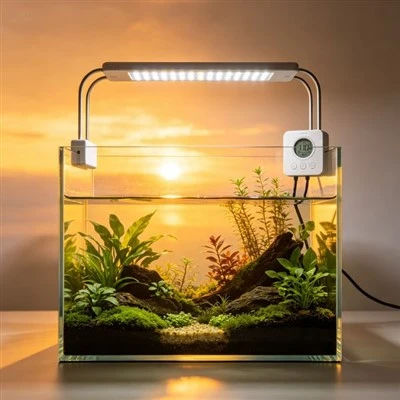
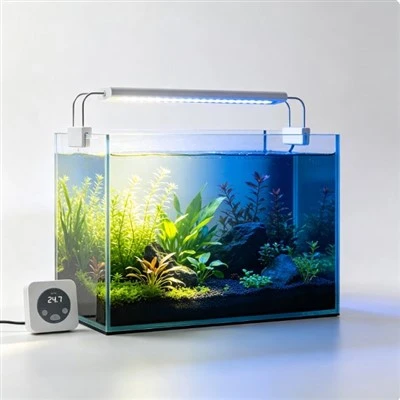
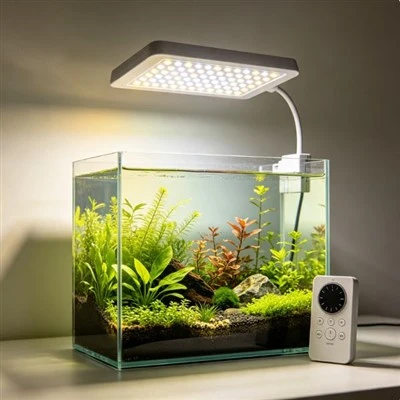
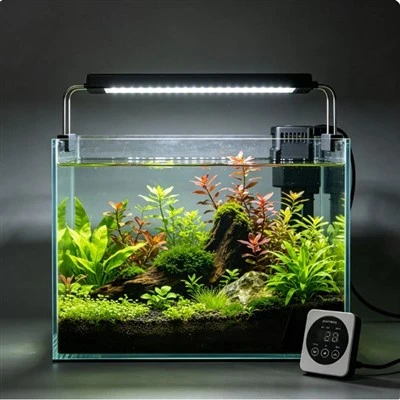
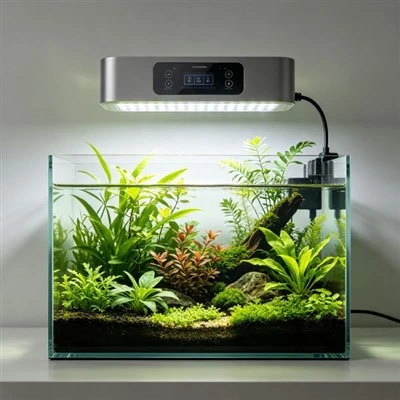
Marine seagrass creates a lighting problem that a single reading cannot describe. Long leaves rise from the substrate, bend with flow, overlap, and shade one another. The leaf tips may pass close to the fixture while the growing bases remain much deeper. Measuring only above the canopy can therefore produce a value that says little about the planting plane. Even a careful light map is only part of the picture: species identity, water clarity, nutrients, carbon availability, flow, temperature, and substrate conditions also influence the system. Good practice is to document these factors together and avoid promising growth from one number.
Correct identification comes first. Seagrasses are marine flowering plants, but different species have different forms and care requirements. A seller's broad label or a resemblance to common freshwater grass is not enough. Record the accepted species name when known, leaf height, planting depth, substrate, temperature, salinity, and dependable care guidance. Then define why light is being measured. The owner may be comparing fixture positions, checking how an expanded canopy changes distribution, or investigating a shaded patch. A clear question prevents random measurements from becoming an unsupported target.
Use at least two useful planes. One lies around the moving upper canopy; another lies near the substrate where leaves emerge. In a tall or uneven bed, add middle-height and edge locations. Measurements should be taken with the same instrument orientation, fixture program, room conditions, and water state. Record whether pumps were running, because the leaves may sweep across the sensor or repeatedly shade it. A brief reading at one instant can catch either open water or a passing leaf. Several consistent observations, reported with the method, are more informative than a lone maximum.
Consider a patch whose tips approach the surface while its bases sit under a dense layer of older leaves. A reading just above the tips is high compared with one at the substrate. It would be misleading to publish the first value as "the light received by the seagrass." Both readings belong to the same patch but represent different positions. The owner can photograph the measurement locations, note canopy height, and repeat the map after trimming or growth. The comparison then explains how structure changed the light field without claiming that either value guarantees a biological result.
Water clarity must be recorded whenever measurements are compared over time. Suspended material, surface film, algae on panels, and changes in water colour can alter transmission or the viewing impression. Clean sensors and aquarium surfaces only by their approved methods. Avoid taking a baseline immediately before maintenance and a follow-up immediately after unless that change is the subject of the test. If the water has become clearer, document it. Otherwise, a larger substrate reading may be wrongly credited to a fixture adjustment.
Flow is both a husbandry variable and a measurement condition. It moves the leaves, changes their angles, and creates shifting shadows across the bed. Do not reduce essential circulation merely to obtain a tidy number. Instead, state whether the system was measured under normal operation and describe the leaf motion. A short sequence of observations can show the range created by movement. If a still-water measurement is needed for a technical comparison, it should be brief, safe for the system, clearly labelled, and followed by restoration of normal flow.
When a change appears necessary, resist adjusting every colour channel and duration at once. Choose one main variable, such as approved fixture height or overall output, and state what outcome will be checked. Keep the ordinary schedule stable long enough to make consistent observations appropriate to the species and system. Record new growth, leaf condition, shading, algae, and water parameters, but avoid diagnosing from appearance alone. Decline may involve planting damage, substrate, nutrients, temperature, grazing, water chemistry, or disease, and expert help may be needed.
Installation over a saltwater aquarium adds practical limits. Use only the manufacturer's permitted mounting range and environmental position. Keep connectors, drivers, and controls away from splash and condensation, preserve ventilation, and disconnect equipment before cleaning or adjustment. A mount that allows useful height changes is valuable only if it remains stable and approved. Do not attach homemade diffusers that trap heat or assume a metal housing is safe when wet. Any liquid entry, loose support, smoke, scorched odour, or unexplained heating stops the measurement work; qualified service should inspect the affected part.
The most useful lighting documentation for a seagrass aquarium is a small three-dimensional record: fixture program and height, tank depth, canopy height, measurement planes, water state, flow condition, and date. Repeat it after a meaningful structural or equipment change, not as a hunt for a perfect daily number. Adjustable mounting and published underwater distribution can make the work easier, but neither replaces species-specific care. When the bed is viewed as a moving canopy rather than a flat target, lighting decisions become more honest, reproducible, and relevant to the real plants.
Reports should preserve the range and context instead of presenting only the largest reading. A useful entry might say that values were observed at the leaf tips, mid-canopy, and substrate under the normal program, with pumps operating and the water clear after routine maintenance. Add a sketch showing where each position was located. When the bed expands, repeat those same locations and add new ones where shading has developed. This record allows a keeper or adviser to distinguish a fixture change from a canopy change and to discuss the system without pretending that one attractive number represents every moving leaf.
Before comparing products, request distribution data, measurement distance, test medium, channel settings, and mounting limits. Numbers taken in air at an unspecified position cannot be dropped into the underwater map without explanation. The most credible supplier shows how the values were obtained and leaves the keeper to decide, with species expertise, whether the fixture fits the real bed.