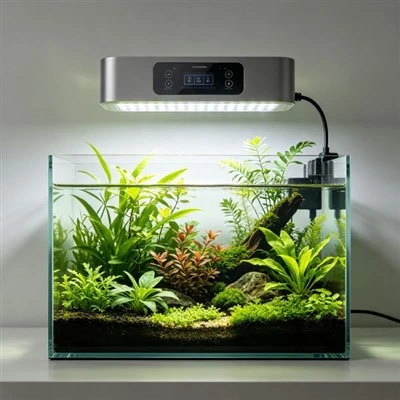
Salt Film on a Reef Light Lens
Salt Film on a Reef Light Lens begins with a marine aquarium where spray dries on the optical surface. The relevant physical or operational link is that salt deposits scatter and absorb light and may hide damage. This does not mean every visible change comes from the lamp. It means the stated link is the first cause worth checking under controlled conditions. Describe what a person can see, when it occurs, and what changed recently. Keep conclusions proportional to the evidence, especially when plants, corals, fish behaviour, electrical safety, or product performance are involved.
Spectrum affects appearance and biological use, but channel names are not measurements. Blue, red, full spectrum, moon, and UV may refer to very different emitters in different products. If wavelength matters for salt film on a reef light lens, use a reliable spectrum or component specification for the exact model and production version. Visible violet should not automatically be described as ultraviolet. For ordinary viewing, compare a neutral inspection setting with the decorative setting and keep camera white balance fixed when photographs are part of the record. Here, that point helps evaluate the documented mechanism: salt deposits scatter and absorb light and may hide damage.
The first observation for this case is specific: inspect the cool unplugged lens from several angles. Make that observation before opening an app or moving the fixture. Note the clock time, room light, water condition, current programme, mounting position, and any recent cleaning or equipment change. A fixed photograph may support the notes when exposure and position remain constant. The objective is a reliable starting point that another person could recognise, not a dramatic before image.
Finish the salt film on a reef light lens review with a clear decision. If the controlled check supports the proposed cause, clean with the method in the manual and prevent repeated spray. If results do not repeat, restore the baseline and investigate the next most plausible factor. If safety evidence is uncertain, stop and obtain qualified help. Keep the record with the aquarium so future changes can be compared with it. The best setting is not a universal number; it is a documented arrangement that meets the defined purpose and can be maintained safely and consistently. For this scenario, the key observation is to inspect the cool unplugged lens from several angles.
Use this controlled check: compare readings or a fixed-exposure photo before and after approved cleaning. Change no other major variable during the comparison. If measurement equipment is involved, record its model, orientation, position, and whether it is designed or corrected for underwater use. If the test depends on human viewing, use the normal seat or working position rather than an ideal angle chosen for the test. Repeat the result before accepting it as the explanation for salt film on a reef light lens.
The schedule has at least three independent parts: start time, total duration, and output during that duration. Ramps and low night settings still need to be included when describing the full day. For salt film on a reef light lens, copy the whole timeline onto paper rather than quoting only the peak percentage. Compare the first visible output and final output with room daylight and household activity. A stable, repeatable schedule is more useful than a complicated preset whose actual timing no one has checked. The controlled check remains practical: compare readings or a fixed-exposure photo before and after approved cleaning.
The practical response is to clean with the method in the manual and prevent repeated spray. Apply it in the smallest reversible step that can answer the question. A viewing or control issue may become clear in minutes, while biological responses require appropriate time and species-specific interpretation. Avoid increasing intensity simply because the first change was subtle. Large simultaneous adjustments erase the baseline and can create a new problem that looks like confirmation of the old one.
Build a baseline for salt film on a reef light lens from the current installation. Note tank dimensions, water depth, fixture model, mounting height, programme, room-light conditions, and recent maintenance. Add the exact time because daylight and scheduled output can vary through the day. The baseline should describe what exists before the first adjustment, including inspect the cool unplugged lens from several angles. Without it, a later improvement may be real but impossible to reproduce. A baseline also prevents a temporary manual setting from quietly becoming the new daily routine. Any adjustment should support the decision to clean with the method in the manual and prevent repeated spray.
One limit must remain visible throughout the process: do not scrape coated optics with abrasive tools. Check the manual for the exact model, and keep plugs, adapters, external connectors, vents, and mounts in their intended environment. Disconnect equipment before cleaning or mechanical inspection. When damage, liquid entry, unstable mounting, unusual odour, or severe heat is present, stop the experiment and seek manufacturer or qualified electrical support.
Claims should stay inside the evidence. A product can be described as dimmable when its controls demonstrate dimming, but smooth low-level performance should be tested. Moisture protection requires the exact rating and configuration. Energy savings require a defined comparison. Plant or coral outcomes require conditions and observation, not a spectrum graphic alone. When writing about salt film on a reef light lens, state what was measured, what was merely observed, and what remains dependent on the aquarium. Accurate limits make advice more useful, not less. The stated limit also applies: do not scrape coated optics with abrasive tools.
A short written result closes the loop. Use the title Salt Film on a Reef Light Lens in the log, followed by the starting condition, the controlled change, the observation period, and the outcome. State whether the result was measured, photographed, or judged by eye. If the explanation remains uncertain, restore the known stable arrangement and test another cause later. This record prevents the same question from being answered with a different guess each time it appears.
Human vision adapts quickly, which can make salt film on a reef light lens hard to judge. After looking at a bright blue tank, a neutral setting may seem yellow; after a dark room, moderate light may seem intense. Allow the eyes time to adapt and compare from the normal viewing distance. If two fixtures are being evaluated, hide their brand and setting display when possible. The goal is to separate actual differences from expectation, recent visual adaptation, and the contrast created by the room. This evidence belongs in the written record for Salt Film on a Reef Light Lens.