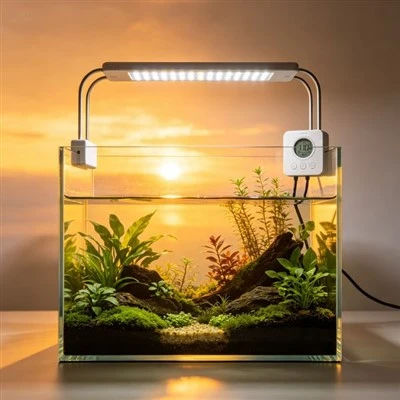
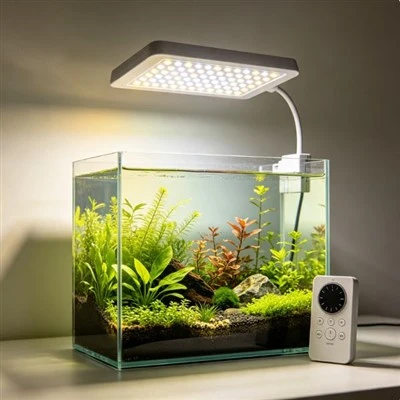
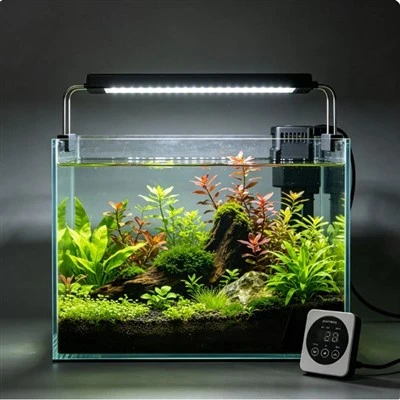
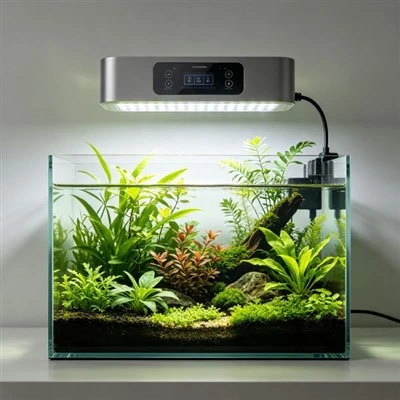
An aquarium light can appear switched off while a few LEDs remain faintly visible in a dark room. The glow may be so weak that it is invisible during the day and obvious only after the eyes adapt. This symptom can occur when a small current reaches the driver or LED circuit through control electronics, an illuminated switch, capacitive coupling in wiring, standby circuitry, or another path. Similar appearances can also accompany wiring or equipment faults, so a home observation alone does not establish the cause or safety.
Start with condition, not curiosity. Check from outside the equipment for visible damage, suspected moisture, unusual heat, smoke, a burning smell, repeated operation of a protective device, damaged cords, or loose accessible connectors. Stop using the product if damage or moisture is present and follow the safe disconnection and support route. Do not open the driver, probe mains wiring, defeat a switch, or remove protective parts to chase a faint light.
Identify exactly what "off" means. The app may show zero while the power supply remains energised. A controller may be in standby, a timer may have completed a fade, or a wall switch may interrupt one conductor while another arrangement remains connected. Record the light model, approved power supply, controller, switch type, connected accessories, programmed state, and which local indicators remain on. Different off states can produce different observations.
Describe the glow without exaggeration. Note which LEDs are visible, whether they are steady or pulsing, how long the effect lasts, and whether it changes after a documented normal isolation step that the user is permitted to perform. A brief fading glow after isolation and a steady glow while standby electronics remain energised are different observations and should be recorded separately. Use the same dark-room viewing condition. A phone photograph can mislead because automatic exposure makes tiny light levels look dramatic, so it should show context and not be treated as a calibrated brightness measurement.
Small currents can create visible light because LEDs may emit at levels far below normal operation. An illuminated wall switch or electronic control can allow a tiny path; parallel cables can couple a small alternating current; some power electronics retain or manage charge after switching. These are possible mechanisms, not a remote diagnosis. The exact wiring, driver design, controller topology, and local installation determine which explanations are relevant.
An external comparison may help only when it is explicitly permitted and safe. For example, observing whether the glow ends after the complete approved system is isolated by its normal means can distinguish a powered standby condition from light persistence after disconnection. It does not authorise rewiring or prove that the installation is compliant. If the source remains uncertain, the manufacturer or a qualified electrician should assess the product and circuit under the applicable conditions.
Avoid common shortcuts. Adding a random resistor, replacing a switch, reversing plugs, using an unapproved smart device, or modifying the driver can create shock, fire, compatibility, and warranty risks. A faint glow is not a reason for a customer to experiment inside mains-powered equipment near water. Equally, support should not dismiss the report as "normal" without confirming the exact product, control, and installation for which any normal behaviour was documented.
Manufacturers can reduce uncertainty by specifying off-state and standby behaviour, compatible controls, isolation method, and standby power under stated conditions. Manuals should explain indicator meanings and when to stop use. Support records should capture the switch or controller, wiring context without requesting unsafe access, and any environmental warning. Repeated reports with one control type or regional installation deserve technical review rather than separate improvised answers.
Qualified testing may examine off-state voltage, current, waveform, driver behaviour, switch topology, and leakage paths with instruments and procedures suitable for mains-connected equipment. Those measurements should identify the complete configuration and local supply arrangement. A high-impedance meter can show a voltage that does not by itself describe available current or risk, so numbers require expert interpretation. Customers should not be asked to reproduce such measurements. The service route exists precisely because a glowing LED is not a safe test instrument.
The aquarium's light-dark routine is a separate practical concern. A very faint electrical glow may or may not create meaningful illumination in the tank, depending on its level and geometry. Do not infer a biological effect from visibility to a dark-adapted person or an exposure-boosted phone image. If the product has documented abnormal off-state behaviour, follow the manufacturer's remedy. Otherwise, address the electrical cause first rather than covering LEDs, adding unapproved components, or changing animal care based on speculation.
Customer language should remain proportionate. "A small residual current is one possible explanation" is more accurate than "all LEDs do this" or "it is harmless." State the limits of remote assessment and the exact next step. If qualified review finds a normal documented standby characteristic, explain how approved isolation works. If it finds an installation or product fault, record the correction and affected identity. Clear communication reduces fear without dismissing a symptom that deserves proper context.
Retailers can prevent confusion by demonstrating the intended off control and explaining any documented standby indicator before sale. Display wiring, smart switches, or shared power strips may not match a customer's installation, so the demonstration is not proof of home behaviour. Staff should record reports instead of recommending improvised components. Consistent escalation helps engineering see whether one controller or regional switch arrangement appears repeatedly.
The practical response to faint off-state glow is calm and bounded: screen for damage or moisture, identify the real control state, record the complete approved setup, perform only permitted external checks, and escalate electrical uncertainty. The glow may result from a very small current, but its size on camera cannot establish the condition behind it. Safe diagnosis depends on the circuit and product evidence, not on how mysterious a dark-room LED appears.