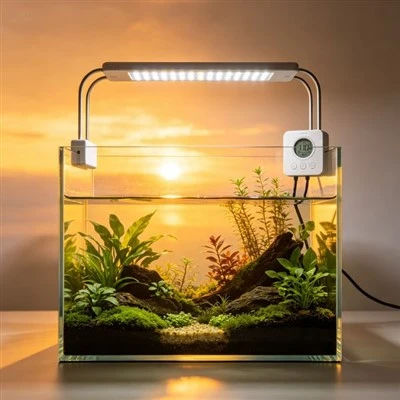
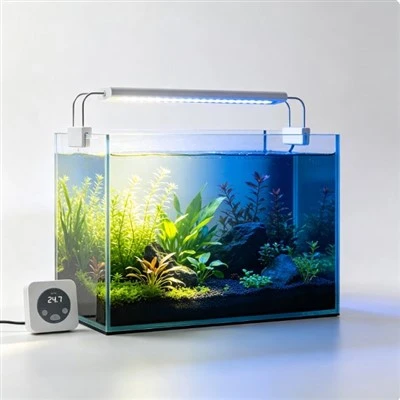
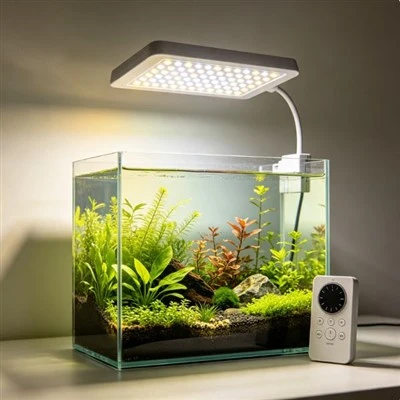
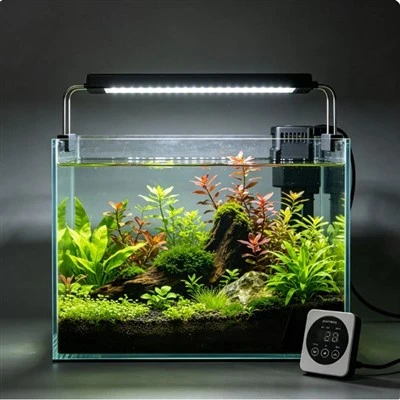
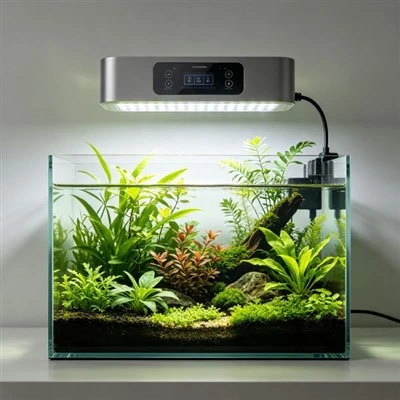
The app says "off," the aquarium is dark, and the next scheduled sunrise is hours away. Even so, the controller may still be keeping time, listening for a wireless command, powering an indicator, or maintaining a low-voltage supply. Those functions can consume energy while the LEDs produce no intended light. This is standby or off-mode consumption, depending on how the product and measurement framework define the state. The important point is that visible darkness and zero electrical input are not the same claim.
Different off states can exist within one product. A local button may turn off only the LED channels while leaving the network active. A sleep mode may retain the schedule but reduce communication. Removing mains power eliminates ordinary powered standby but may also stop the clock, erase volatile state, or change how the light restarts. Comparing products requires the same functional state. One "off" reading cannot fairly be compared with another product that has been unplugged or placed in a deeper mode.
Low power is harder to measure well than many owners expect. A basic plug-in meter may have limited resolution, uncertain accuracy near the bottom of its range, or an update interval that hides changing network activity. A display of zero can mean "below the resolution shown," not necessarily no consumption. Before testing, read the meter specifications, confirm that it is suitable for the expected load, and give the system enough time to enter the intended state.
A practical measurement record identifies the fixture, adapter, controller, firmware where relevant, network connection, off command, indicator state, meter, test duration, and room condition. Measure the complete power path that a customer actually uses rather than one internal board in isolation. If the wireless connection is intentionally disabled for a second test, label that as a different mode. Repeating the test at the same state helps reveal whether short communication bursts or clock activity are affecting a brief observation.
Annual energy can be estimated only after a credible power value and time pattern are known. Power multiplied by hours gives energy, with consistent units, but a calculation based on a rounded or unresolved display can create false precision. The schedule may also include illuminated operation, transitions, manual overrides, and firmware activity that a single standby snapshot does not represent. State the assumptions and keep standby energy separate from the energy used while the LEDs are on.
The illuminated indicator is not a power meter. A bright status LED can operate from a small current, while most standby consumption occurs elsewhere; a dark controller can still power a receiver or supply. Touching the adapter is not a measurement either. Warmth may come from losses during operation or another condition and deserves attention if unusual, but it cannot quantify off-mode watts. Users should never open a mains adapter or expose conductors to obtain standby data.
Networked behaviour needs special care in comparisons. A controller connected to a cloud service may wake periodically or respond to local traffic. Results can depend on connection state, firmware, and the measurement interval. That does not make standby testing impossible. It means the report should identify whether the product was networked, paired, idle, searching for a connection, or operating only from its internal schedule. A manufacturer can publish more than one clearly named state when those functions differ.
There is also a husbandry distinction. Turning the LEDs off should create the intended visible dark period, but an energy reading does not prove that every indicator, room light, or nearby display is biologically irrelevant. Conversely, unplugging a controller each night merely to remove a small standby load may disrupt schedules or recovery behaviour. Energy decisions should be made from measured use and the product instructions while preserving a stable, suitable routine for the aquarium.
Useful product data states the complete configuration, input conditions, off command, network condition, measurement method, and result with appropriate precision. It avoids implying that "zero on the app" means zero watts, and it does not combine standby and illuminated efficiency into one flattering number. Service information should also explain what happens to the clock and saved program after mains power is removed, because that behaviour affects whether an energy-saving routine is practical.
Standby power is usually a small part of a lighting discussion, but it is a good test of honest reporting. Define the state, measure it with equipment that can resolve the load, keep network and timing functions visible, and calculate energy without invented precision. The result helps buyers compare real operating modes and helps designers see where control power is used. Darkness tells the eyes that the LEDs are off; only a defined electrical measurement tells the rest of the story.
Longer observation can reveal what a snapshot hides. A networked controller may draw brief bursts while checking a connection, downloading approved data, or updating its clock. An energy meter that accumulates watt-hours over a suitably chosen period can characterize an average if its resolution and accuracy are adequate, while a power analyser can show changing states in greater detail. Either report should distinguish measured values from estimates and describe any activity allowed during the interval. A single rounded "0 W" display should not be multiplied into an annual savings claim.
Standby design also affects resilience. A small retained supply may preserve the schedule and make remote control available, while a deeper mode may save more energy but require a longer wake-up or lose a function. These are product decisions, not evidence that one mode is always preferable. Interfaces should tell users what remains active and what happens after power is removed. That clarity lets an owner balance energy use with reliable timing without repeatedly unplugging equipment or assuming that an app icon describes every energized circuit.