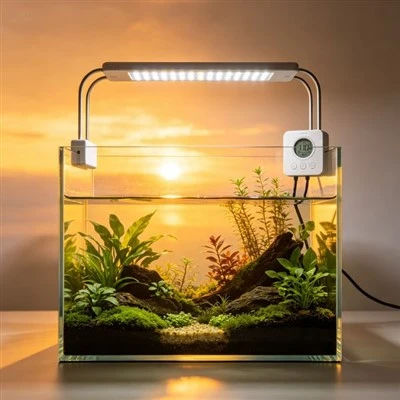
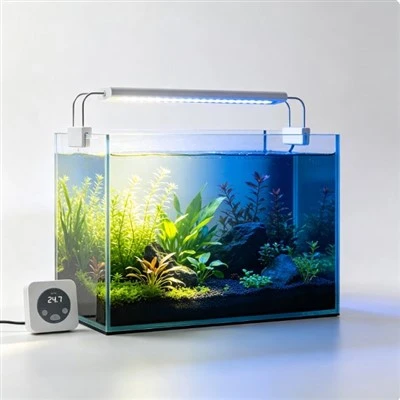
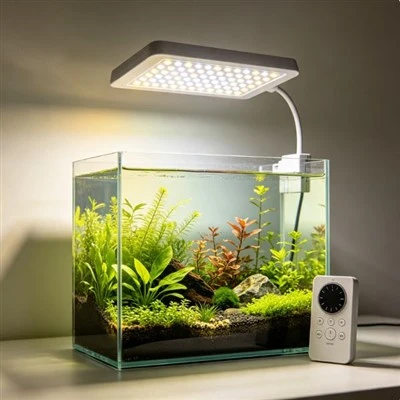
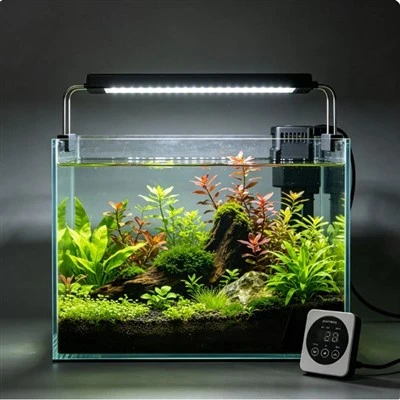
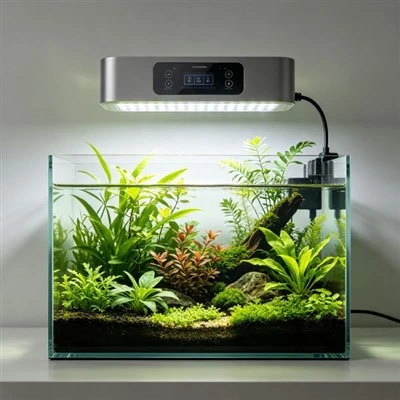
To eliminate uncertain factors and avoid relying on luck for successful aquarium management, we have formulated these "Ten Golden Rules". They are natural principles to guarantee healthy aquarium‑fish culture, keep fish and aquatic‑plants vigorous, and maximize your aquarium's performance.
1. Tropical Temperature for Substrate and Water
Special attention should be paid to the interaction between substrate and water. Installing heating cables under the aquarium substrate brings unique benefits. Heated water rises, turning the substrate into an integral part of the tank's chemical‑physical system. Heat is evenly distributed throughout the aquarium. Nutrients produced inside the substrate circulate back into the water and reach aquatic‑plant leaves. Conversely, flowing water carries oxygen down into the substrate. This keeps the substrate biologically active for longer, prevents dead zones and stops substrate blackening. The heating system simulates natural horizontal and vertical groundwater flow in tropical habitats. Furthermore, it operates on a safe 24‑volt low‑voltage current, completely harmless to humans and aquatic animals.
2. Suitable Lighting
Depending on aquarium size and shape, you may use fluorescent tubes, mercury‑vapour lamps (HGL) or metal‑halide lamps (HQI). Any of these light sources will preserve fish's natural colours and support healthy plant growth. Most importantly, proper lighting ensures sufficient dissolved‑oxygen supply during daytime hours. 100 % oxygen saturation is not enough for stocked aquariums. Both fish and oxygen‑consuming bacteria break down leftover feed and organic waste. Aquatic plants also require oxygen, especially in late‑afternoon hours. Sufficient oxygen reserves built up in daylight prevent oxygen shortages at night, which can only be achieved with appropriate lighting.
3. Stable Water Quality
Natural tropical water bodies maintain highly‑stable water‑quality parameters, even over long periods. Fast‑flowing water shows very little fluctuation in pH, carbon‑dioxide level and water hardness. This principle can be difficult for beginners without chemical knowledge. Community aquariums require a neutral‑pH environment and stable acidity, with carbonate hardness kept at a minimum of 3‑4 °dKH. Neutral pH is ideal for mixed communities containing acid‑loving fish such as neon tetras and alkaline‑adapted species like African cichlids. Neutral pH is regulated through CO₂ injection, which works reliably only when carbonate hardness stays between 3‑4 °dKH. This avoids misleading CO₂ readings caused by other acidic substances and delivers stable, consistent water conditions. Controlled carbon‑dioxide supplementation also supplies aquatic plants with an optimum level of CO₂.
4. Natural‑Balanced Aquatic‑Plant Nutrition
Most tropical natural water bodies lack certain mineral salts, particularly essential trace‑elements for plant growth. Spring water fed continuously by underground sources replenishes these nutrients, so chemical composition varies widely across natural habitats. Regular nutrient supplementation inside closed aquariums cannot be overlooked. Nutrients absent from tap water should be added during scheduled water‑changes. Water‑changes also remove fish waste and plant metabolic by‑products. Chemically‑unstable trace‑elements such as iron, manganese and other micronutrients need small daily doses to avoid toxic accumulation from over‑dosing.
5. Biological Filtration System
Aquariums are often overstocked relative to their water volume. Metabolic waste is produced not only by fish, but also by snails and aquatic plants, gradually polluting the water. While regular water‑changes and mechanical filtration (filter wool, activated carbon, ceramic media) remain essential, biological filtration has become increasingly important. Biological filters use bacteria‑colonized media to decompose dissolved pollutants and clean aquarium water. Specialized filter bacteria can break down residual chelating agents and excess fertilizer complexes. Similar large‑scale biological techniques are used in industrial wastewater treatment to restore polluted water to drinking‑water standards.
6. Powerful Water Flow
Strong water circulation equalizes tank‑wide temperatures, washes organic waste off plant leaves and delivers fresh nutrients. Fast‑moving current also removes surface bio‑films that easily cling to foliage. Naturally, most tropical fish originate from streams and rivers with flowing water. Robust water movement encourages exercise and improves fish fitness.
7. Densely‑Planted Aquatic Vegetation
A high‑performance planted aquarium depends on dense, healthy plant growth. Key benefits are listed below:
Creates beautiful aquascape layouts
Enables root‑zone biological activity in substrate
Distributes oxygen through plant roots deep into the substrate
Prevents substrate blackening
Produces abundant dissolved oxygen for the aquarium
Inhibits algae outbreaks
Suppresses pathogenic bacteria
Absorbs impurities and toxic substances from water
Some aquatic plants release antibiotic‑like compounds
Provides ideal hiding and spawning sites for fish
8. Balanced Fish Population
A harmonious aquatic ecosystem with fish and plants relies on a carefully selected, balanced community. Follow these stocking guidelines for planted aquariums:
Avoid mixing aggressive, incompatible fish species
Do not introduce plant‑eating fish
Add algae‑eating fish immediately after tank setup for algae control
Select fish sharing the same preferred water temperature, ideally 25‑26 °C
Introduce snail‑eating fish to prevent snail overpopulation
Stock fish from all three water layers: bottom‑dwellers, mid‑water and top‑swimming species
Avoid highly‑specialized feed‑dependent fish unless you can reliably supply their required diet
9. Proper Tropical‑Fish Feeding & Water Management
High‑quality, vitamin‑rich and easily‑digestible fish feed produces active, healthy tropical fish. Most tropical fish come from freshwater habitats with almost no dissolved salts. Low‑salt fish food is required, otherwise fish risk intestinal disorders. Water‑quality maintenance is equally important to feeding. Always treat replacement water during water‑changes to prevent water‑related stress and harm.
10. Monitoring All Aquarium Parameters
Carry‑out regular testing for temperature, pH, nitrite, iron content, carbonate hardness and other key water‑quality indicators to maintain a healthy aquarium. Compared with vast natural water bodies, aquariums hold a tiny water volume. Water parameters can swing rapidly from one extreme to another, therefore long‑term stability and consistency are critical. Routine monitoring allows aquarists to detect potential risks at an early stage and take corrective action before problems escalate.