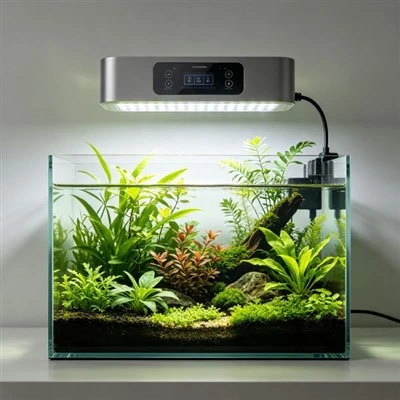
1. The structural features and lighting needs of a coral branch cultivation tank
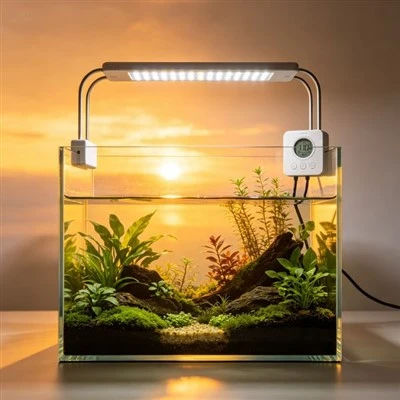
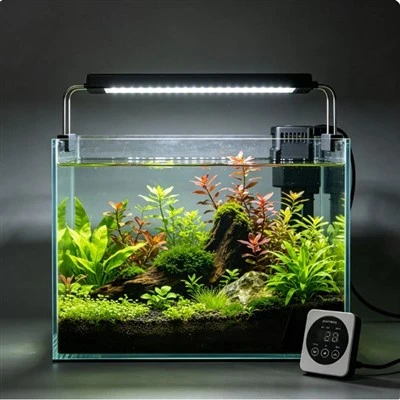
The Frag Tank is a functional Aquarium Light system that is made just for coral reproduction and growth. Its design aims are very different from those of show tanks. To make better use of light, the branch breaking cylinder is normally just 20 to 40 centimetres deep in water. Corals, on the other hand, are frequently placed in a flat pattern with a lot of density, which makes lighting more important. In this building, lighting is not just a tool for illumination, but also an important piece of equipment that affects how well manufacturing works. The broken branch cylinder needs lights that give off stable and high PAR values, as well as lights that evenly spread light to prevent uneven development from areas with too much or too little intensity. Also, the lights need to be able to protect themselves from excessive humidity and salt spray and let heat escape.
2. The main part of the aquarium light in the broken branch tank
Aquarium lights have different effects on the growth and health of corals in the broken branch tank. the light gives the algae the energy they need to photosynthesize, which lets the coral make the nutrients it needs to grow. Second, stable light can help broken branches mend, speed up tissue regeneration, and raise the survival rate. Third, the spectral structure of light directly impacts how coral shows colour. This is because different wavelengths activate different fluorescent proteins, which makes the colours richer. Lastly, a steady light output helps keep the system stable as a whole, which lowers the danger of stress reactions and whitening. So, in the broken branch tank, the light not only decides if the coral can develop, but it also has a direct effect on how fast it grows and how good it is in the end.
3. A strategy for controlling the PAR and spectral design of the branch cutting cylinder
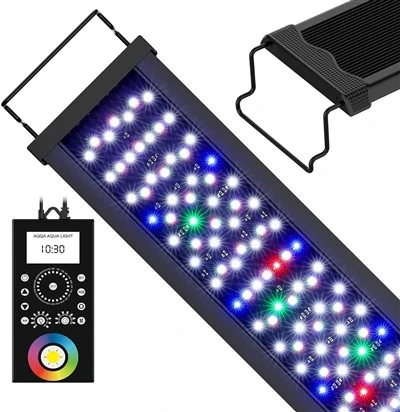
When designing a broken branch cylinder lamp, the spectrum and PAR value are the two most important things to think about. For photosynthesis to work, blue Aquarium Light should be the main source of light, making up 50% to 70% of the total. About 10% to 20% of the light is purple, which helps improve colour depth and fluorescence performance. White light is employed to improve spectral integrity and makes up about 10% to 20% of it. To keep algae from growing, you should keep the red and green light levels low. varying kinds of corals need varying amounts of PAR control. SPS corals, for instance, need a PAR value of 200 to 400, while LPS corals can live in a range of 100 to 200. Low light levels can slow down growth, while high light levels can make light less bright or even whiten it. So, it's very necessary for broken branch cylinder lamps to be able to dim.
4. Important technologies and system needs for lamp design
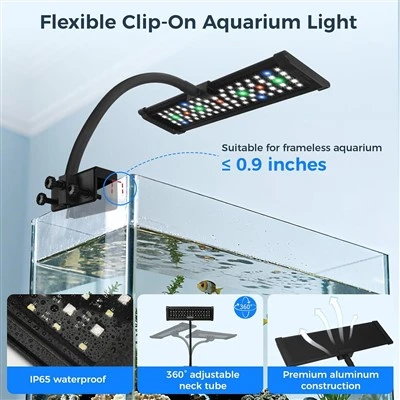
The broken branch cylinder light fixture needs to meet a number of technical standards. the uniformity of the light demands good optical design, such wide-angle lenses and a multi-point light source structure, to make sure that the light is evenly spread across the water surface. The next feature is multi-channel dimming, which lets users change the spectral ratio for different stages and switch between growth mode and colour mode. The third is the constant current drive system, which can keep the current output stable, stop the light from flickering, and make the LED aquarium lights longer. Also, the lighting fixtures need to be waterproof and anti-corrosive since the branch breaking cylinder is very humid and corrosive. They also need to have a decent way to get rid of heat so that they can work properly for a long time.
5. Analysis of application scenarios, typical misunderstandings, and a summary
In real life, the broken branch cylinder lamp is often utilized in commercial coral farming, player propagation systems, and hybrid systems that mix display and culture. varied application settings have varied needs for lighting, but the basic idea is always the same: it should be efficient, stable, and easy to regulate. But a lot of people still have some wrong ideas while utilizing it, including mindlessly going for high power without paying attention to PAR values, light uniformity, or using low-quality driving power sources. These things can hurt the growth of corals. To accomplish the aims of efficient breeding and high-quality hair colour, an excellent branch cutting cylinder lighting system should have precise spectral control, steady output, high uniformity lighting, and a solid structural design.