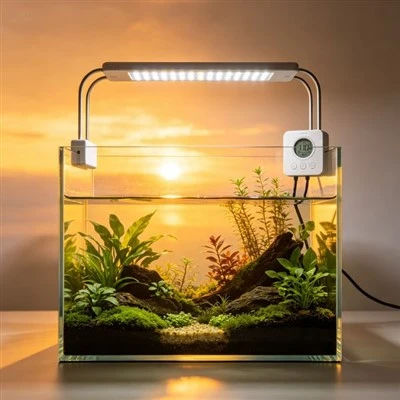
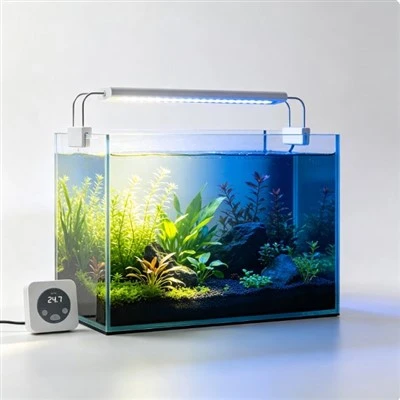
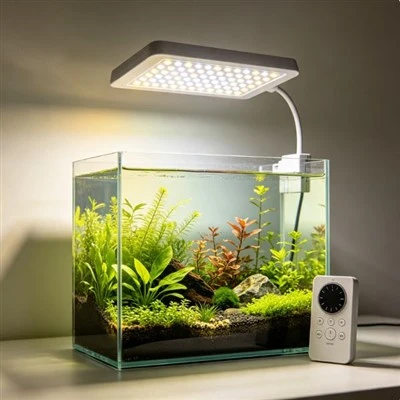
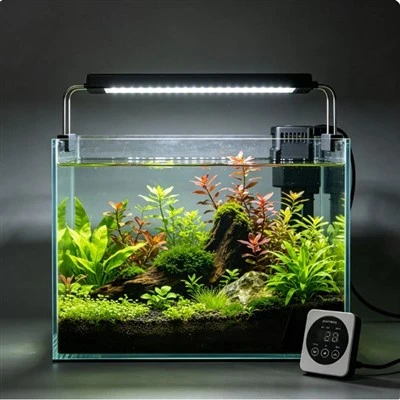
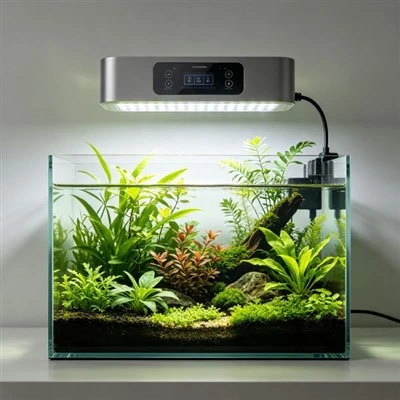
一,The spectrum design goals of aquarium lights and regular LED lights are not the same.
Most regular LED lights use broad-spectrum white light technology, which focuses on covering the parts of the human eye that are most sensitive to light. This makes the lighting environment look brighter and more natural. However, this spectral structure might not be good for the growth needs of aquatic creatures
aquarium lights go through band augmentation so that aquatic plants or corals can develop. there will be strict rules about how much blue light there is compared to red light. The blue light band helps the water get into the aquarium lights better, which lets light reach the bottom.
二, Differences in how well they let light through and how well they work in water
Water has some properties that make it absorb and scatter light, and the distance that light of different wavelengths can travel in water is variable. Water doesn't absorb short wave blue light very quickly, but it does let it through easily. Long wave red light, on the other hand, is more easily absorbed by water.
Most professional aquarium lights use optical lens design and wavelength combination optimization to make the light more even underwater, which makes sure that the bottom of the fish tank is well lit. If you use ordinary LED lights, you can have the following problems:The light is focused on the surface of the water, which makes the bottom of the fish tank not bright enough. This can easily cause aquatic plants to develop quickly at the top and die off at the bottom.
三,The color temperature and color rendering index have various uses
Normal LED lights are more concerned with how comfortable they are for the human eye. They usually have a color temperature range of 3000K to 6500K and a color rendering index requirement based on daily lighting standards.
Aquarium lights need to find a balance between looking good and being good for the environment. use multi-color temperature mixing technology to make the colors of fish and other sea creatures more vibrant and to mimic how light changes in nature.
People commonly use cool and warm light sources aquatic habitats since this kind of light is for photosynthesis in aquatic plants. The amount of blue and purple light in marine coral ecosystems will go up the algae that live with coral are more sensitive to blue light.
The color rendering index design of is also different. Regular LED lights try to have a high color rendering index to bring back the colors of real things. Aquarium lights, on the other hand, focus more on how the colors of aquatic species look better.
四,Different levels of safety and waterproof and moisture-proof structures
Because aquariums have significant humidity and even direct contact with water, aquarium lights need to be built to be safer.
Most professional aquarium lights have a sealed structure that gives them a lot of protection. The outside of the lamp body is normally built of materials that resist corrosion so that long-term water vapor erosion doesn't damage the internal circuit.
Most LED lights are only good for dry interior spaces. If you put regular LED lights directly over the fish tank, the following problems may happen if they are exposed to water vapor for a long time
五,Differences in the ability to work continuously and the stability of life
Aquarium lights often need to be on for more than 10 hours a day in real life, and some aquatic ecosystems even have longer light cycles. Because of this, aquarium lights need to be able to handle a lot of heat and have stable power.
LED lights may last longer in theory, but their heat dissipation structure is mainly made for places where the lights are only on for short periods of time. It may speed up the process of light decay if it is used continually under a heavy load for a long time.
Aquarium lights normally employ better LED chips and better heat dissipation channels to keep the light decay rate low, which keeps the water illumination stable.
六.,Differences in price, cost, and application positioning
When it comes to price, professional aquarium lights are usually more expensive than regular LED lights. This is mostly because they cost more to research and develop and to build an ecological spectrum.
The production scale of regular LED lights is huge, the technology is well-established, and they are mostly utilized for general purposes like lighting in homes and offices. This means that they are better at controlling costs.
Aquarium lamps are a type of specialty lighting that needs to have its optical structure optimized and its ecological adaption tested, which makes the whole cost of making them quite high.