What kinds of aquariums usually use blue light in their lights
A common use for aquarium lights is to create blue light environments, which we commonly see in high-end fish tank exhibits or aquarium retailers. A lot of people assume blue light is merely for looking cool, but it actually has distinct uses.
There are coral tanks and seawater tanks
As the water gets deeper in the ocean, the blue band of light is the only one that can get through. Because of this, many marine species have changed to live in this type of environment. Professional seawater aquarium lights normally make the blue light stronger to mimic natural marine settings and help algae that live in corals to photosynthesis.
Next is the night viewing mode
A lot of smart aquarium lights now have a "moonlight" option, which is essentially blue light at a low level. You may keep the fish tank in a dim light at night by turning on the blue light of this aquarium lamp. This won't disturb the fish's sleep cycle and will also make the fish tank look better.
The third option is to make the fish's body colour brighter.
other decorative fish, such neon lights fish, peacock fish, and other marine fish, can look better in blue light because it makes their body colour stand out. When aquarium lighting give off the right amount of blue light, the colour of the fish will look more layered.
What kinds of settings are good for aquarium lighting with white light
The most frequent and widely utilised light source is white light from aquarium lamps. White light is the main source of light for almost all types of aquarium systems.
aquarium lights give out white light that is most like natural sunshine.
High-quality LED white light can mimic the light in nature, which is a mix of many wavelengths. So, white light is the most reliable choice for growing fish or aquatic plants.
Second, white light can accurately show the colour of the fish tank.
If a fish tank exclusively utilises blue light or other single-color light, the colour can get messed up, even though it appears nice. When using white light from aquarium lamps, fish, aquatic plants, and landscaping stones will present a more natural effect, which is also why many aquarium shops commonly use white light to display their fish tanks.
while you're just starting out with fish farming, it's best to choose aquarium lights that give off stable white light.
White light doesn't have a very strong effect on the water, thus it is less likely to produce ecological problems when there is too much light.
A lot of professional aquarium lighting schemes are based on white light, with a little bit of blue and red light added to make a whole spectrum system.
The red light from the aquarium light is especially crucial if your fish tank is a water grass tank. Adding red light bands is one reason why many high-end water lawn lights cost more.
Red light has a big effect on how aquatic plants photosynthesise.
Aquarium lamps that give off the right amount of red light will help aquatic plants grow faster and make their leaves look brighter. Some red aquatic plants
The Palace of Red
Butterfly in Red
Heart Blood Orchid
These water plants can't show their best state if there isn't enough red light.
many experienced aquarium players use the red light of the aquarium light with high colour rendering white light. This keeps aquatic plants healthy and stops the aquarium from seeming too red.
it should be noted that a high proportion of red light may also lead to an increase in algae. So, it's best to pick aquarium lights that let you change the spectral ratio.
Aquarium Lamp Configuration Cases (Practical Experience)
Let's look at a real-life example to better understand how different spectra work.
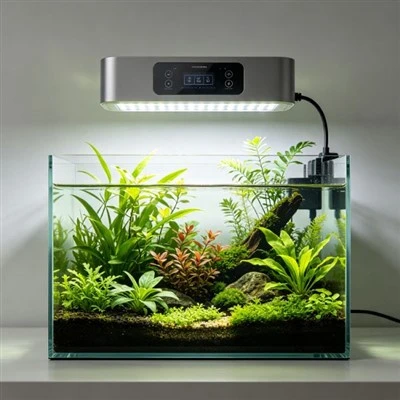
This is a water grass tank that is about 60 centimetres wide and has medium-density water grass in it along with some small tropical fish. At first, this fish tank only used ordinary white light aquarium lights, but two problems occurred:
The growth rate of aquatic plants is slow, and some red aquatic plants have a greenish color.
Later, the lighting configuration was adjusted to include three spectral combinations:
60% Aquarium Lamp White Light
25% red light for the aquarium
15% aquarium light blue light
After the change, the aquatic plants got a lot better in about two to three weeks, and the red aquatic plants started to develop colour slowly. The fish tank also looked better overall at the same time.
The current trend in the development of aquarium lights
As LED technology becomes better, aquarium lights are getting smarter and more professional. Compared to early simple lighting fixtures, many lamps now have complete spectrum control.