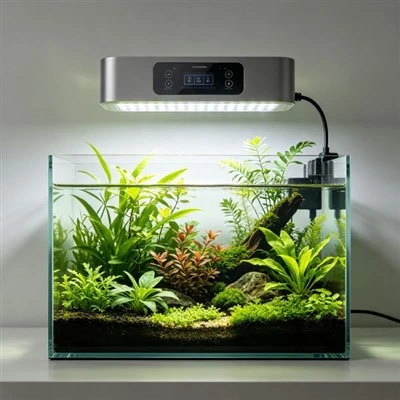
Why Light Uniformity Matters for SPS Corals
Why Light Uniformity Matters for SPS Corals is a practical question because an aquarium light has to match a real tank, not a catalogue label. Coral response also depends on species, placement, flow, temperature, nutrients, water clarity, and gradual acclimation. This article explains the decision in plain language. It avoids universal wattage rules and does not treat one tank, one PAR reading, or one product sample as proof that every installation will behave the same way. The goal is to choose a reef led light that can be tested, installed safely, and adjusted without guessing.
Reef lighting must be judged at coral positions rather than from the brightness seen above the tank. Water depth, surface movement, rockwork, fixture spacing, optics, and water clarity can create large differences across SPS corals and lighting uniformity. Coral fluorescence is a viewing effect and is not a complete health check. Coral colour and growth also respond to flow, temperature, nutrients, feeding, stability, species, and acclimation. A PAR map provides useful placement information, but it does not replace observation of tissue condition and behaviour. When a new light or setting is introduced, make gradual changes and keep other husbandry factors as stable as practical so the response can be interpreted.
For SPS corals and lighting uniformity, placement and acclimation matter as much as the published maximum output. Build a grid of readings at the actual coral heights, including edges and shaded areas. Record fixture height, channel settings, water depth, surface movement, and meter model so the map can be repeated. Use coral response to refine placement gradually. Pale tissue, retraction, loss of colour, or reduced extension can have several causes, including temperature, nutrients, flow, pests, disease, or rapid lighting change. Do not diagnose the light from one symptom alone. When moving a coral upward or changing a fixture, use smaller steps and allow time for observation before making another major adjustment.
A useful specification sheet for reef led light should describe the complete product, not only the LED chips. Relevant fields include input voltage and frequency, measured power, power supply details, channel arrangement, control range, timer behaviour, dimensions, weight, mounting limits, cable and connector details, materials, operating environment, and included accessories. For photosynthetic applications, request a PAR map or raw readings with the test distance, grid, water or air condition, sensor model, channel settings, and stabilisation time. For visible appearance, photographs can help only when exposure, white balance, room light, and settings are controlled. Numbers from different test methods should not be treated as directly comparable. Ask for tolerances and model specific documents rather than a catalogue claim covering a whole series. For this article, apply that check specifically to why light uniformity matters for sps corals.
Before approving the product, test the reef led light under the same conditions planned for SPS corals and lighting uniformity. Confirm the label, plug, accessories, manuals, packaging, and model identity before operation. Check mounting security, cable routing, controls, timer recovery after power loss, dimming smoothness, channel response, noise, flicker visible to a camera, and temperature after the unit stabilises. Measure input power and, where relevant, map output at repeatable points. Run several on and off cycles and inspect connectors, seals, screws, and finish after normal handling. Record the method and result instead of writing only pass or fail. If the sample differs from the production specification, resolve the difference before approving a bulk order. A sample is evidence for that configuration, not proof of every future batch.
Installation should follow the instructions for the exact model. Keep mains connections, power supplies, and controllers in the intended environment, and do not assume that every component has the same moisture rating as the light body. Check brackets, suspension points, feet, or supports for the stated tank dimensions and fixture weight. Route cables so water cannot follow them directly into a connector or outlet, and use a drip loop where the design and local guidance call for one. Leave the ventilation and clearance required by the manufacturer. Do not cover heat sinks or place adapters where splashes, condensation, salt creep, or cleaning water can collect. After installation, confirm that the reef led light cannot fall into the aquarium and that normal feeding, lid removal, and maintenance do not strain the cable or mounting system. For this article, apply that check specifically to why light uniformity matters for sps corals.
Operate the reef led light with a stable baseline before making fine adjustments for SPS corals and lighting uniformity. Record the daily start and stop time, overall intensity, channel settings, mounting height, recent maintenance, and any room daylight. Change one major variable at a time and allow enough observation time for the type of system. Fish behaviour can change within minutes, while plant or coral responses may take days or weeks and can be affected by other conditions. Clean optical surfaces only with an approved method and with power disconnected. Dust, mineral film, salt creep, condensation, and fingerprints can alter output and heat transfer. If the controller, fan, power supply, connector, or housing behaves abnormally, stop using the equipment and follow the service guidance rather than improvising a repair.
Common reef mistakes include copying another tank's channel percentages, moving a coral and changing the light on the same day, using fluorescence as a health score, and assuming that a centre PAR value represents the whole rockwork. For SPS corals and lighting uniformity, the practical cure is to keep the decision traceable. Record the question, the test condition, the result, and what would count as an acceptable outcome. If a claim cannot be connected to a model specific specification, test report, repeatable measurement, or observed result, treat it as unverified. This approach protects both hobby users and business buyers because it separates useful evidence from attractive product language without requiring a laboratory for every decision.
The final decision for why light uniformity matters for sps corals should be simple to explain. Choose the reef led light that fits the physical tank, provides the required distribution and control, has documentation suitable for the target market, and can be maintained safely. Keep the approved model, settings, accessories, and test record together so a later replacement or production batch can be checked against the same baseline. For SPS corals and lighting uniformity, start conservatively, observe the tank, and adjust with measured steps. If the result is unstable, return to the last known safe setting and inspect the lighting system together with water conditions, livestock needs, and maintenance history. Reliable lighting comes from matching the product to the job and confirming the result in the real aquarium.