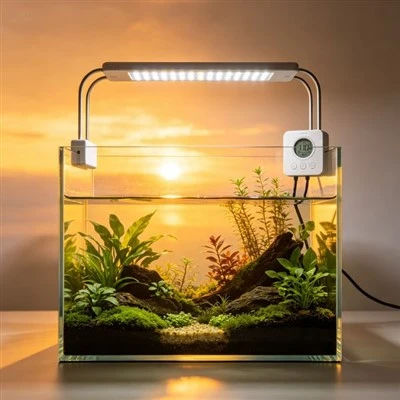
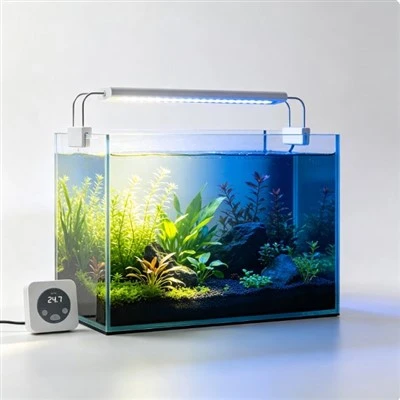
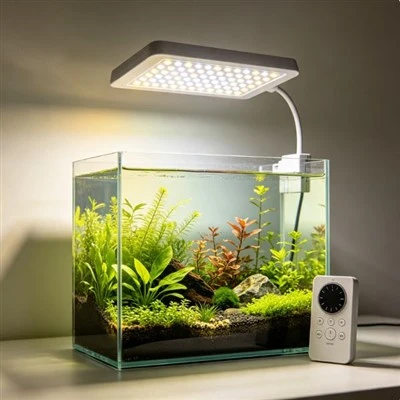
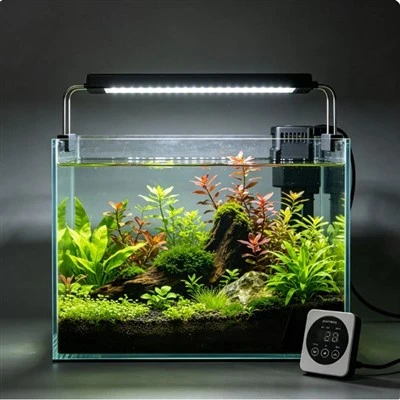
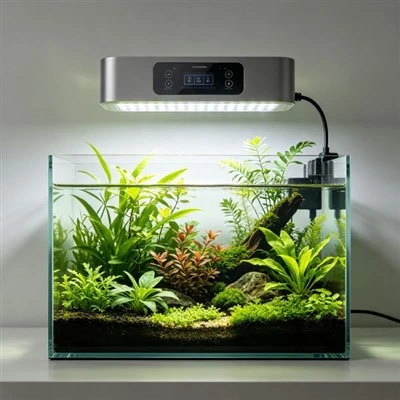
In a busy aquarium shop, a fan-cooled light may disappear beneath conversation, pumps, and traffic. Bring the same fixture into a quiet bedroom at night and a soft whirr or periodic speed change can become obvious. The product did not necessarily become louder; the listening environment changed. A useful acoustic claim therefore needs more than a decibel number. It needs the background sound, microphone distance and angle, acoustic weighting, operating state, fixture orientation, surrounding surfaces, sample condition, and a method that controls, characterizes, or corrects for the room's contribution.
Sound level changes with position. Moving a microphone farther from a compact source generally lowers the measured level in a suitable open field, but reflections and extended source geometry complicate simple distance rules. A hard wall, glass aquarium, ceiling, canopy, and workbench can reinforce or redirect sound. A test beside a reflective corner cannot be compared directly with one in an absorptive room merely because both reports use the same unit. The measurement distance and source-to-microphone geometry must appear beside the value.
Background noise sets another limit. If room ventilation, pumps, computers, or outdoor traffic approach the fixture's level, the meter responds to their combination. Switching the light off can characterize the room, but the laboratory should apply the correction or validity rule required by its chosen method rather than casually subtracting decibels as ordinary numbers. Background can also change during the test. Recording a quiet-room baseline and monitoring interruptions prevents a closing door or passing vehicle from becoming part of the product specification.
Weighting and bandwidth describe how the instrument treats frequency. A-weighted sound level is common for approximating aspects of human hearing, while other weightings or spectral data answer other questions. The notation should be stated; "25 dB" alone is ambiguous. Two fans with a similar weighted level can sound different if one has a prominent tone, bearing tick, speed modulation, or broadband airflow. A one-third-octave or narrower spectral analysis and notes on tonality may be useful for engineering even when marketing presents a single summary value.
Fan state is not fixed until the thermal state is defined. Some aquarium lights start at low speed, increase after warming, respond to channel power, or cycle around a control threshold. Test each normal fan mode that the user can encounter and allow the fixture to reach the stated stabilized operating condition. Record channel settings, ambient temperature, input condition, mounting orientation, clearances, and any automatic speed changes. Measuring only the first cool minute can understate the sound produced during a long bright period.
Sample condition matters too. Cable contact with a housing can buzz, a loose bracket can resonate, and a grille can create turbulence. Those may be genuine product or installation issues rather than reasons to discard the result. Inspect the approved assembly, mount it as instructed, and report whether the sample is new, conditioned, or taken from service. Multiple samples help distinguish a characteristic design sound from one damaged fan, but the number of samples and the way results are summarized should remain visible.
An everyday comparison makes room effects clear. Set a fixture close to a bare wall and reflected sound can change the meter reading and what a listener hears. Move it to the middle of a more absorptive test space and the measured level and perceived installed sound may be lower even at the same fan speed. Neither location is "the truth" without a defined objective. A standardized or well-documented setup lets engineers compare products; an in-room evaluation tells an owner whether the installed combination is acceptable at the normal listening position.
Owners can troubleshoot without defeating cooling. Check that the fixture is mounted correctly, clearances and vents are unobstructed, and no external cable or loose approved accessory is touching a vibrating surface. Note when the sound begins, which light scene is active, whether speed cycles, and how room pumps affect perception. Do not stop a required fan, insert objects through a grille, cover vents, or reduce cooling to obtain a better reading. New grinding, scraping, burning odour, or unstable operation calls for safe shutdown and qualified service.
Manufacturers should publish enough context to reproduce a noise claim: exact model and revision, fan control state, sample count and condition, mounting, ambient temperature, stabilization, microphone type and calibration status, distance, angle, room background, weighting, and test environment. If a "silent mode" reduces output or changes thermal limits, that tradeoff should be explicit. A comparison chart should not mix measurements from different distances or backgrounds as if the smallest printed number alone identifies the quietest fixture.
A credible acoustic result is a description of a source in a defined setting, not a universal promise about every room. Distance and source-to-microphone geometry affect the received sound-pressure level, background establishes what can be resolved, weighting shows how frequencies were combined, and thermal stabilization reveals the fan state a customer will actually hear. Pair the meter reading with listening observations and spectral detail when needed. The aim is to report fan sound under reproducible conditions while preserving the airflow that the aquarium light was designed to need.
Acceptance also depends on use. A steady broadband sound tolerated in a shop may disturb a sleeping area, while an occasional speed step can attract more attention than a slightly higher constant level. User panels can complement instrument data if the room, samples, sequence, and questions are controlled, but subjective preference should not be relabeled as a universal acoustic threshold. Product guidance can help buyers by describing normal fan states and offering condition-specific measurements rather than promising "inaudible" operation. Installation advice should keep the approved mount firm and away from unintended resonant contact without adding soft material that blocks cooling or compromises support.
Periodic quality checks should compare acoustic results with approved baselines after fan, grille, firmware, or housing changes. A similar average level can hide a new tone, so change control should review both the summary metric and the spectrum or listening record.