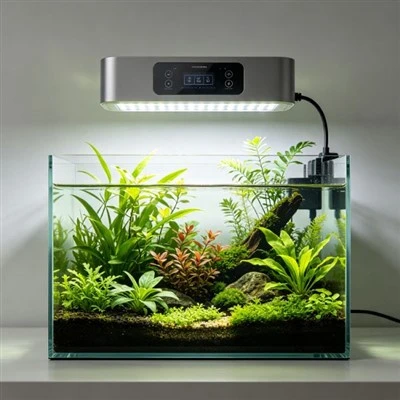
一,Basic rules for aquarium lights to work for a long time without stopping
In modern aquatic habitats, aquarium lamps are essential artificial lights. Their major job is to mimic the lighting conditions seen in natural water bodies, which helps fish and aquatic plants carry out their usual biological functions. Most aquarium lights on the market today use LED technology. Companies like Philips and Tetra have put a lot of money into aquarium lighting technology. LED aquarium lights are said to last longer, but that doesn't imply they can run for a long time without stopping. The aquatic ecology has a pattern of day and night. Keeping artificial light sources on all the time will slowly throw off the balance of biological rhythms in the water body. So, from an ecological point of view,
二,The way that long-term continuous use affects the decay rate of aquarium lights
The main technical problem with aquarium lamps that run for a long time is that the rate at which the light fades changes. When figuring out how long LED lights will last, people frequently utilize the luminous flux maintenance rate index instead of just how long the lamp stays on. The main things that determine the rate of light decay are how well the chip can control temperature, how stable the driving current is, and how well the packaging material resists aging. When the aquarium lamp is under a lot of stress for a long period, the semiconductor material within will keep getting hot, and the lattice structure may get tiny cracks. This will show up as a progressive loss of brightness and a shift in color temperature. If the aquarium lamp's heat dissipation structure isn't good enough, the heat inside the lamp body won't be able to escape to the outside world quickly enough.
三,The connection between the light cycle and the circadian rhythm in aquatic habitats
The aquatic ecosystem is more than just a bunch of fish and water bodies. It is a complicated web of life that includes fish, aquatic plants, and microbial populations. Most ornamental fish have a definite circadian cycle. If the lights in the aquarium are on all the time, they may be subjected to powerful artificial light, which might change their behavior in strange ways. Common signs include fish being more active than usual, changes in their eating patterns, and higher long-term stress reactions. In severe situations, these changes may even hurt fish's immune systems. A good light cycle is also important for the growth of aquatic plants.
四,The link between keeping aquarium lights on all the time and the chance of algae blooms
One of the most prevalent environmental problems that can happen when aquarium lights are left on for a long time is that algae can grow too much. For algae to flourish, three things usually need to be true: there needs to be light energy, water nutrients, and the right temperature. If you leave the light on in the aquarium for a long time, the nitrogen and phosphorus molecules that are still in the water may transform into food for algae to spread quickly. The microbial community in the water body is not yet totally stable, especially when a new aquatic ecosystem is being set up. If there is a lot of light for a long time, green algae can easily stick to the glass of the fish tank or the leaves of aquatic plants
五, The main effect of aquarium lamp working temperature on the life of the equipment
One of the most critical physical factors that affects how long aquarium lighting last is temperature. Semiconductor luminous materials don't work as well in high temperatures, so aquarium lamps need to be installed in a place where air may flow freely. The best temperature range for work is usually between 20 and 30 degrees Celsius. If the temperature around the LED chips stays above 40 °C for a long time, their lifespan may drop significantly. The internal power module will keep getting hotter as long as the aquarium lamp is on, and the driving capacitor may lose capacity over time because it is running at high temperatures for a long period. This will damage the stability of the lamp output
六, Suggestions for how long to use aquarium lights and how to make the environment better for them
Aquarium lights don't have to be on for a long time for regular people to see fish tanks. Most people say that you should limit your daily exposure to light to between 6 and 8 hours. If there aren't many aquatic plants or the water ecosystem is rather stable, you can lower the amount of time the plants are exposed to light. The aquatic ecological tank's light exposure period can be prolonged to 8 to 10 hours to enhance photosynthesis. However, this should be done in conjunction with the carbon dioxide supply system and water quality testing management methods