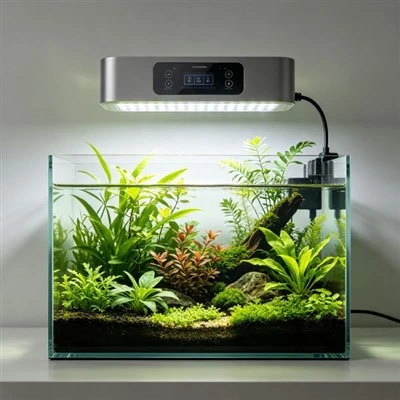
Why Nano Tanks Aren't Just "Small Versions" of Big Reef Tanks
Here's the physics most new reefers never get told directly: light intensity at the coral's surface depends heavily on how far that light has to travel through water before it gets there. A nano tank, typically shallow with just a few inches of water depth, gives light almost no distance to lose intensity before hitting the rockwork. The exact same fixture that produces a moderate, comfortable PAR reading at the bottom of a deep 40-gallon tank can blast out a much higher reading in a shallow nano setup, simply because there's so much less water in the way.
This is exactly why judging a light purely by its wattage misses the real picture. A powerful fixture isn't automatically wrong for a small tank, but the actual light intensity reaching your coral in a nano setup needs a different approach than simply copying settings from a larger system.
So Can a 150W High Power Coral Reef Aquarium Light Actually Work on a Nano Tank
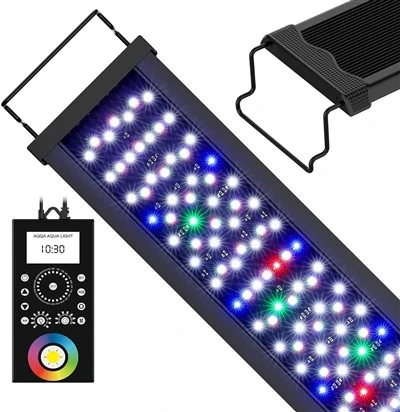
Yes, technically, but "can work" and "should run at full output" are two separate questions. What actually determines whether a high-power fixture is safe for a nano tank comes down to whether you can control how much of that power actually reaches the coral, through dimming, mounting height, and a proper acclimation period, rather than whether the fixture itself is somehow incompatible with a small footprint.
A general rule of thumb some reef keepers use for wattage planning is roughly 1-2 watts of quality reef LED per gallon for mixed reef setups, and 2-3 watts per gallon for SPS-dominant systems that need more intense light. On paper, a 150W fixture running over a small nano footprint can land well above that range, which is exactly why dimming capability matters so much for this specific pairing.
Comparison Table Matching Light Intensity to Tank Depth
|
Tank Type |
Typical Depth |
PAR Reaching Coral (Same Fixture) |
Adjustment Usually Needed |
|
Nano tank |
Shallow, a few inches of water column |
Higher, light travels a short distance |
Dim output, raise mounting height, cap around 250 PAR for most nano mixed setups |
|
Mid-size tank |
Moderate depth |
Moderate |
Standard mounting height (roughly 6-12 inches above the surface) usually sufficient |
|
Large, deep tank |
Substantial depth |
Lower, more light lost through the water column |
May need less dimming, sometimes closer mounting or higher output |
Signs Your Nano Tank Is Getting Too Much Light
Coral bleaching, where coral expels the symbiotic algae (zooxanthellae) living in its tissue, leaving it pale or white, is the extreme end of what too much light can cause, and it can happen within as little as 72 hours under a serious light spike according to reef keeping references. But full bleaching isn't the only warning sign, and it's usually not the first one.
Watch for these earlier indicators that light intensity is running too high for your setup:
Coral coloration looking washed out or unusually pale, without full bleaching yet.
Polyps staying closed or retracted for extended periods during peak lighting hours, rather than showing healthy extension.
A sudden increase in nuisance algae, particularly hair algae or similar growth, which often ramps up alongside excess light.
Tissue recession near the base of frags or colonies, which can show up weeks after a lighting change, not immediately.
A lot of these symptoms get misdiagnosed as water quality problems, since reef keepers instinctively check parameters first. It's worth ruling out lighting as the cause before assuming something's wrong with your water chemistry.
How to Safely Run a High-Power Light on a Small Tank
A few practical steps make a genuine difference here:
Choose a fixture with real dimming control. Being able to run a 150W unit at a fraction of its output gives you the flexibility a fixed-output fixture simply can't offer on a small tank.
Raise the mounting height. Most reef LED fixtures are designed to sit somewhere between 6 and 12 inches above the water surface, and moving a fixture higher reduces PAR intensity while widening the coverage footprint, both useful adjustments on a small tank.
Acclimate new lighting gradually, not all at once. A commonly recommended approach is starting around 30% intensity and increasing by roughly 10% per week, or alternatively starting at 50% for the first two weeks before ramping further, giving coral time to adjust rather than shocking it with a sudden jump.
Use a PAR meter rather than guessing from wattage alone. A PAR meter, the Apogee MQ-510 is a commonly referenced standard in the hobby, tells you what's actually reaching your coral, which is the only reliable way to know if your setup is dialed in correctly.
Know your target range and don't exceed it. As a general reference point, softies generally do well around 100-200 PAR, LPS corals around 150-250 PAR, and SPS corals typically need 200-400 PAR or more, though many nano-specific setups intentionally cap around 250 PAR for mixed reef stocking, partly because heat management becomes a limiting factor before light alone does in a small water volume.
Clip-On Aquarium Light Sometimes the More Practical Nano Tank Choice
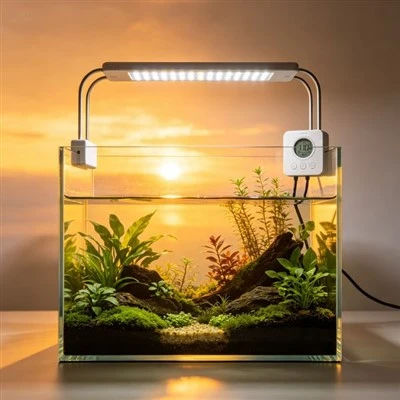
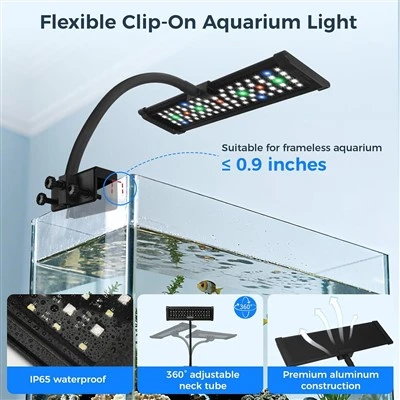
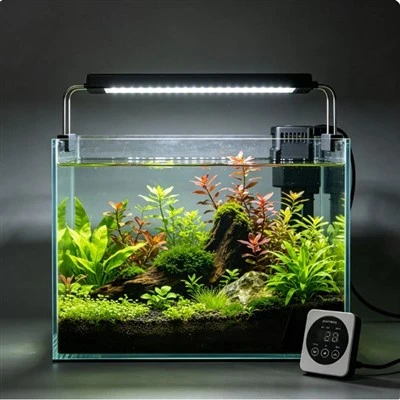
For a lot of nano setups, a Clip-On Aquarium Light ends up being the more sensible choice rather than a compromise. Nano tanks already have limited surface space, and a clip-mounted fixture doesn't compete for that footprint the way a canopy or rack-mounted light might. Its output also tends to land closer to what a small mixed reef actually needs, without requiring the dimming and mounting adjustments a high-power fixture demands to avoid overshooting your target PAR range.
That said, this isn't a universal fix. If you're keeping light-hungry SPS corals like Acropora, which often want PAR in the 300-400+ range, a basic clip-on unit may simply not have the output to get you there, even at full power. The right choice really comes down to what you're actually stocking, not just the size of the tank.
Real Example A GAKO Case Study on Right-Sizing Nano Tank Lighting
We've worked with hobbyist clients through GAKO who initially installed a full-power high-output reef fixture over a small nano tank, expecting better coral color as a result. Within a couple of weeks, several coral pieces showed visible paling and reduced polyp extension. After introducing dimming to bring output down substantially, raising the mounting height, and running a proper multi-week acclimation ramp back up to a target PAR appropriate for the tank's mixed softie and LPS stocking, coloration and polyp behavior recovered.
A Note on Industry Standards and Recognition
Within the reef keeping community, there's broad agreement that lighting mistakes, particularly overpowering a small system without acclimation, are among the most common and most expensive causes of coral loss in the hobby, which has pushed manufacturers toward building dimming and scheduling features directly into modern reef lighting rather than treating them as optional extras.
Common Mistakes When Lighting a Saltwater Nano Tank
A handful of mistakes account for most nano tank lighting problems:
Assuming higher wattage always means a better tank. Without accounting for the shorter water column in a nano setup, a powerful fixture can easily overshoot what your coral actually needs.
Running a new fixture at full power from day one. Skipping acclimation is one of the most common, and most avoidable, causes of coral bleaching after a lighting upgrade.
Relying on the fixture's rated wattage instead of an actual PAR reading. Two fixtures with identical wattage can produce very different PAR outputs depending on design, so a meter reading tells you far more than the spec sheet alone.
Mistaking light stress symptoms for a water quality issue. Paling coral or closed polyps often get chalked up to parameters, when the actual cause is sitting directly overhead.
How to Decide If a High-Power Light Fits Your Nano Tank
A few questions to work through before committing to a fixture:
Does the light have real dimming control, not just an on/off switch, so you can bring output down to a nano-appropriate level?
What's your tank's actual water depth, and how does that compare to the depth the fixture's PAR specs were measured at?
What coral species are you keeping, since softies, LPS, and SPS corals have meaningfully different PAR requirements?
Are you prepared to run a multi-week acclimation period, rather than jumping straight to your target intensity?
FAQ
Q: Is 150W too powerful for a nano reef tank?
A: Not automatically, but it can easily overshoot what a small tank needs if run at full output without dimming. The wattage itself isn't the problem, it's whether you can control how much of that output actually reaches your coral.
Q: Can too much light actually hurt coral?
A: Yes, genuinely. Excess light intensity can cause coral to expel the algae living in their tissue, a process called bleaching, which can begin within as little as 72 hours under a serious sudden increase in intensity.
Q: How do I know if my nano tank lighting is too strong?
A: Watch for coral coloration looking pale rather than vibrant, polyps staying closed during peak lighting hours, a sudden increase in nuisance algae, or tissue recession near coral bases, especially if these symptoms show up shortly after a lighting change.
Q: Should I dim a high-power light for a small tank?
A: Generally yes. Dimming gives you control over actual output, which matters more in a nano tank where the shallow water column means less natural light attenuation before it reaches the coral.
Q: Is a Clip-On Aquarium Light powerful enough for a nano reef tank?
A: For softies and many LPS corals, often yes. For light-hungry SPS corals needing 300+ PAR, a basic clip-on unit may not provide enough output even at full power, so it's worth matching the fixture to your specific coral stocking.
Q: How long should coral acclimate to a new, more powerful light?
A: Common approaches range from starting at 30% intensity and increasing roughly 10% weekly, to starting at 50% for the first two weeks before ramping further, generally spanning two to four weeks total depending on the specific protocol and coral sensitivity.
Q: Does tank depth really change how much light reaches the coral?
A: Yes, significantly. Light loses intensity as it travels through water, so a shallow nano tank allows far more of a fixture's output to reach the coral compared to the same fixture positioned over a deeper tank.
Q: What's the best way to measure actual light intensity in my tank?
A: A dedicated PAR meter, with the Apogee MQ-510 commonly referenced as a hobby standard, gives you an actual reading of usable light reaching a specific point in your tank, which is far more reliable than estimating from a fixture's rated wattage alone.
Final ThoughtsIt's Not About the Wattage, It's About What Reaches the Coral
Whether a 150W High Power Coral Reef Aquarium Light belongs on your nano tank isn't really a yes-or-no question about the fixture itself. It comes down to whether you can dial in the actual intensity reaching your coral, through dimming, mounting height, and a proper acclimation period, to match what your specific coral stocking actually needs in a shallow water column.
Before setting up lighting on a new nano tank, it's worth reaching out to an Aquarium Lights supplier for guidance based on your tank's actual depth and coral species, rather than assuming a bigger, more powerful fixture is automatically the better choice.