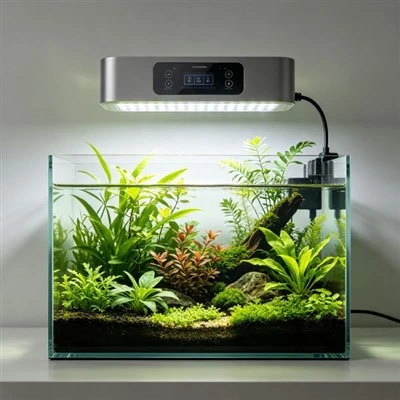
A cylindrical aquarium invites people to walk around it. There is no permanent back panel, and a plant or fish hidden from one chair may be fully visible from the opposite side. That freedom complicates lighting. Curved glass changes apparent position and magnification, reflects windows and viewers at shifting angles, and makes a narrow bright source noticeable from more places. A fixture centered over the opening may create a bright upper core while décor casts vertical shadows below. Planning should therefore begin with real sightlines and service access, not with the rectangular length rules commonly used for conventional tanks.
Measure the aquarium's diameter, water depth, top opening, cover, and any central brace or filter structure. Then sketch the room around it: windows, doors, seats, walking routes, television screens, and ceiling lights. Mark typical eye height for a standing adult, a seated viewer, and children if relevant. The useful field is the portion of the inhabited and planted volume that can be lit safely, not simply the outer circle of glass. Keep the fixture, mount, cable, controller, and power supply within their documented clearances and environmental conditions.
Inspect glare before selecting a permanent orientation. A low-profile bar that looks shielded from one chair may expose individual LEDs to someone on the other side. Curved glass can also reflect the fixture or a bright window as an arc that follows the viewer. Test with a temporary nonpowered mock-up of the fixture dimensions if possible, or hold a cardboard outline at the planned height while another person walks around the tank. Do not suspend or tilt live equipment using an improvised support. Approved shades and mounts are the appropriate tools when glare control is needed.
The aquascape can distribute light more effectively than a pursuit of perfect symmetry. Tall hardscape in the center may block a single overhead source and create a ring of shade, while dense planting on one side changes the field as it grows. Arrange species-appropriate open areas and shelter with stability and maintenance in mind. View the structure from every side before filling, because a cave that is accessible from the front of a rectangular sketch may be sealed against a curved wall. Lighting cannot correct unstable rockwork or a layout that prevents cleaning.
Suppose a round aquarium stands between a dining area and a window. At lunch, the window reflection hides the center from one side; at dinner, the overhead fixture is visible from a low chair on the other. Raising lamp output improves neither problem and makes the pale substrate more glaring. A blind used during direct sun, modest room-light balance in the evening, and an approved glare shield address the two sightlines separately. Walking around after each change confirms that solving one seat has not simply moved the reflection to another.
Coverage should be checked in vertical as well as horizontal terms. Look at the surface, middle, and floor from several directions under a neutral program. Note shadow lines beneath leaves, wood, equipment, and the central mount. If plants have defined light needs, assess the conditions at their actual positions using documented manufacturer data or a consistent measurement method. A controller percentage alone does not state intensity, and a reading at the water surface does not describe the bottom. Changes in water clarity and plant growth should be recorded because they alter the useful field.
The circular water surface does not require a circular fixture, but shape affects how efficiently the field is used. A long bar may extend beyond the opening or concentrate its ends over glass, whereas a compact source may emphasize the center. Multiple sources can reduce some shadows while creating more glare angles, cables, and mounting loads. Compare physical drawings and documented beam information at the intended height. Avoid assuming that a product named for a particular tank diameter covers every depth, aquascape, and plant placement within it.
Photography can reveal problems and create false ones. A phone may brighten a shadowed center automatically, darken the outer ring, or capture the fixture reflection as a white band. Take reference images from marked positions with similar exposure where possible, but confirm every concern by eye and through direct inspection. A visually even photograph is not proof of uniform light, and an uneven photograph is not a calibrated map. Measurements, when needed, should use a suitable instrument and a defined grid rather than image brightness alone.
Mounting deserves conservative treatment. A central pendant or arm can suit the geometry, but only when the ceiling, stand, rim, and hardware are rated and installed for that purpose. A cable should not become a handhold along a walking route, and the fixture must not obstruct the lid or feeding opening. Keep dry components away from splash and condensation. If the aquarium requires frequent top access, rehearse removal of the cover with power disconnected before finalizing the position. A beautiful central alignment is not useful if every water change risks striking the light.
Use a timer and stable settings while evaluating the room. Photograph four marked viewpoints at the same times for a week, including daylight and evening conditions. The goal is not to make all images identical; the curved vessel will always present different reflections and apparent shapes. Look instead for unacceptable glare, areas that cannot be inspected, overheating concerns, and persistent plant shading. Adjust one factor at a time within product limits. Two modest, safely mounted sources may suit some layouts better than one central source, but that choice depends on actual geometry and should not be assumed universally.
A cylinder rewards three-dimensional planning. Measure the opening and depth, map every viewer, manage windows and room light, shape the aquascape with stable sightlines, and protect service access. Choose equipment for documented optics and mounting options rather than an unsupported promise of "360-degree coverage." No overhead lamp can make curved glass behave like an invisible wall or eliminate every shadow from a central structure. A successful arrangement accepts those optical facts and provides a comfortable, inspectable view from the places where daily life actually happens.