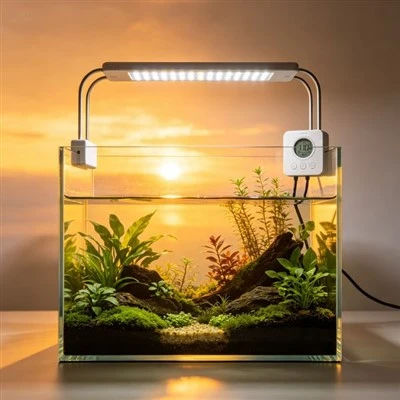
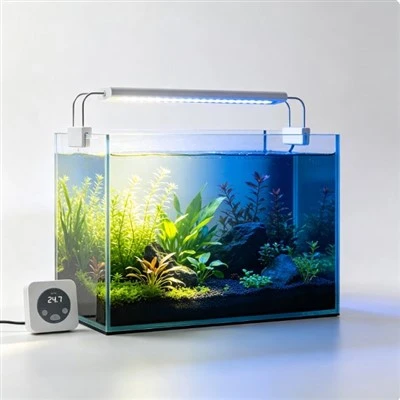
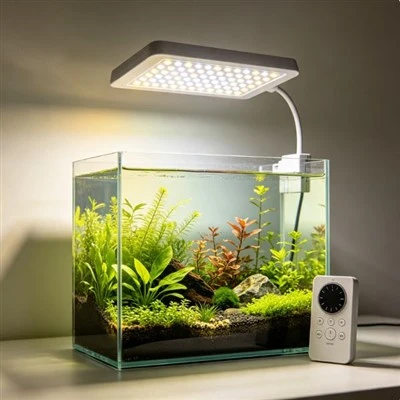
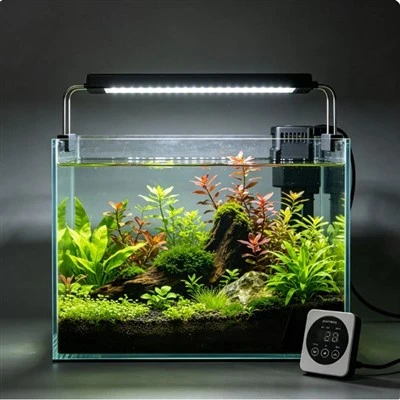
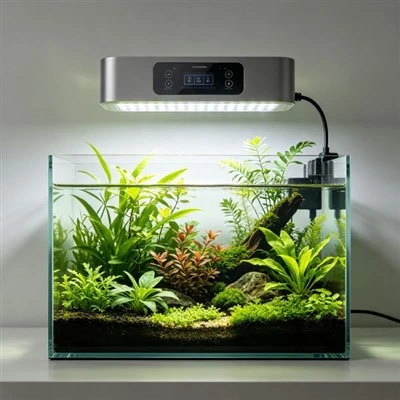
A peninsula aquarium projects outward from a wall, leaving two long faces and one short end open to view. The arrangement can divide a room beautifully, but it gives a light fixture nowhere to hide. A housing shielded from the sofa may expose its LEDs to someone approaching from the kitchen, while a cable routed neatly down one side may cross the view or walkway on the other. Glare control is therefore not a single front-facing adjustment. It is a three-sided study of eye height, room lighting, windows, hardscape, mounting position, and safe access.
Begin with the people who use the room. Mark common seats, standing routes, children's eye level, and any place where someone bends to work or play. Look toward the empty aquarium from each point and note the proposed height of the light. Include reflections from windows, television screens, polished tables, and pale walls. The most troublesome sightline may occur only for twenty minutes at sunset or while a person sits at a dining chair. A quick daytime inspection from the main sofa will miss it.
Fixture orientation changes more than appearance. A bar shifted toward one long face can reduce exposed diodes there while increasing them on the opposite face. Tilting may redirect glare but can also change coverage, mechanical load, and the distance to water. Use only positions and hardware allowed by the manufacturer, and check that the mount fits the aquarium's glass, rim, or support. Never solve glare with a loose homemade flap that blocks cooling vents, absorbs moisture, or can fall into the tank. An approved optical shield is meaningful only when installed as directed.
Hardscape provides visual screening when it remains compatible with the aquarium's biological and maintenance needs. A tall central branch or plant group can interrupt a direct view across the fixture's reflection, while lower edges keep the peninsula open. It should not become an unstable wall assembled purely to hide light. Build rock and wood securely, preserve swimming space, account for growth, and keep tools able to reach all three panes. A layout that looks balanced on day one may create a dark barrier after stem plants reach the surface.
At home, imagine the wall end contains an overflow and all cables exit there. From the living-room side, a low-mounted fixture appears clean and the LEDs are hidden. From a breakfast stool at the open end, however, the viewer looks directly upward into them. Moving the light a few approved millimeters toward the center and fitting the manufacturer's end shield may improve that stool without harming the long view. The household should repeat the walk-through after dark, when the tank becomes the brightest object and reflections change.
Room-light coordination often produces more comfort than reducing aquarium output alone. Closing a blind during direct sun can remove a bright streak on one face. A dim background lamp behind the seated viewer can reduce the contrast of a luminous tank in an otherwise black room. Keep the aquarium's care-appropriate day and dark schedule stable; room lighting should not silently extend the display period all night. Record when each source operates so a glare complaint at 8 p.m. is not blamed on a setting used only at noon.
The useful light footprint should be checked across the tank's width, not just its length. A peninsula is commonly aquascaped to be viewed from both long sides, so plants or habitat at each edge may sit at different angles beneath the fixture. Inspect the surface, middle, and bottom from all faces under a neutral setting. Manufacturer maps are helpful only when mounting height and test conditions are provided. If a measurement tool is used, keep the location and method consistent. Do not increase all channels simply because one hardscape shadow exists near an edge.
Cable routing needs its own plan. Keep cables out of walking paths, prevent them from being pulled during cleaning, and maintain any drip arrangement required by local electrical and product guidance. The wall end often offers the least visible route, but it may also contain wet plumbing and a service door. Label controllers and power supplies and keep dry-location components in a suitable dry area. Reversible cable entry can be valuable, but only if the product is designed to be assembled that way; turning a sealed connector or opening a housing without authorization is not a routing method.
Cleaning reveals why three-sided access matters. Algae, mineral film, and fingerprints scatter light and can create glare that was not present after installation. Clean each viewing panel and any permitted lens or cover surface with compatible methods before redesigning the lighting. Spray cleaners near an open aquarium can contaminate water, and unsuitable solvents may damage plastics or coatings. With power disconnected, inspect the mount, shield, cable, and ventilation openings at the same time. A shifted bracket or dirty cover can explain a new bright line more directly than an electronic fault.
Product evaluation should focus on controllable geometry: documented beam pattern, physical shielding, stable fore-aft adjustment, approved suspension or arm options, and cable exits that suit the service end. No phrase such as "zero glare" can cover every viewer and reflective room. Request dimensions and test images from known distances instead of relying on a single frontal photograph. Verify that any accessory belongs to the exact model and does not compromise cooling or environmental protection. Flexibility is useful when its limits are explicit.
The peninsula becomes comfortable when all three views are treated as real, not when one hero angle is perfected. Walk the room at several times, check seated and standing sightlines, coordinate room reflections, preserve stable hardscape and maintenance access, and route cables safely toward the service end. Make small approved changes and repeat the circuit after each one. Some shadow and reflection will remain because glass, water, and bright sources have physical edges. The aim is controlled glare and a readable habitat from daily positions, not an impossible promise that every angle will look like a studio photograph.