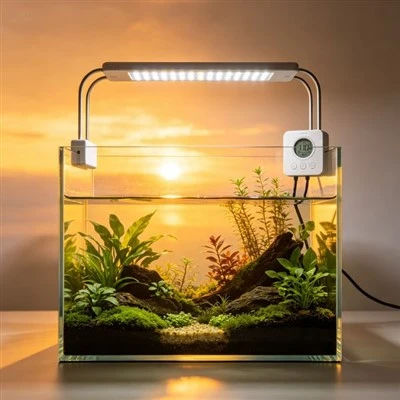
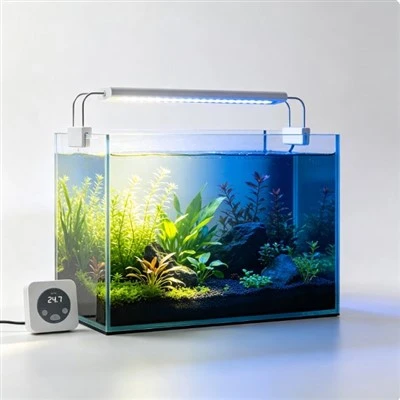
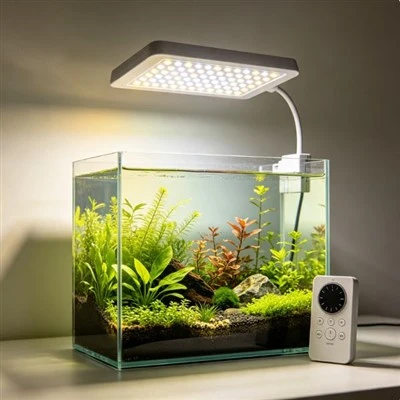
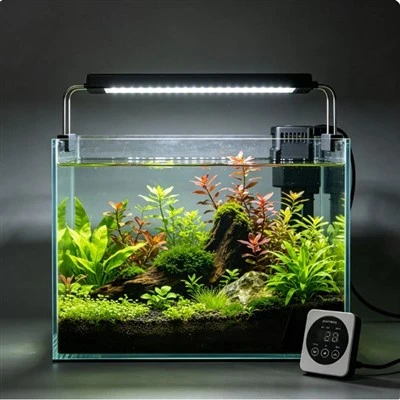
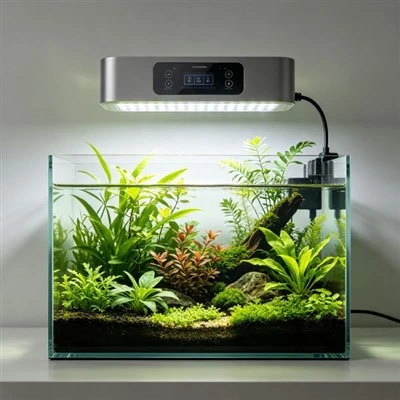
A fish show or community event turns an aquarium into a temporary public installation. The tank, light, cables, mounts, and controls travel to an unfamiliar hall, operate around crowds, and are removed a day or two later. The main risks are not solved by choosing the most theatrical output. Animal welfare, transport, stable mounting, electrical safety, ambient hall light, glare, working access, and a responsible operator matter first. A conservative neutral setting often shows the fish clearly while keeping the setup easier to manage.
Read the venue rules before packing. Record permitted electrical connections, load limits, inspection requirements, opening hours, emergency access, ceiling or stand restrictions, and who may install equipment. Obtain qualified help for any fixed or venue electrical work. The aquarium's own plan should list tank cover, fixture, mount, controller, supply, cables, spare approved parts, and safe isolation point. Label each item so teardown does not mix it with another exhibitor's similar black adapter.
Test the complete kit at home or in the workshop. Assemble the actual stand, tank or safe equivalent, cover, fixture, mount, and cable route in the intended order. Run the event program, verify timer recovery, and rehearse feeding and maintenance access. Do not assume a clamp will fit the venue table or that a suspension point will exist. Any overhead or hanging method must be explicitly approved and professionally suitable; temporary string, tape, and improvised hooks are not acceptable above livestock and visitors.
Hall lighting changes the visual requirement. Bright ceiling fixtures may wash out a low display, while spotlights can create front-glass glare. Visit or request current information about the space, then commission the aquarium after arrival. Start with moderate neutral light and view it from the aisle and staff area. Adjust only within the approved fixture range. Saturated modes can attract attention but may hide natural colour, uneaten food, or condition during inspection. Keep a neutral preset one action away.
Lower electrical input can reduce the heat added by the lighting system, but neutral colour alone does not guarantee a lower temperature. Actual input, fixture efficiency, airflow, room conditions, water volume, and other equipment matter. Monitor the environment through the event's appropriate care plan. Do not advertise a "cool white" setting as physically cooler without measurement. If the hall becomes warm, address the complete holding system and seek experienced guidance instead of relying on colour or brightness adjustments.
Crowd sightlines should not create animal or human risk. A child may look upward into an exposed source, and a visitor may lean on the table or touch a cable. Use controlled beam edges, secure barriers, stable supports, and cable covers required by the venue. Keep power supplies off the floor and away from wet handling. The tank cover must remain secure for species that may jump. Never remove it for a cleaner photograph during public hours.
Assign one operator for the final lighting state. That person knows the normal setting, inspection mode, opening and closing times, fault response, and local shutdown. Other staff should not experiment with app presets for photographs. Post a brief dry-area instruction card and keep the controller accessible only to responsible people. If wireless control fails in a crowded hall, a dependable local method must still turn the light off. The app is not the emergency plan.
Daily darkness can be difficult because venue work lights may remain on before opening or after closing. Ask when the hall truly becomes dark and include that in the aquarium schedule. If the event runs late, avoid leaving the display lit overnight simply because nobody returns to press a button. Verify the timer after setup and after any outage. A short show does not remove the need for a coherent light-dark cycle based on credible care guidance.
Inspect the installation at opening, during operation, and before closing. Check mount movement, cable tension, condensation, splash, heat, timer state, and crowd barriers. Record issues rather than making undocumented changes. Equipment that becomes damaged, wet where it should remain dry, smoking, unusually hot, or emitting a burning smell must be isolated safely and removed from public use. Do not open a fixture or perform an improvised repair in the hall.
Teardown begins only after a named person confirms power isolation and the animal transfer plan. Let components cool as required, dry them through approved methods, inspect for impact or wet exposure, and pack them in labelled protection. Separate damaged parts so they cannot be installed automatically at the next event. Note which cable was too short, which area had glare, and which instruction confused staff. A short after-action record turns one temporary display into a safer future kit.
Products suited to events have clear mounting dimensions, robust labelled components, simple manual controls, known recovery behaviour, accurate input-power data, and documented environmental limits. Their value appears in the setup sequence rather than in an extreme headline number. When the public arrives, the aquarium should look calm and readable, the staff should know who controls it, and every cable and bracket should already have a safe place. Temporary lighting succeeds by being thoroughly prepared, not by looking improvised for one exciting weekend.
Transport protection is part of that preparation. Pack lenses, touch panels, brackets, and cables so they cannot rub or take impact, and keep wet aquarium tools in separate containers. Carry only approved spare mounts, fasteners, and power parts, with labels that match the checklist. On arrival, inspect each item before installation instead of assuming a padded case prevented all damage. On return, update the inventory and replace suspect parts before storage. A repeatable transport process prevents the same fixture from becoming progressively less dependable across a season of short events. Store the completed event report with the kit, so the next operator begins with evidence rather than memory.