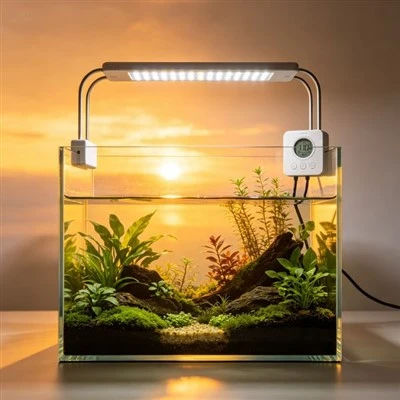
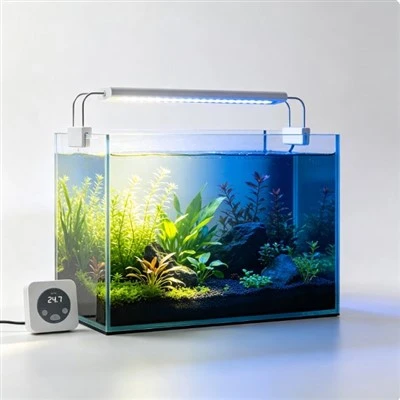
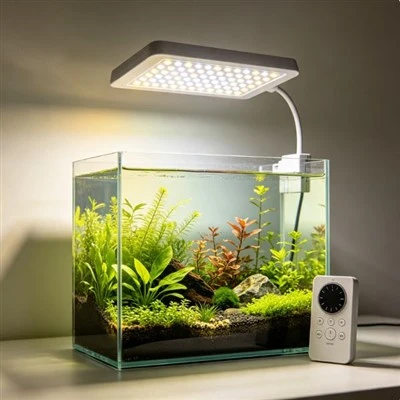
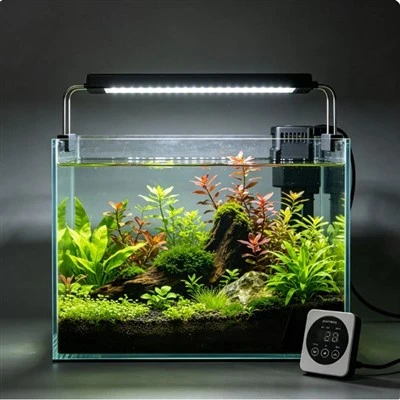
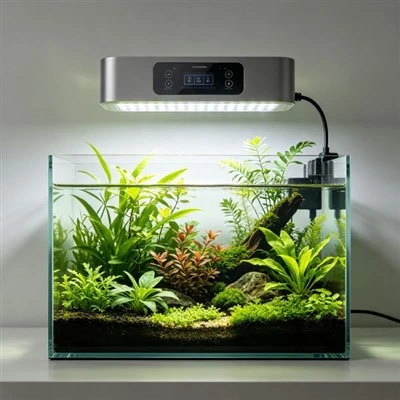
A new aquarium light can arrive feeling almost as cold as the delivery truck that carried it. Bringing that box into a heated home changes the fixture's surroundings much faster than the fixture itself can warm. The first impulse is often to open everything, place the light over the tank, and check whether it works. A short pause is usually the more sensible receiving routine. The concern is not that cold air somehow damages every light. It is that a cold surface entering warm, moisture-laden air can collect condensation, including in places that are difficult to see.
Condensation follows ordinary dew-point physics. The saturation vapor pressure of water rises as air temperature rises. When warm, humid room air meets a sufficiently cold fixture, the nearby air cools; if it reaches its dew point, water condenses on the surface. The same effect appears on eyeglasses when someone walks indoors on a winter day. Metal parts may show visible droplets first, but plastic seams, cable entries, control boxes, and packaging cavities can also be damp. A fixture does not need to have been splashed by aquarium water for moisture to be present after delivery.
Conditions differ enough that a universal waiting time would be misleading. A small package delivered on a mild day may equalize quickly, while a heavy metal housing that spent hours below freezing can take much longer. Indoor humidity matters too. A warm room where cooking, showering, or drying laundry has raised the moisture level presents a different situation from a dry, ventilated room. The manufacturer's receiving and installation instructions should therefore take priority over an improvised number of minutes. If those instructions specify acclimation while sealed or give a minimum temperature range, follow them.
Before opening the package, note whether the carton is crushed, wet, punctured, or unusually cold. Photograph obvious shipping damage before disturbing it, especially if a carrier claim may be needed. Read the supplied instructions and identify which pieces are intended for a dry location. If the maker directs users to leave the product in its sealed bag while it warms, doing so limits contact with humid room air during the coldest period. Do not assume every product uses the same packaging strategy; an instruction written for that exact model is more useful than a general internet rule.
Once opening is appropriate, inspect rather than immediately energizing. Look along the housing, lens, plug, connectors, cable junctions, controller, and external power supply. Moisture may appear as droplets, a misted surface, or dampness inside a clear bag. Check for cracks, loose hardware, bent mounting parts, and damaged insulation at the same time. A dry cloth can remove moisture from an approved exterior surface, but wiping the outside does not prove that an enclosed cavity is dry. If moisture seems to be inside a part that should remain closed, stop and contact the seller or manufacturer.
Consider a January delivery to an apartment kept at 23 degrees Celsius. The carton has been in an unheated van, and the aluminum body feels painfully cold. Within two minutes of opening, a fine film appears on the metal even though the aquarium is across the room. That film is a useful warning, not a cosmetic inconvenience. Leaving the unit disconnected in the room, with the packaging handled as the instructions specify, allows its temperature to approach the room gradually. Power-on belongs after the permitted acclimation period and after the accessible parts are visibly dry.
Trying to accelerate the process can create new problems. A hair dryer can heat one area much faster than another, force humid air toward openings, soften plastics, or exceed a component's intended temperature. Placing the fixture directly on a radiator or heater is equally hard to control. Shaking a cold unit or repeatedly plugging it in to "see if it is fine" provides no useful drying evidence. If the instructions do not describe an assisted warming method, normal room acclimation is the safer default. Suspected internal moisture calls for support, not experimental power cycles.
The receiving area should also be separate from the aquarium's splash zone. It is easier to distinguish delivery condensation from tank water when the inspection happens on a dry table with good neutral light. Keep the plug disconnected, arrange the cable so it cannot fall into water, and wait to install brackets until all parts can be handled securely. For a model with detachable connectors, do not connect or disconnect them while damp. Any gaskets or caps should be left in the condition specified by the maker rather than opened merely to search for moisture.
This simple routine matters to buyers and suppliers alike. Clear packaging labels can state storage limits, acclimation steps, inspection points, and the conditions required before power-on. Product documentation should identify the environmental rating of each component instead of implying that the entire system shares the rating of one part. Approved mounting hardware and replacement parts also reduce guesswork if shipping damage is found. None of that guarantees a trouble-free shipment, but it gives the owner a defensible sequence to follow and useful information to report if support is needed.
The practical rule is to treat temperature and dryness as conditions to verify, not as assumptions based on the room feeling warm. Check the parcel, follow the model-specific instructions, let the equipment acclimate, inspect every accessible component, and energize only when the stated conditions are met. If the product remains unusually cold, shows recurring moisture, or has instructions that are unclear about acclimation, keep it disconnected and ask the manufacturer for model-specific advice. Record the room conditions and photographs so the question can be answered with evidence. A delay of an evening is inconvenient; a rushed test of damp electrical equipment is unnecessary. The aquarium will not benefit from switching on a new lamp a little sooner, while careful receiving preserves both safety and the evidence needed to resolve a damaged delivery.