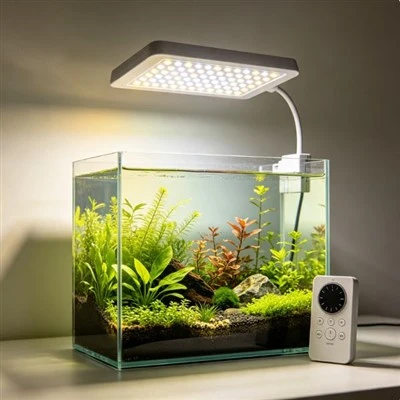
A nano light works correctly when its adapter sits beside the tank, yet it dims, flickers, or resets after the owner adds a long low-voltage extension around a cabinet. The adapter label has not changed, so the cable may seem too simple to matter. Electrically, it matters because every conductor has resistance. When current flows through that resistance, part of the available voltage is lost along the path. The fixture then receives less voltage than the supply produces, and connectors or undersized conductors can add further loss.
The basic relationship is often written as voltage drop equals current multiplied by resistance. That compact expression explains several practical observations. A longer conductor usually has more resistance than a shorter conductor of the same material and cross-section. A smaller conductor generally has more resistance than a larger one of the same length and material. Higher load current produces more drop through the same resistance. Temperature, connector condition, and construction also matter, so cable length alone cannot define a safe extension.
The relevant path is round trip. Current travels from the supply to the load and returns through another conductor, which means the electrical length includes both directions. A socket two metres away may require substantially more than two metres of conductor once the cable descends the stand, forms a safe drip loop, passes through service openings, reaches a controller, and returns within the paired cable. Measuring only the straight line across the room understates both the installation length and the routing needed to keep connectors dry and accessible.
Symptoms depend on the complete system. One light may simply produce less output when its input falls. Another may reset as a controller crosses its minimum operating voltage. A driver may enter protection, and a high-resistance connector can create local heating as well as voltage loss. Dimming level changes current demand, so a cable arrangement that appears stable at a low setting may become unstable at a higher approved setting. None of these patterns proves cable drop without measurement and controlled comparison, but each makes the power path worth checking.
Start by restoring the original approved arrangement. Remove unapproved extensions and splitters, inspect the exterior of cables and connectors after safe disconnection, and test only the normal settings permitted by the instructions. Record the supply model and output rating, cable and connector identity, total routed length, fixture setting, and observed behaviour. If operation returns to normal with the original lead, the extension remains a suspect, but the result still does not authorise a homemade replacement or hidden joint near water.
For engineering evaluation, measure supply voltage and load current with suitable equipment and a defined method, then compare voltage at the relevant points under the same operating condition. The conductor size, material, round-trip length, connector resistance, ambient condition, and steady or changing load should be included. Measurements on energized circuits belong to people with the necessary competence and risk controls. A home user should not pierce insulation, expose conductors, or probe an open supply to obtain a number.
Raising the adapter voltage is not a safe correction. It can expose the light, controller, or driver to excessive voltage when current is low, when the cable is shortened, or when the load changes. Similarly, doubling conductors, splicing unknown cable, or choosing a plug only because it fits can create polarity, current-rating, contact, and moisture problems. The correct solution is an approved cable length or power arrangement whose conductor, connector, load, and voltage-drop limits have been evaluated together.
An everyday cabinet route shows why product drawings help. A nominal one-metre gap from tank to outlet can consume much more cable after the lead travels down the rear, forms a drip loop below the connector, avoids a door hinge, and leaves service slack. A dimensioned drawing lets the buyer check this before installation. It also shows where a controller or detachable joint will sit, which matters because a dry-rated connection should not be left in a splash or condensation path merely to gain reach.
Product information should state the supplied lengths and the reference points used to measure them. If approved extensions exist, the document should identify compatible loads, maximum configuration, conductor specification, connector type, polarity or keying, and any change in available output or control behaviour. A generic statement that a cable is "low voltage" does not establish that every extension is acceptable. Low voltage reduces some hazards, but it does not remove the possibility of overheating, unreliable operation, or damage from incorrect connections.
Distance changes performance only through the physical power path, not by magic. Map that path, count both conductors, include every connection, and compare the original configuration before forming a conclusion. Keep mains adapters and dry-rated joints protected from water, and stop using parts that are loose, discoloured, melted, wet inside, or unusually hot. Once length, current, resistance, and connector condition are documented, a dim remote fixture becomes an engineering problem with testable causes rather than an invitation to increase voltage blindly.
Cable resistance is not set by length alone. Conductor material, cross-sectional area, temperature, strand condition, and connector terminations all contribute. A thin lead and a thicker lead of equal length can produce different drops at the same current, while a damaged crimp can dominate an otherwise adequate cable. Labels based only on one-way distance therefore tell too little. Designers should calculate the expected range, verify it under maximum intended load, and include production tolerances and temperature. They should also check startup and dimming transitions, not just one steady scene. Owners do not need to perform those calculations to act safely: keep the specified power chain, protect it from strain and water, and ask for an approved longer lead whose whole electrical path has been evaluated.