一,Technical principle: The fundamental distinction between semiconductor luminescence and thermal loss management.
The way typical light sources emit light limits their ability to convert energy efficiently:
Fluorescent lamp: The fluorescent powder gives off light by ionizing mercury vapor. It only has a luminous efficiency of 50–70 lumens/watt (lm/W) and needs ballast to start, which uses even more energy. Its spectrum has a lot of non-photosynthetically active radiation, such infrared, which means that about 70% of electrical energy is turned into thermal energy.
A metal halide lamp uses a high-temperature arc to excite metal halides and make them give off light. The luminous efficiency can be as high as 90-140 lm/W, but the working temperature can be over 1000 °C, and more than 60% of the thermal radiation is lost. To keep working, it needs a cooling system.
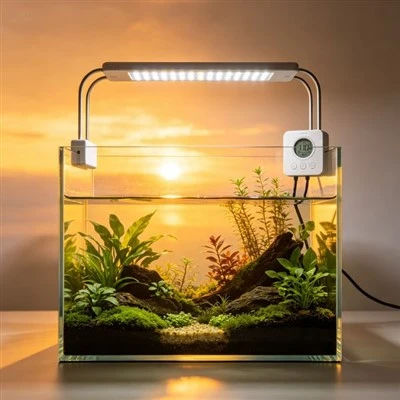
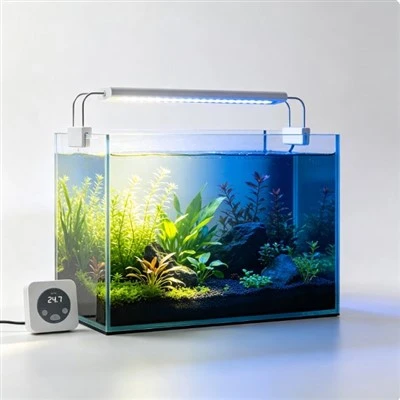
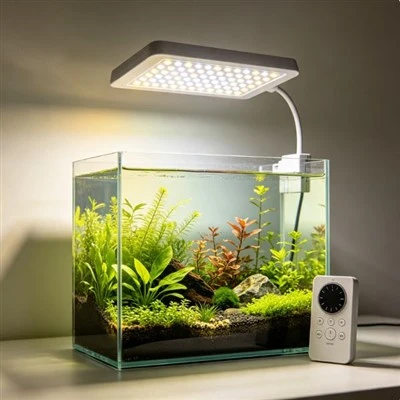
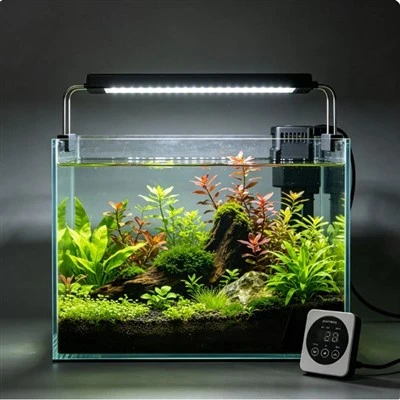
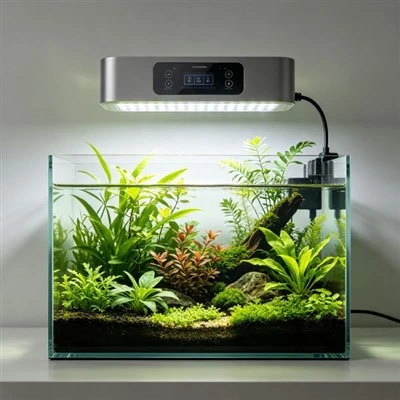
Aquarium Color-Changing Waterproof Lighting emit light directly through electron hole recombination in semiconductor PN junctions, with a light efficiency of up to 50-200 lm/W, and the spectrum may be accurately adjusted to the range of photosynthetically active radiation (PAR, 400-700nm). For instance, the blue light (450nm) and red light (660nm) of a certain brand of LED aquarium light make up more than 80% of the total light output, and the energy use is more than three times higher than that of regular light sources. Also, LED uses DC drive, which means there is no ballast loss, and it only works at temperatures between 40 and 60 degrees Celsius, which cuts down on the costs of thermal management by a lot.
二,Comparison of energy use: a quantitative examination of lab data and real-world situations
1. Differences in how much light a unit gives off and how much energy it uses
For example, if you want to get a PAR value of 1000 μ mol/m ²/s:
Fluorescent lamp: needs about 250W of power and uses 2190 kWh of power each year (based on 12 hours of use per day).
A metal halide lamp needs roughly 150W of power, but it also needs a cooling fan that uses about 20W. The total power use is 1460 kWh/year.
LED lights only use 80W of power and use 700 kWh per year. They use 68% less energy than fluorescent lights and 52% less energy than metal halide lights.
2. Confirming Cases of Factory Farming
The partnership between Dalian Ocean University and shrimp farming companies in Zhangzhou, Fujian Province shows that after installing a custom LED lighting system, the energy use per unit of output went down from 0.8 kWh/kg to 0.3 kWh/kg. This saves more than 120000 yuan a year on electricity bills. The system makes the most of light energy by changing the spectrum dynamically (with blue light as the major source to encourage feeding during the day and red light as the main source to lower stress at night).
3. Family Aquarium Scene
For example, a 60cm × 30cm × 40cm aquarium:
The traditional option is two 40W fluorescent bulbs that use 350 kWh of electricity each year.
LED solution: One 24W full-spectrum LED lamp that uses 105 kWh of power per year and doesn't need to be changed often (the fluorescent lamp lasts roughly 8000 hours, while the LED lasts up to 50000 hours).
三,Lifecycle: A full breakthrough from new materials to system design
1. Differences in how long core materials last
Light bulb with fluorescent light: The filament's evaporation causes the light to fade, and the humid environment speeds up the oxidation of the electrodes, which means that the actual lifespan is cut by more than 30%.
Metal halide lamp: The arc tube turns black, which makes the light less efficient. The lamp lasts about 12000 hours, but switching it on and off often can cut its life in half (the initial surge current is three times the steady-state current).
LED: It is made of wide bandgap semiconductor materials like gallium nitride (GaN) and should last more than 100,000 hours. The actual product lasts longer because of the following design:
Epoxy resin encapsulation keeps moisture and salt from corroding the LED lights. In seawater, IP67 waterproof LED lights can last up to 50,000 hours.
Constant current driving circuit: A certain type of LED aquarium light keeps 90% of its original light intensity after 30000 hours to avoid light loss due to changes in current.
Optimizing heat dissipation: The junction temperature is kept below 60 °C with an aluminum substrate and a fin style heat sink. This is 40 °C lower than with regular light sources.
2. Full Lifecycle Cost Comparison Based on a 10-Year Usage Cycle:
Fluorescent lamp: It costs 600 yuan to maintain the lamp, which means replacing the tube 12 times (50 yuan each time). The whole cost is 22500 yuan, which includes electricity.
LED lights: You don't have to change them, and they only cost 7000 yuan in power, which is only 31% of the cost of the fluorescent light option.
四,Benefits for the environment: Value of pollution control in business and sustainable development
1. Getting rid of the risk of mercury pollution
Each fluorescent lamp has roughly 5 to 10 milligrams of mercury in it. When 1 billion fluorescent lamps are thrown away each year, they release 50 to 100 tons of mercury, which pollutes water and land for a long time. Mercury and lead are not found in LEDs. After being thrown away, valuable metals like silver and gallium may be easily taken apart and reused.
2. Help with cutting down on carbon
For example, in China's aquaculture industry, replacing the current fluorescent lights with LEDs and calculating the annual electricity use at 10 billion kWh would cut carbon dioxide emissions by 8 million tons (0.8 kg/kWh). This is the same as planting 440 million trees for the environment.
3. Design that is good for the environment
Some LED aquarium lights come with photo biosensors that can check the quality of the water in real time and keep the ecosystem in balance by changing the spectrum. For instance, when the amount of algae is more than normal, the automatic increase of red light (660nm) stops algae from reproducing and cuts down on the need for chemical algae removers.