一, Coral survival depends on providing energy for photosynthesis.
A lot of people think that corals are just animals, however most reef-building corals have really created a symbiotic relationship with a tiny single-celled algae called diatoms. Chlorella resides in coral tissue and gives the coral a lot of nutrients through photosynthesis.
Diatoms use photosynthesis to turn carbon dioxide and nutrients in water into organic compounds like sugars, lipids, and amino acids when there is enough light. Corals will use these compounds directly to grow, break down food, and repair tissue. Studies have demonstrated that more than half, or perhaps the majority, of the energy needed by numerous corals is derived by photosynthesis.
This is also why corals in aquariums can stop growing, lose tissue, and even die if they don't get enough light for a long time. , a good lighting system is one of the most important things for coral breeding to work.
二,Changes the colour and beauty of coral
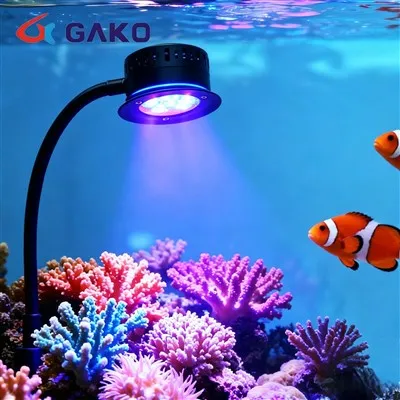
Corals are quite popular in the aquarium lights market because they have really bright colours. Many corals can show vivid colours like fluorescent green, fluorescent blue, purple, orange, and even red when the light is appropriate.
In general, the blue light band is one of the most important spectra. Blue light can make the fluorescent proteins in coral bodies work better, which makes corals look incredibly pretty when they shine in the light. A lot of professional reef lights will increase the blue light ratio to make coral look better in colour.
It's also very vital to have the right amounts of purple light and full-spectrum white light at the same time. Purple light can make the colours of corals stand out more, while white light is more like natural light and helps keep corals healthy overall. If the spectral arrangement isn't right, such not enough blue light or too much white light, it could make the coral colour darker, brown, or slow down the speed at which the colour develops.For players who want their aquarium lights to look well, the lighting system is typically the most important part of the whole thing.
三, Help the process of coral bone formation and calcification
Light not only changes the colour of hard coral, but it also directly affects how quickly the coral grows. Calcification is the process by which hard coral builds its skeleton by constantly adding calcium carbonate.
Diatoms' photosynthesis provides most of the energy needed for calcification. When the aquarium lights bright enough, photosynthesis works better, which gives corals more energy and speeds up the construction of bones.
For instance, soft corals usually need low to moderate light levels, whereas some high-end tiny bony corals need brighter light levels. If the light is too low, bones will grow much more slowly. Too much light exposure can also hurt tissues. So, when making aquarium lights, you need to think about both how the light is spread out and how the colours complement.
四,Set up a consistent circadian rhythm
Corals in the ocean are affected by the sun rising and setting, which creates a biological cycle. Some corals, for instance, only do photosynthesis during the day and then extend their tentacles at night to catch food.
By mimicking fluctuations in natural light, aquarium lights can help corals set up a regular circadian rhythm. Most modern aquarium lighting systems offer the following features:
Make it look like sunrise
The light gets brighter slowly so that the coral doesn't get too much strong light all at once.
The main stage for lighting
Give steady and enough light to help photosynthesis.
Make it look like sunset
As the light steadily faded, the coral slowly began to enter a twilight state.
五, Affects how well corals can adapt and how healthy they are.
Corals really need a stable lighting situation. Corals may become stressed if the light's strength or spectrum fluctuates a lot. For instance, when you suddenly switch to brighter lights, some corals may lose tissue, change colour, or even lose algae.
So, when you change the light fixtures or the brightness of the lights, you usually need to do it slowly, like by lowering the brightness at first and then slowly raising the light intensity so that the coral can become used to the new environment.
The lighting in the aquarium also has a big effect on where you put the corals. In general, corals that need a lot of light are put in the top layer of the aquarium, and corals that need less light are put in the bottom or side portions. This can use the way light fades in water to make a place where different corals can grow.