

一,The main danger of too much light is that it might mess up your circadian cycle and stop the production of melatonin.
Fish, like to humans, depend on circadian cycles to manage physiological functions, and their melatonin release exhibits an inverse relationship with light intensity. The light level on a full moon night is barely 0.3 lux, while on a night with no moon, it is less than 0.001 lux. When the light in the tank stays above 2000 lux, fish make less melatonin, which messes with their sleep cycles. Experiments have demonstrated that sea bass subjected to 5000 lux light for 12 hours exhibit a 63% reduction in melatonin levels and a 41% decline in immunoglobulin concentration relative to their normal habitat, so directly compromising disease resistance.
Too much light and damage to the visual system
Fish retinal cells are sensitive to different amounts of light, but there is a universal level at which light saturation occurs. For example, the dragon fish's retinal cone cells work best when the light is between 1500 and 2500 lux. When the light level goes above 4000 lux, lipid peroxidation events happen in the retinal photoreceptor cells that can't be reversed, which makes it hard to see. High-intensity blue light (450–480nm) can penetrate the cornea and directly harm the retinal pigment epithelium, leading to photokeratitis. Clinical signs encompass recurrent collisions of the fish body with the cylinder wall and erratic swimming patterns.
A rise in oxidative stress and metabolic load
Algae in water can photosynthesize faster when there is a lot of light, which can cause the amount of dissolved oxygen to suddenly rise (up to 15mg/L or more) during the light period. After the lights go off, the amount of algal respiration drops sharply to below 3mg/L. This daily change in dissolved oxygen levels makes fish constantly modify their metabolic rate to keep up with changes in their environment. This causes reactive oxygen species (ROS) to build up. Studies indicate that prolonged exposure to 6000 lux of light in koi carp causes a 58% reduction in liver superoxide dismutase (SOD) activity relative to the control group, along with the accumulation of the lipid peroxidation byproduct malondialdehyde (MDA) in gill tissue, ultimately resulting in necrosis of gill filaments.
二,Common signs and symptoms of too much light intensity
Signs of Unusual Behavior
More likely to get darker: Fish that used to be active in the upper and middle strata, including lanternfish and peacock fish, have been hidden under the shadow of sunken trees and aquatic plants for a long time.
Less effective feeding: Carnivorous fish, such dragonfish and map fish, don't react quickly when they are fed, which lowers their predation success rate by more than 30%.
Color of the body that is not normal: Red fish, including blood parrots and red devils, have dark bodies and too many melanocytes, which makes them look like they have "black spot disease."
Signs of physical damage
Gill lesions: Gill filaments swelling, too much mucus secretion, apparent fusion of gill pieces, and shedding of epithelial cells under a microscope
Epidermal injury: Bleeding or ulcers that look like dots form on the skin, mainly on the abdomen and the base of the fin.
Problems with reproduction: Female fish's ovaries stop growing, male fish's testes shrink, and the rate at which fertilized eggs hatch drops below 40%.
Imbalance in the Environment How well it works
Algae are getting out of hand: When there is a lot of light, green algae grow very quickly, and the pH of the water can rise by 0.8 units in 24 hours.
Microbial imbalance: The action of nitrifying bacteria is stopped, and the amount of ammonia nitrogen goes from 0.2 mg/L to 1.5 mg/L in under 48 hours.
Substrate degradation: The substrate sand turns black and smells bad because organic matter breaks down faster. The amount of hydrogen sulfide in the air is more than the permissible level of 0.01mg/L. 3. A scientific control scheme for light intensity
Standards for light intensity that are specific to each species
Based on the lighting conditions in their natural habitat, fish can be classified into three groups:
Type shows the best range of light intensity for species and the best light source.
8000–10000 lux of bright light is good for zebrafish and minnows in shallow water. Lamp with 10,000K metal halide
Fairy Fish and Lotus Lamp for Forest Scattering 3000 to 5000 lux LED Gradient Lighting System with Adjustable Settings
Bottom-dwelling, low-light rat fish and irregular fish (less than 500 lux) LED light with a warm 2700K color and a shading board
System for Managing Dynamic Lighting
Method for segmented lighting: Using a cycle of "3 hours of strong light (4000 lux), 4 hours of medium light (2500 lux), 3 hours of weak light (1000 lux), and 2 hours of darkness" to mimic how the light changes in the Amazon Basin in the morning and evening
Control that is intelligent in the spectrum: Connected to the spectrometer via an app, it can monitor the PAR value (photosynthetically active radiation) in real time and automatically change the ratio of red light (630–660 nm) to blue light (450–470 nm) to 3:1.
Emergency reaction system: If the sensor senses an unusual rise in light intensity (like a lighting fixture that isn't working), the backup sunshade will turn on within 30 seconds, and the alarm system will go off.
Technology for environmental compensation
Light attenuation compensation: If the water in an aquarium is more than 50 cm deep, the light intensity needs to be raised by 15% for every 10 cm of depth. Alternatively, a convex lens can be used to focus the light.
Improving the structure of shading: Use a black acrylic shading board to keep the light reflectance below 8%. To change the light intensity in a specific area, use a magnetic shading curtain.
Layer of biological shading: Adding black shell shrimp or planting water plants that can handle shade, including Ficus microcarpa and Iron Crown, can cut down on light by 20–30%.
Standards for Taking Care of Equipment
Cleaning cycle for lamps: Every two weeks, wipe the lampshade with a very fine fiber cloth. Every three months, clean the heat dissipation fins extremely well to keep dust from building up and making the light less effective.
Finding the ballast: To make sure that the harmonic distortion rate is less than 5% and to keep fish from getting stressed out by flicker, check the output waveform with an oscilloscope every month.
Every six months, use a laser level to change the angle of the reflecting plate so that the light is focused on the middle layer of the water and the pollution of reflected light on the cylinder wall is lessened.
三,Examples of how the industry uses it
Aquarium Smart Reef Led Tank Fix
The Shanghai Aquarium has an intelligent dimming system that uses 12 sets of LED modules that can be controlled separately. These modules provide channels for 420nm violet, 450nm blue, and 6500K white light.
In daytime mode, the light stays at 500 μ mol/m ²/s from 10:00 to 14:00, which is when coral symbiotic algae do their photosynthesis.
Mode for twilight: Change to 2700K warm light at the time when fish are looking for food (18:00–20:00), and the light intensity reduces to 150 μ mol/m ²/s.
Mode for the night: The moonlight simulation time (22:00–6:00) lets in 450nm blue light and lets you set the light level to 0.5 lux.
Examples of Remodeling Your Home Aquarium
A player in Beijing changed a regular T5 light tube to a full-spectrum LED, but ran into problems like peacock fish fading and water grass melting leaves. Fix by making the following changes:
To lower the peak light intensity from 8500 lux to 4200 lux, put in a light intensity sensor.
Add a timer so that the light goes through a cycle of "6 hours of strong light, 4 hours of dimming, and 2 hours of darkness."
Put a matte film on the wall of the cylinder to cut the amount of light that bounces off it from 1200 lux to 350 lux.
After the change, fish ate 25% more food, and the development rate of aquatic vegetation went back to normal.
What kind of pressure or damage can the intensity of aquarium lamps cause to fish? How to avoid it?
Popular Products
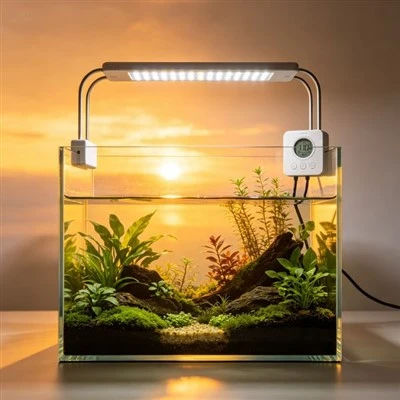
LED Aquarium Light With Sunrise And Sunset Timer
The LED Aquarium Light with Sunrise and Sunset Timer is a 24-hour programmable aquatic lighting fixture equipped with a
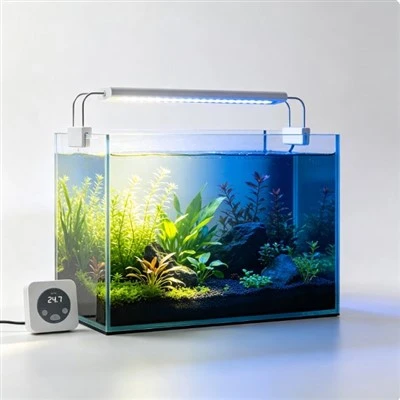
24/7 LED Aquarium Light With Timer
The 24/7 LED Aquarium Light with Integrated Timer provides automated full-spectrum lighting for freshwater
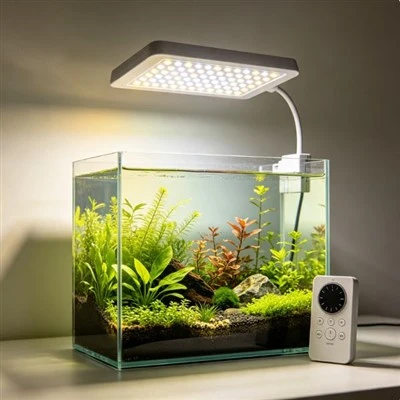
Dimmable LED Aquarium Light With Timer
The Dimmable LED Aquarium Light with Built-in Timer is an engineered freshwater LED fixture that combines full-spectrum
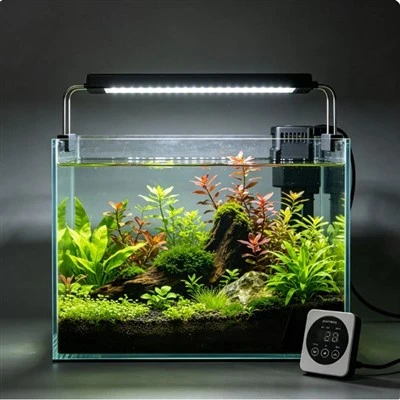
LED Aquarium Light With Memory Timer
This full-spectrum LED fixture provides controlled illumination for freshwater planted systems and fish-only aquariums.
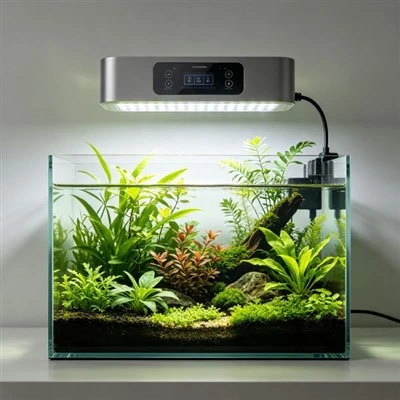
Programmable LED Aquarium Light With Timer
This series provides full-spectrum lighting for freshwater environments, featuring an integrated digital controller for

LED Aquarium Light With Digital Timer
This fresh-water LED aquarium light combines full-spectrum diodes with an integrated digital timer to simplify aquatic