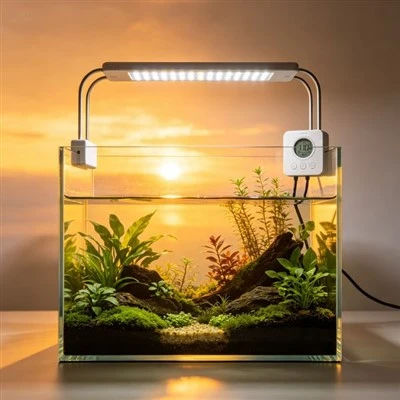
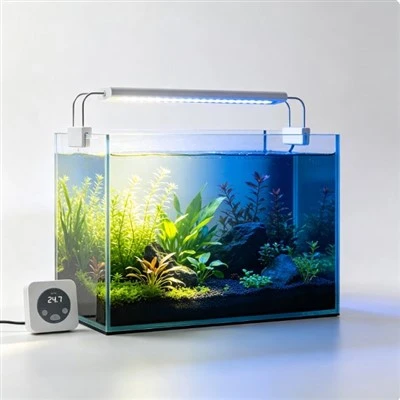
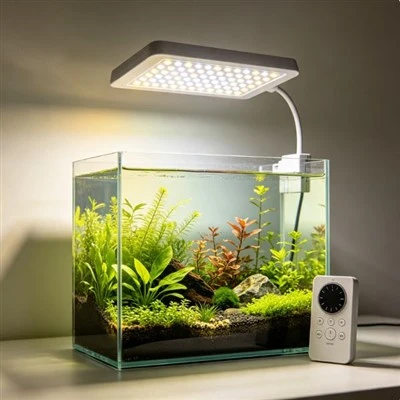
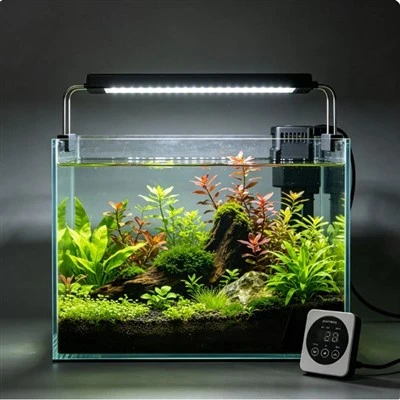
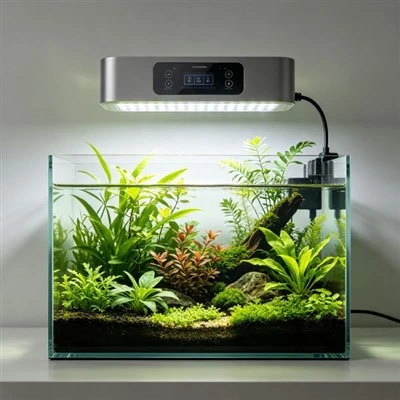
Aquarium water can turn blue, green, amber, or another colour during a prescribed treatment. When that happens, familiar décor may look wrong and the lamp may seem weaker or shifted in colour. The change is not automatically a fixture fault. Coloured compounds can absorb some wavelengths more than others and allow others to pass, changing both visibility and the viewer's impression. Lighting should be kept as a stable observation tool while treatment decisions follow the product label, the animal's condition, and qualified advice. It should never be adjusted as though brightness could prove that medication is working.
Before treatment begins, make a short neutral-light record if time and the situation allow. Note the fixture program, room lights, water clarity, visible colour, and normal viewing position. Photograph only if it can be done without delaying care, and keep exposure and white balance fixed. Once medication is added, record the dose time and observed water colour exactly as the instructions permit. A comparison made this way can show that the water's appearance changed while the lamp setting remained constant. It cannot measure treatment success or replace examination of the animals.
The optical effect is easiest to see with familiar objects. A blue treatment may make a red ornament look dull, while pale gravel appears unusually cool. The red object has not necessarily faded, and the LEDs have not necessarily lost output. The coloured water altered what reached the object and what returned to the eye. Depth also matters: a short path near the front glass can look less affected than a long path to the rear. Comparing a fixture through treated water with one shining through air is therefore not a fair test of the light.
Use one repeatable neutral inspection setting during the treatment period. It should be sufficient to observe swimming, breathing, body condition, food, and waste without becoming a new all-day high-output program. Check at the times required by the treatment and husbandry plan. If an animal worsens, follow the label's response instructions and contact an appropriate professional. Do not add intense light in an effort to "see through" the colour; that changes another environmental variable and may still fail to reveal the relevant detail.
Camera processing can create a second layer of confusion. Automatic white balance often tries to remove a strong colour cast, making the water look clearer or a different shade in successive images. Exposure may rise when the scene becomes darker, falsely suggesting that the lamp became brighter. Lock the available controls and include a known neutral object outside the treated water when making a technical record. Do not use a corrected social-media photograph to judge the medicine concentration. The image shows a processed appearance, not a laboratory analysis.
Follow every instruction about filtration and media. Some treatment labels specify whether adsorbent material such as activated carbon should be removed or restored, and those directions are part of the treatment-not a lighting choice. Do not remove, add, or change media simply because the water colour is visually inconvenient. Likewise, never redose based on how saturated the aquarium looks. Actual volume, label directions, timing, and professional guidance govern dosing. The lamp cannot determine concentration by eye.
The daily light-dark cycle should remain stable unless credible care or treatment instructions require otherwise. Treatment already changes the system; unnecessary changes in duration, intensity, and colour make observations harder to interpret. Record any unavoidable adjustment. A real dark period also makes it easier to compare animal condition at consistent points rather than leaving inspection light on all night. If the aquarium must be monitored after hours, use only the brief light and method recommended for the actual situation.
Water colour may change as the treatment period progresses. That shift can involve dilution, breakdown, filtration, water changes, or interactions specified by the product, but appearance alone does not explain which. Note the time, water actions, and label-directed steps. Compare from the same angle under the same light. If colour clears after an instructed water change, do not report that the LEDs recovered. If it remains, do not assume the fixture is failing. Keep the electrical and treatment records separate so each can be evaluated properly.
Normal installation safety still applies. Keep controllers, plugs, and power supplies away from wet work, and disconnect equipment as directed before reaching into the aquarium. Treatment spills should be cleaned according to both medication and fixture instructions; do not spray cleaner onto a lamp or control. If coloured solution reaches a dry-only electrical part, keep it de-energized and obtain service advice; smoke, odour, or excess heat requires the same cautious response. An urgent animal-care situation is not a reason to handle mains connections with wet hands.
After the prescribed course and associated water changes are complete, return to the original neutral setting before judging the fixture. Confirm that room light, mounting position, and camera controls match the baseline. A gradual restoration of normal-looking colours supports the explanation that the water changed the view; it does not validate the treatment medically. Continue to assess the animal through the required care process. If the light still appears abnormal in a safe dry comparison, then investigate its program, supply, and technical condition.
A neutral inspection preset is the most relevant lighting feature here because it creates continuity through a visually confusing period. Saved settings, clear controls, and a reliable timer help the owner avoid accidental changes. Product instructions should explain colour modes without implying diagnostic ability. The responsible conclusion is simple: tinted water can strongly alter appearance, while the lamp remains only one part of the observation setup. Treatment is judged by correct medical or husbandry evidence, not by how bright a decoration appears.
Keep the medication packaging or an exact label record with the aquarium log until the course and follow-up are complete. If technical support is asked about a colour change, provide the product name, timing, water actions, and unchanged lamp program. That context prevents an optical question from being separated from the treatment that created it.