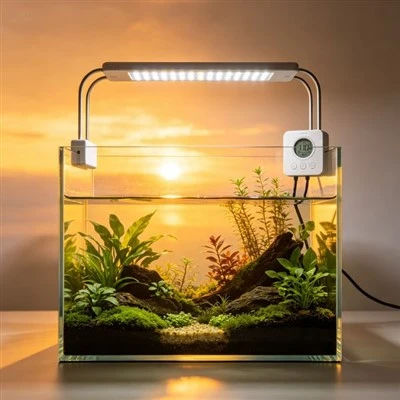
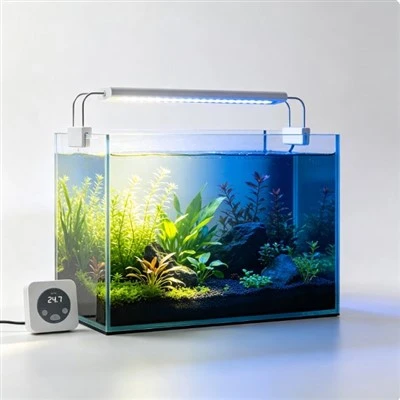
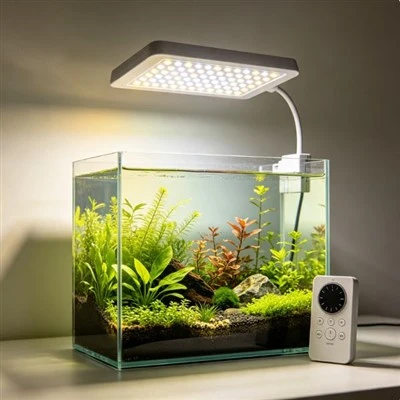
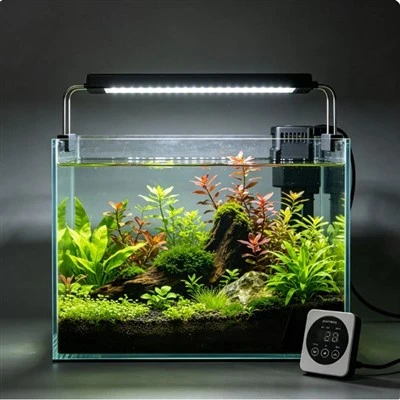
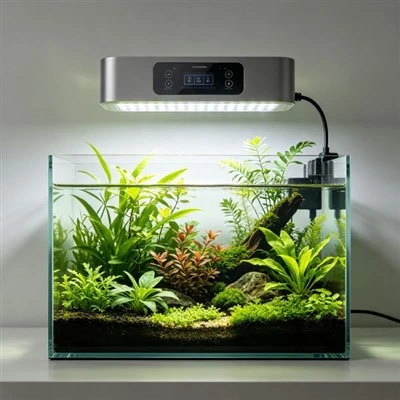
A divider may split one glass box into two living spaces, but it also splits the way light travels. Clear sheet, frosted plastic, mesh, perforated panel, plant mat, and opaque partition each transmit, scatter, or block light differently. Deposits and algae can change them further. A fixture centered over the outer aquarium may therefore produce a bright compartment, a shaded strip, and reflections that did not exist before division. Treating the tank as one rectangle with one average setting overlooks the actual fields on either side.
The first job is not lighting; it is confirming that divided housing is appropriate. Species compatibility, visual separation, water volume, circulation, temperature, filtration, escape routes, and the security of the divider require reliable husbandry guidance. A transparent partition can stop physical contact while allowing continuous sight of another animal, which may or may not meet the intended purpose. An opaque panel may provide visual separation but restrict flow. More light cannot correct an unsuitable social arrangement or compensate for poorly exchanged water.
Document the divider itself. Note material, color, thickness, hole or mesh size, height, distance from the cover, attachment method, and whether water or animals can pass around the edges. Check that it is aquarium-safe and installed securely without damaging the tank. Photograph it clean, then inspect how biofilm, mineral deposits, scratches, or plant growth alter visibility over time. "Clear" does not mean optically absent, especially when light strikes at an angle or two compartments have different backgrounds.
Map both sides independently. At several points in the normal light program, view each compartment from the front and above where safe. Mark direct bright areas, divider shadows, surface cover, hardscape shade, and glare from the opposite side. If live plants are present, consider their actual positions and requirements rather than applying one controller percentage as a universal measurement. Keep the fixture height and room light recorded. A reading taken through the divider cannot be assumed to match one taken on the unobstructed side.
Pay attention to the upper edge. A divider that stops below the water surface may allow animals to cross, while one that reaches the lid can interfere with feeding openings, braces, or light mounts. A narrow gap above an opaque panel may spill light into the opposite compartment and produce a bright stripe without providing useful coverage lower down. Do not extend the divider with unknown plastic or attach it to the fixture. Resolve escape prevention and separation with components designed for the aquarium, maintaining ventilation and service clearance.
For example, an opaque black divider sits beneath the center of a long bar light. One compartment contains tall stems, while the other has low décor and a pale floor. The divider creates a dark vertical band, and the pale side looks much brighter to the viewer. Raising every channel makes the open floor glare but does little to illuminate directly behind the opaque panel. Shifting approved coverage toward the useful areas or using two modest independently controlled fixtures may address genuinely different layouts, provided mounting and electrical requirements are satisfied.
Circulation must be checked after every divider or lighting-related rearrangement. A partition can create a low-flow pocket where food and debris collect, and moving plants to correct shade can block openings further. Observe water movement, verify temperature on both sides when relevant, and test water according to the husbandry plan. Do not infer equal conditions merely because both compartments share a filter. Likewise, do not treat a dim area as proof of poor water. Light reveals some debris; it does not measure dissolved waste or oxygen.
Different lighting schedules may seem attractive when the compartments contain different plants or shelter arrangements, but the animals still share a room and may share water. Spill from one side can reach the other through the divider or across the surface, so "off" on one controller may not create darkness there. Map the combined schedule and preserve a suitable dark period. If the inhabitants genuinely require incompatible environments, independent dimming is not a complete solution; the housing plan itself should be reviewed with species-appropriate guidance.
Inspection routines should respect both compartments. Use a brief neutral setting to identify animals, leftover food, plant damage, and divider gaps, then restore the stable program. Watch feeding access separately on each side and keep tools from transferring contaminants where quarantine or isolation procedures require separation. If the divider is part of disease management, obtain professional guidance; shared water may defeat the purpose regardless of visual separation. Lighting claims should never imply that a colored channel sterilizes the divider or prevents transmission.
Cleaning can change transmission enough to look like an electronic adjustment. A frosted panel coated with algae may become more opaque, while wiping a clear sheet can suddenly brighten the neighboring side. Clean only with aquarium-safe methods and avoid scratching surfaces that depend on clarity. Record the condition of the panel when comparing settings. If the divider must be removed, secure the animals appropriately and preserve filtration and temperature; do not lift it casually while a fixture or cable obstructs the opening.
The best equipment choice follows the two real fields. A single fixture may work when the divider is highly transmissive and the layouts are similar; separate controllable sources may be more practical when the partition is opaque or the habitats genuinely differ. Neither solution is automatically superior. Compare documented coverage, mounting clearance, cable routing, heat, service access, and failure behavior. Ensure that every fixture remains independently secure and that removing the divider cannot pull or destabilize its mount. Then observe each side over time. A divided aquarium succeeds when husbandry, flow, and visibility are designed for both spaces, not when one brightness number is forced across a barrier.