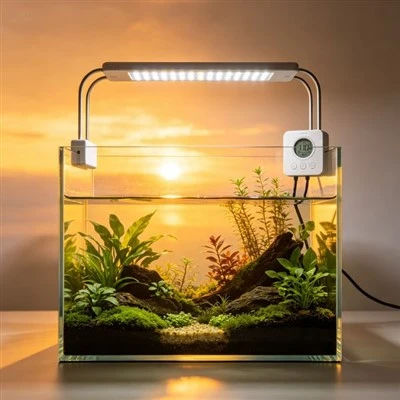
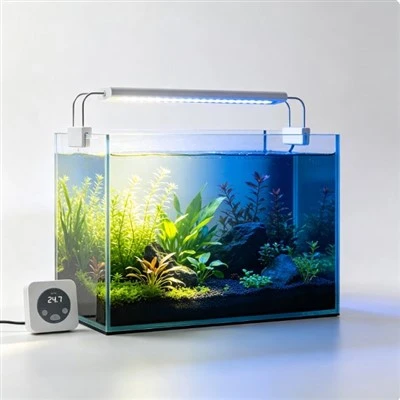
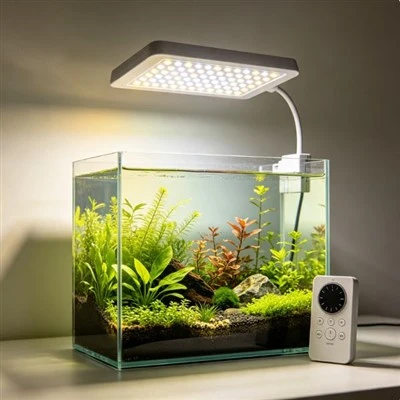
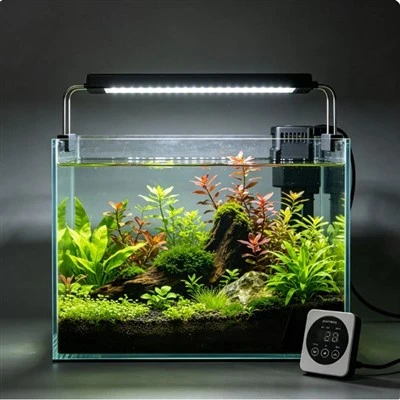
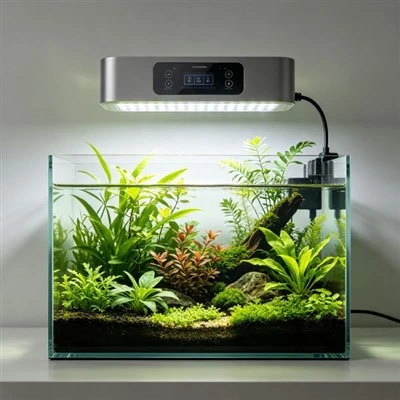
A kitchen aquarium can be part of everyday family life: someone makes coffee beside it in the morning, sunlight crosses the room at noon, and ceiling lights come on during dinner. The same location also exposes the display to conditions that are uncommon in a quiet living room. Steam raises local humidity, cooking releases fine grease particles, and activity around sinks and counters increases splash risk. None of these facts automatically makes a kitchen unsuitable, but they make placement, inspection, and cleaning more important than simply choosing a brighter aquarium light.
Start by mapping the room rather than judging the empty counter. Note the hob, oven vent, kettle, sink, dishwasher outlet, opening windows, and the route used to carry hot pans. Observe where steam travels when the extractor is running and when it is not. A corner that seems dry at lunchtime may receive a warm plume every evening. The aquarium, its light, controller, power supply, and connectors need the clearances and environment specified for those components. Calling the lamp "for aquariums" does not mean every electrical part belongs in spray or cooking vapor.
Grease behaves differently from an obvious water splash. Tiny airborne droplets can settle gradually on the lens, housing, lid, cables, and nearby wall. Mixed with dust, the film may become sticky and surprisingly difficult to see. It can reduce the amount of light reaching the aquarium or scatter light toward the viewer. If a formerly crisp display looks dull, LED aging is only one possible explanation; a dirty cover glass or lens may be responsible. Inspection under room light, with the equipment disconnected, helps separate surface residue from an output problem.
Cleaning should follow the fixture and tank-cover instructions. A soft cloth and an approved solution may be sufficient for some surfaces, while other materials have special restrictions. Household degreasers can contain solvents, fragrances, or surfactants that are unsuitable near aquarium water or incompatible with plastics and coatings. Spraying cleaner directly toward a mounted fixture also encourages liquid to enter seams. Disconnect power, remove a part only as permitted, apply the approved cleaner to the cloth when directed, and prevent residue or drips from reaching the tank.
Changing room light adds another layer. An east-facing kitchen may fill with sun during breakfast and become dim by late afternoon. Under-cabinet strips and pendant lamps can extend the apparent day after the aquarium timer turns off. Direct sun may create bright patches, reflections, or extra heat even though the aquarium fixture has not changed. For a week, record when sun reaches the glass, when room lights operate, and when the display lamp runs. The combined pattern is more useful than treating the aquarium timer as the tank's only light exposure.
Consider a small planted tank placed two meters from the stove. Its owner raises the fixture intensity because the water looks yellow and the plants seem less vivid. On cleaning day, a brown-gray film comes off the glass lid, and the view becomes clearer without changing the program. In this case, the apparent dimness was partly a maintenance issue. The lesson is not that every dim kitchen tank is dirty. It is to check the optical path-lens, cover, condensation, and room reflections-before concluding that the light source has lost performance.
Ventilation can reduce cooking moisture and airborne residue, but it should not be treated as a protective rating. An extractor may be off, undersized, or unable to capture steam from a kettle elsewhere on the counter. Airflow can also move vapor toward the aquarium instead of away from it. Keep dry-location connectors and power supplies where splashes and condensation are not expected, form cables according to electrical and manufacturer guidance, and avoid a socket likely to be reached by wet hands. Local electrical requirements should be followed, especially near sinks.
Routine checks fit naturally into kitchen habits. While wiping the surrounding counter, look for droplets on the housing, residue on the cover, cable damage, blocked ventilation openings, and a mount that has shifted. Confirm that salt or mineral deposits have not bridged a seam. Watch water temperature during heavy cooking periods because room heat and direct sun can change it, though the amount will vary with aquarium size and location. If an electrical component has become wet contrary to its instructions, disconnect safely if possible and seek qualified guidance rather than testing it repeatedly.
Product selection is easier when specifications are precise. A cleanable housing, documented environmental limits, approved mounting options, replaceable external parts, and clear instructions are practical advantages in a demanding room. Check whether stated protection applies to the fixture only or also to the controller, connectors, and power supply. Verify that cleaning access does not require moving the aquarium and that the mount leaves room to remove a lid. No feature eliminates the need for sensible placement; even a well-documented product should not be installed closer to steam or splash than permitted.
A successful kitchen aquarium is managed as part of the room, not as an isolated glass box. Keep it away from predictable steam and grease sources, include daylight and household lighting in the schedule, clean only by approved methods, and inspect the whole electrical path. Reassess the location when a new kettle, extractor, blind, or under-cabinet lamp changes the environment; placement that worked last year may no longer receive the same vapor or light. A dated photograph from the main viewing position can also reveal slowly accumulating film that is easy to miss from day to day. When the display changes, look first for ordinary causes such as residue, condensation, or a shifted room-light pattern. These small observations protect the equipment and make lighting decisions more accurate, while allowing the aquarium to remain where people can enjoy it during real daily routines.