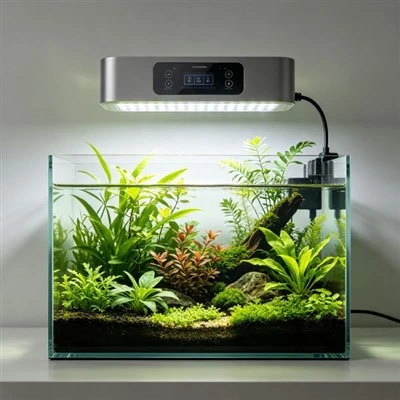
Seeing fish remain close to the surface can make an owner look immediately at the aquarium light. The upper water may appear calmer, brighter, or warmer, and changing intensity is an easy action. Surface position, however, is not a diagnosis. Fish may use the top because of normal species habits, feeding routines, social interactions, water flow, temperature, available oxygen, water-quality problems, irritation, or illness. The priority is to notice whether there are warning signs and to check life-support conditions before spending valuable time testing colors and brightness.
Breathing pattern provides more useful context than position alone. Look for rapid or labored gill movement, repeated gulping, loss of balance, unusual stillness, clamped fins, or multiple fish changing at once. Observe from a short distance so an approaching person or food container does not alter the scene. Some surface-oriented species routinely occupy the upper zone, and fish commonly rise around feeding time. A sudden change affecting normally midwater or bottom-dwelling fish deserves greater attention, especially when it coincides with abnormal respiration or recent equipment trouble.
Check the basic system promptly. Is the filter running and moving water as expected? Is surface agitation present if the setup depends on it? Has an air pump stopped, a hose kinked, or an intake become blocked? Measure water temperature with a dependable thermometer because warmer water generally holds less dissolved oxygen and also changes metabolism. Test relevant water parameters with suitable kits used according to their instructions. Ammonia or nitrite problems cannot be ruled out by clear water, and a light adjustment does not correct them.
Imagine arriving home to find several fish grouped beside the outlet and breathing quickly. The lamp has been on at its normal setting, so dimming it may make the scene look calmer without addressing the shared cause. Inspection reveals that the filter impeller stopped after maintenance and surface movement is minimal. Restoring life support safely and checking water conditions are rational responses; waiting an hour to compare blue and white channels is not. This example does not prove every surface gathering means low oxygen or filter failure. It shows why equipment checks come first.
Recent events help narrow the possibilities. Record a water change, new livestock, medication used under professional guidance, a power interruption, unusually warm weather, excess feeding, filter cleaning, or aerosol use near the tank. Note whether all species are affected, whether the change happens only at meals, and whether it continues after the room becomes quiet. Compare current readings with the aquarium's established range rather than relying on one generic number. If a test result is unexpected, repeat it carefully and confirm that the reagent or sensor is in usable condition.
Lighting can still influence how fish distribute themselves. A sudden transition, strong reflection, lack of shelter, or bright contrast between the tank and room may change use of space. Yet those explanations should be explored after urgent water and respiratory concerns have been assessed. Keep the existing program stable while observing, unless an electrical or heat problem requires it to be switched off. A neutral inspection setting can improve visibility for a few minutes. Avoid making several channel, flow, feeding, and décor changes together, because the response becomes impossible to interpret.
If tests indicate a water-quality problem, follow reliable husbandry guidance appropriate to the species and situation. Corrective steps can differ, and careless large changes may create additional temperature or chemistry stress. When fish show severe respiratory distress, loss of equilibrium, injury, or a rapidly worsening pattern, contact an aquatic veterinarian or experienced qualified source promptly. Photographs, a short video, measured temperature, test results, stocking details, and a list of recent changes are more useful to that person than the statement that the fish "did not like the light."
The physical layout deserves review once immediate risks are controlled. Confirm that flow reaches more than one corner, that surface access is not completely blocked by plants or a tight cover, and that species-appropriate shelter exists below. Observe whether dominant individuals are excluding others from safer areas. Review stocking and compatibility rather than assuming a different spectrum will resolve crowding. Aquarium lights can make a tank easier to inspect, but they do not supply circulation, remove nitrogen waste, or replace an environment suited to the animals being kept.
A simple log prevents memory from reshaping the story. Write down the clock time, lamp stage, room temperature, water temperature, test readings, filter operation, feeding time, breathing rate as observed, and which fish occupy the surface. A pattern that appears only just before food is very different from a sudden all-day change after a power cut. The log also helps reveal whether a lighting change truly preceded the behavior or was made afterward. Use descriptive observations rather than labels such as "happy," "stressed," or "oxygen-starved" that already assume a cause.
The safest conclusion is deliberately modest: surface position is a clue, not a verdict on brightness. Observe respiration, verify filtration and water movement, measure temperature and water quality, review recent events, and seek help when warning signs are present. If only one individual is affected, do not dismiss the situation merely because the others appear normal; injury, social exclusion, or illness may still require informed attention. If the whole aquarium changes at once, prioritize shared environmental causes and recent system events. Continue observing after any corrective action and document whether respiration and distribution actually change. A calm appearance after dimming should never be treated as proof that the underlying condition is resolved. Only then evaluate whether glare, transitions, or habitat lighting contribute to the pattern. This order protects the fish from delays caused by an attractive but weak explanation. A dimmer button is convenient; careful observation and functioning life support are what turn that first clue into responsible action.