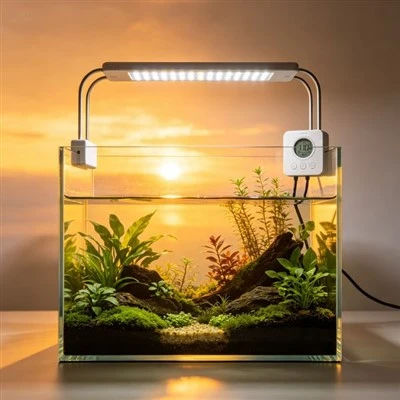
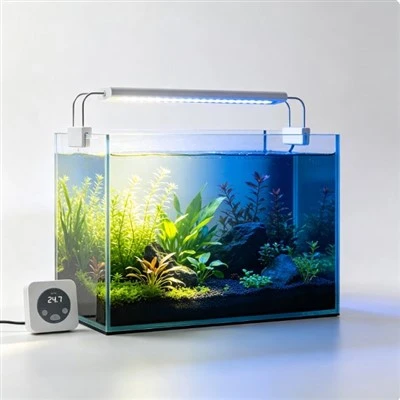
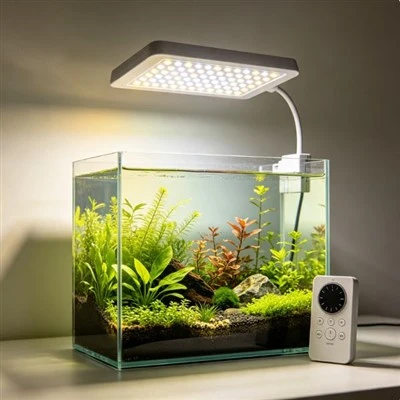
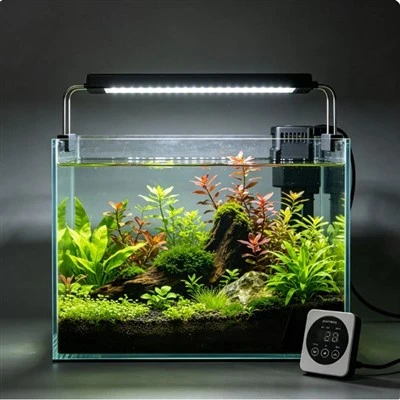
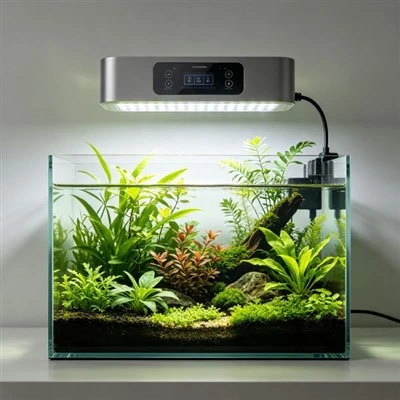
A wooden canopy can make an aquarium look like a finished piece of furniture, but it also changes the lamp's operating environment. Heat that would rise into the room may collect around the fixture, humidity can linger after evaporation, and cables or vents become hidden from daily view. A lamp that operates normally in open air may run much warmer once enclosed. The first question is therefore not how to hide the light completely. It is whether the fixture is approved for the proposed enclosure and whether the canopy provides the ventilation, clearance, moisture control, and service access specified by the manufacturers.
Document the cavity before installing anything. Measure internal length, width, and height; locate existing vents, fans, openings, braces, and feeding doors; and record the room's highest expected ambient temperature. Mark where spray or condensation appears during normal operation. Compare these facts with the light's permitted ambient range, mounting orientation, clearance, and enclosure instructions. "LED runs cool" is not a specification. LEDs, drivers, connectors, and control electronics all produce or handle heat, and the aluminium housing may feel warm because it is moving heat away from internal parts.
Air needs an actual path. A decorative row of small holes may not provide useful exchange if warm air cannot leave and cooler air cannot enter. Look for an inlet and outlet that remain open when the canopy is against the wall. Avoid arranging cables, towels, food containers, or filters across them. If a fan is part of an approved canopy design, confirm its direction, noise, maintenance, and failure response. Do not attach an improvised fan to a sealed fixture or assume airflow in one corner cools every component.
Commission the installation under the most demanding normal condition. Close the canopy as it will be used, run the intended light program and other enclosed equipment, and allow the environment to reach a stable operating state. Measure air temperature at clearly recorded safe locations with suitable equipment; do not touch exposed electrical parts or infer internal junction temperature from one surface reading. Compare the result with documented limits. Repeat after seasonal room changes or major canopy modifications. A brief open-door test cannot represent hours of closed operation.
Humidity and splash follow different routes from heat. Evaporation can condense on a cooler wooden lid and drip somewhere that never receives direct spray. Bursting bubbles may leave a narrow deposit above one area. Inspect the ceiling, edges, fasteners, light shield, cable exits, and connectors with power disconnected. Staining, swollen wood, corrosion, or repeated residue deserves investigation. Never assume a closed canopy protects ordinary indoor components from moisture. Use each part only within its stated environmental exposure and keep supplies and connections in permitted dry locations.
A remote power supply may reduce heat inside the canopy only if that arrangement is supplied or approved as part of the system. Moving a driver, extending a cable, or substituting a supply can change electrical performance and compliance. Do not cut or splice leads to create a cooler-looking installation. Instead, choose a fixture whose documented architecture suits the cabinet and route the original cables through protected openings without pinching or abrasion. Keep connectors accessible for inspection rather than burying them behind fixed woodwork.
Wood itself needs clearance and observation. It can discolour, warp, or retain moisture long before an obvious electrical fault appears. Follow both the canopy maker's and light maker's minimum distances. Do not line the cavity with reflective foil, foam, or fabric unless an engineered design explicitly permits it; these additions can change heat flow and introduce combustible or moisture-trapping material. If glare leaks through a door gap, solve it with a compatible shade or carpentry detail that does not touch the fixture or block air.
Service access should be tested with the aquarium in normal use. Can a person clean the shield, inspect the mount, remove the light, and reach the feeding opening without balancing the fixture over water? Can the canopy be opened without pulling a cable tight? Create a safe sequence and label any removable panel. Disconnect equipment as directed before work. A beautiful enclosure that requires energized maintenance or awkward lifting is not finished design. The operator's hands and tools need planned space.
Controllers and timers should remain understandable outside the hidden cavity. Save the normal program, verify the correct clock, and test recovery after a power interruption. If the control is mounted inside, confirm that its temperature and humidity limits are met and that users need not reach past wet surfaces to operate it. Do not leave the canopy open permanently to solve a wireless problem; that changes both light spill and ventilation. Use supported controller placement and keep a practical local control method available.
Fault signs demand a conservative response. Unexpected dimming, repeated shutdown, odour, discolouration, fan failure, or a rising enclosure temperature should not be masked by reducing output and continuing indefinitely. Take damaged, wet, smoking, unusually hot, or burning-smelling equipment out of use through a safe isolation process and seek qualified support. Inspect the canopy for moisture or heat damage as well. Never open a sealed light or bypass thermal protection to keep a display operating.
A canopy-ready lighting product provides more than compact dimensions. It gives clear ambient limits, approved mounting orientation, required clearances, vent information, cable drawings, cleaning access, and any restrictions on enclosed use. The completed installation should pass an ordinary test: air can enter and leave, moisture has no hidden path to dry components, the lamp can be serviced, and the schedule runs with the lid closed. When ventilation comes first, the wooden finish can remain an aesthetic choice rather than an obstacle to safe operation.
Sign off the installation with a dated sketch and one normal-condition temperature record. This gives future owners a baseline when a fan, lid, or room climate changes. A hidden lamp should never become forgotten equipment simply because the canopy door closes neatly.