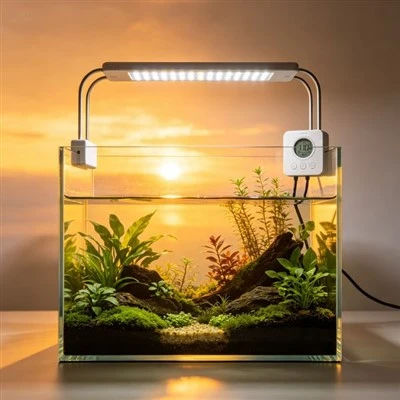
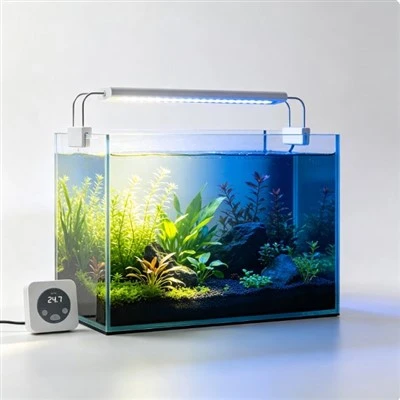
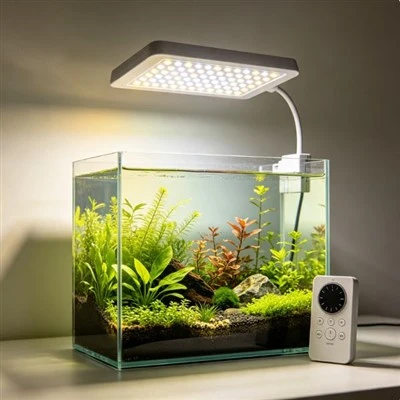
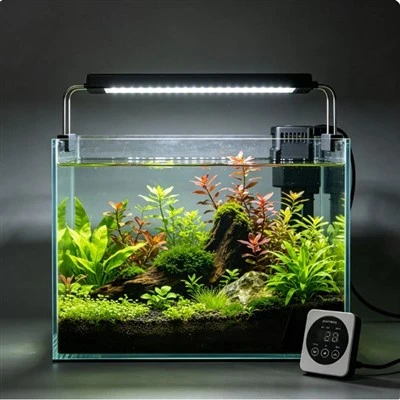
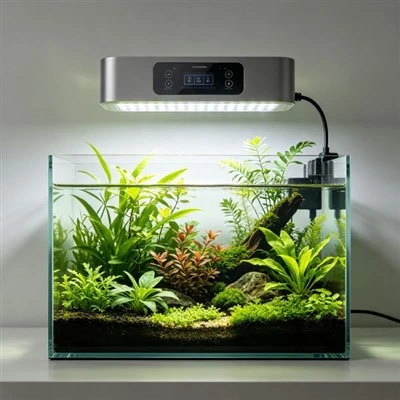
An open-top aquarium can look subtly different on the evening before a top-up. The fixture has not moved, the rocks are where they were, and the controller still runs the same program, yet reflections, glare, and readings at a chosen plane may not match the last record. Evaporation has lowered the boundary between air and water. That change affects water depth, the distance from the source to the surface, the proportions of the optical path in air and water, and the reference geometry used for any comparison.
It helps to separate two distances that are often blended together. If both the lamp and a sensor near the substrate remain fixed relative to the tank, their total physical separation may stay almost constant. As the waterline falls, however, a longer part of that path is in air and a shorter part is in water. The surface where refraction and reflection occur has also moved. A sensor fixed to a floating device behaves differently because its position may follow the water. This is why "same lamp height" is incomplete unless the height reference is stated.
Surface appearance changes too. The rim or top edge may expose more direct view of the LEDs from a seated position. Ripples occur at a lower level relative to the fixture and surrounding glass, shifting reflected paths. Mineral or salt deposits left at the former waterline can catch light and make the change look larger. None of these observations proves that the LED output has increased or decreased. They show that the viewing and measurement geometry is no longer identical.
A simple waterline mark provides a reliable reference. Place it only where it is appropriate for the aquarium and does not damage a panel or obstruct viewing. Before taking a photograph or optical reading, record the actual level, fixture height, measurement plane, circulation condition, and time since the last top-up. If the system is marine or brackish, note salinity using the normal husbandry method because evaporation removes water while leaving dissolved salts behind. Lighting measurements should never become a reason to neglect that biological consequence.
Top up according to the aquarium's established care procedure, using the appropriate water and avoiding a sudden change that is unsuitable for the livestock. The goal is to restore the normal operating level, not to create an optical experiment at the animals' expense. After the level is stable and normal circulation has resumed, repeat the measurement with the same sensor position, orientation, program, and room conditions. If any of those factors changed, write that down rather than treating the two numbers as a clean before-and-after pair.
Suppose a keeper records a reading near the substrate every Sunday. One week the waterline is three centimetres below the reference mark, and the result differs from the previous record. Repeating the reading after a proper top-up may help show whether geometry contributed, but it still does not isolate every factor: surface movement, water clarity, room daylight, sensor positioning, and fixture stabilization can also matter. The useful lesson is not that lower water always produces a particular numerical direction. It is that an unrecorded waterline makes comparisons harder to interpret.
Trying to compensate with extra light is the wrong response to routine water loss. It does not restore salinity, pump submersion, heater operation, or the intended water volume. In some systems, falling water can expose equipment or alter overflow and circulation behaviour. Address the water level through proper husbandry and equipment instructions first. If an automatic top-off system is used, its operation and failure modes deserve their own checks; the lamp should not be used as an indicator that the top-off is safe.
Installation and test instructions can prevent much confusion by defining reference points. "Fixture height" might mean distance to the normal waterline, top rim, lid, or target plane; the document should say which. Distribution or photon measurements should state the water depth and sensor plane. Photographs should include a visible scale or repeatable camera location when they are being used for comparison. These details are more valuable than a single idealized diagram with no operating water level.
Evaporation is ordinary, but it is not optically invisible. A stable lighting record depends on a stable and documented aquarium state. Mark the normal waterline, restore it by the correct care method, keep the measurement geometry consistent, and report any departure. That routine protects both interpretation and husbandry. It also prevents a changing air-water boundary from being mistaken for a changing fixture, which is exactly the kind of everyday error that careful engineering notes are meant to remove.
Photography is particularly easy to misread when the waterline changes. A phone may automatically alter exposure, focus, colour balance, or computational processing between shots, making one scene look brighter even when the fixture setting is unchanged. Locking available camera controls and using the same position can improve a visual record, but photographs still do not replace a calibrated optical measurement. Include the marked waterline in a reference image so a later reader can see the geometry rather than trusting a filename such as "same setup."
Evaporation rate is itself variable. A room heater, fan, open window, surface agitation, season, and fixture heat can change how quickly the level falls. An automatic top-off may reduce variation, yet its sensor position, reservoir, and maintenance determine whether it holds the intended level; it should be installed and tested according to its own instructions. Define an acceptable operating band for routine care and schedule measurements within it. If a comparison is meant to study water-level effects, change level only within safe husbandry and equipment limits, document each condition, and avoid presenting a single tank result as a universal optical law.
A routine log can pair the waterline with top-up volume and optical observations, helping an owner notice whether comparisons occur at a consistent level. The record supports maintenance; it does not justify extrapolating one aquarium's evaporation rate to another home or season.