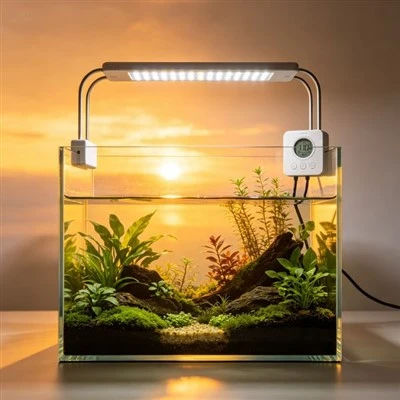
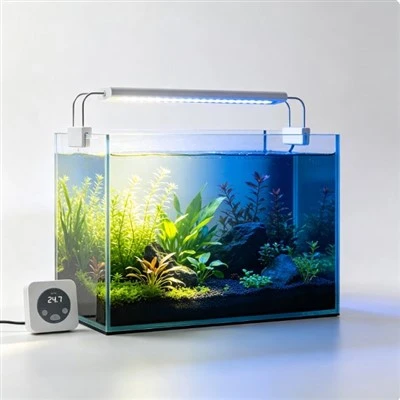
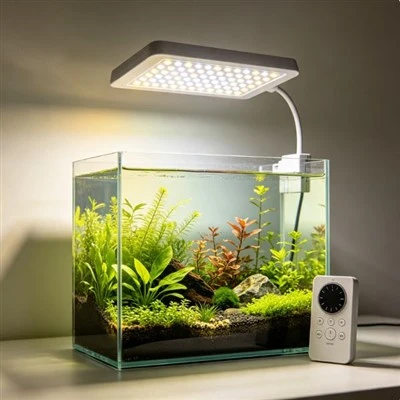
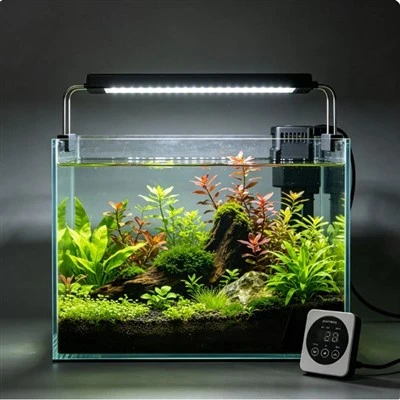
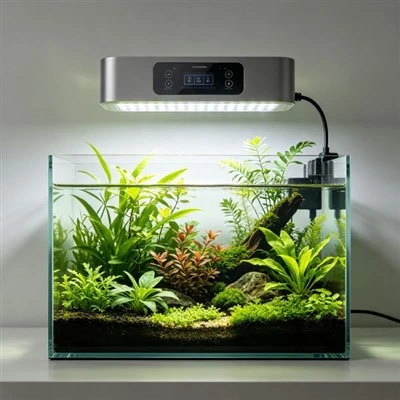
The aquarium may be bright from end to end and still be uncomfortable to watch. A person sitting on a low sofa can see individual LED points beneath the fixture, while someone standing beside the tank sees no problem. This is direct glare, and increasing or decreasing the total output may not address its cause. The path between the source and the viewer matters. Reflectors, louvers, and baffles can all alter that path, but they do different jobs and can change the useful illuminated area as well as the unwanted light.
A reflector redirects light from a reflective surface. Its shape and finish influence where that redirected light goes, so it may help collect light that would otherwise spill outward or shape a broader distribution. A reflector does not simply "add brightness"; it redistributes part of the available light and introduces its own optical losses and angular effects. Its result depends on the source position and geometry. A part designed around one LED board cannot be assumed to work the same way on a fixture with different LED spacing or housing dimensions.
A louver limits the angles from which a bright source can be seen. The familiar form is a set of cells or parallel blades beneath the LEDs. From within the allowed viewing zone, light can pass toward the aquarium. From a high off-axis angle, the blades block a direct line of sight. This can make a low-mounted light more comfortable from a chair, but the cutoff can also reduce illumination near the front or rear edge. A shallow louver may hide the source from one seat while remaining visible from another at a different eye level.
A baffle is a barrier placed to block selected light paths. It may be part of the housing, a side shield, or an internal feature that prevents a particular reflection. Unlike a louver, it does not necessarily create a repeated grid of cutoff angles. The word is sometimes used loosely in product descriptions, so the physical part matters more than the label. A baffle that stops light reaching a viewer can also create a shadow in the tank if its size or position is poorly matched to the installation.
Before trying any accessory, identify the glare. Sit and stand in the normal viewing places, note the eye level, and decide whether the visible brightness comes directly from the LEDs, from the water surface, from the front glass, or from a pale wall. Switch room lights separately when practical. A louver aimed at direct source glare will not necessarily remove a reflection of the entire fixture in the glass. Similarly, changing a reflector may move spill light without solving a sightline that exposes the LED board itself.
Next, record fixture height, tank width, viewer distance, the apparent cutoff angle, and the exact accessory and orientation. Test only parts approved for the model. Compare the centre and edges after installation, using the same output setting and normal waterline. The best result is not the darkest view of the lamp; it is a workable balance between visual comfort, usable aquarium coverage, access for maintenance, and the fixture's approved thermal condition. Photographing the scene can help, but automatic exposure may hide a darker edge or exaggerate a bright source.
A living-room example shows the tradeoff. A shallow louver may make the LED points disappear for a viewer on the sofa while leaving the central aquascape nearly unchanged. The front planting strip, however, may receive less light because it lies outside the new cutoff. Raising the fixture within its permitted range might recover some spread but can expose the source again or increase room spill. A controlled comparison of these conditions is more informative than declaring that louvers always improve a light.
Improvised glare fixes create avoidable hazards. Cardboard, fabric, adhesive film, and unknown plastics can block ventilation, contact hot surfaces, absorb moisture, fall into the aquarium, or weaken a mount. A dark sheet draped over a fixture is not a baffle engineered for that product. Disconnect equipment before permitted accessory work, maintain required clearances, and stop using any part that distorts, loosens, traps unexpected heat, or interferes with electrical connections. If the approved accessory changes operating temperature, that effect belongs in the manufacturer's validation.
Useful glare-control documentation states the compatible model, mounting orientation, allowed height range, and expected change in illuminated footprint. A diagram should show more than a flattering centre view; it should make the cutoff and possible edge reduction understandable. Retailers can help by asking where people normally sit and whether the complaint is direct or reflected glare. Reflectors, louvers, and baffles are not interchangeable decorations. When each is selected for the path it actually controls and checked against the whole aquarium, glare can be reduced without pretending that coverage, cooling, and mounting have stayed unchanged.
Maintenance changes these optical parts over time. Dust, salt spray, fingerprints, and mineral deposits can reduce transmission or turn a controlled surface into a scattering one. Clean only removable, approved parts by the stated method, because abrasives or solvents may cloud a lens, alter a reflector finish, or weaken a plastic louver. Reinstall every clip and fastener in its intended position and confirm that the accessory cannot slide into the tank. For engineering comparison, inspect samples after thermal and environmental conditioning as well as when new. A glare solution that warps, yellows, loosens, or accumulates hard-to-remove deposits may no longer produce the measured cutoff. Product drawings should also state whether published distributions include the accessory, since a bare-fixture photometric file cannot be assumed to represent a louvered or baffled configuration. Optical control remains useful only while its shape, surface, and mounting remain controlled.
For retail displays, a simple seated-eye diagram can prevent a poor accessory recommendation. Mark the normal seat, eye height, tank edges, fixture, and visible source path, then repeat the check after installation. This turns "less glare" into a verifiable sightline without pretending it measures every viewer's comfort.