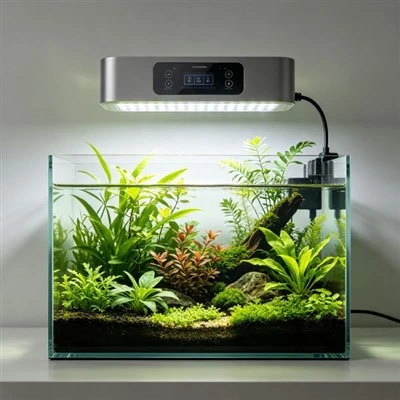
An aquarium may look calm while the room is empty, then seem to empty the moment someone walks down the hallway. Because the fish disappear into plants or caves while the light remains visibly bright, it is tempting to conclude that the lamp is frightening them. The timing points to a more careful question: what changed when the person approached? Footsteps, floor vibration, a moving silhouette, reflections on the glass, the expectation of food, and the sudden contrast between a dim room and a lit tank can all arrive together. The lamp is part of the scene, but it is not automatically the cause.
Begin by observing from farther away than usual. A phone on a stable support can record the tank before anyone enters, during a normal walk past it, and for several minutes afterward. The goal is not to assign emotions from a video. Record visible facts: which species move, which direction they travel, whether only the nearest fish respond, how long shelter use lasts, and whether the reaction occurs on every pass. Compare a quiet weekday with a busy period while keeping feeding and the light schedule unchanged. Repetition helps distinguish a dependable trigger from one memorable event.
Floor construction can matter. A heavy step on suspended timber flooring may transmit vibration through a cabinet even when the walker never casts a shadow over the tank. A door closing, chair rolling, or washing machine entering a spin cycle can create similar signals. Place a hand on the stand only if doing so is safe and does not disturb it, and watch whether objects on the water surface tremble when people pass. Do not try to "test" the fish by stamping repeatedly. The aquarium stand must remain level, stable, and installed according to its requirements; behavior experiments never justify shaking it.
Visual movement is another possibility. A person approaching a brightly lit aquarium from a darker room may appear as a large moving shape against the glass. At certain times, the front panel also acts like a mirror, so the fish see changing reflections as well as the person. Check the view from the fish's level at different times without tapping or pressing on the glass. A plain background on an appropriate panel, closing a curtain during direct glare, or balancing room light before the aquarium's daytime period can reduce contrast. Any material used near the tank must be secure and suitable for the location.
The layout inside the aquarium changes how the response looks. Fish in an open arrangement may cross the entire tank to reach the only dense shelter, making a brief startle conspicuous. Species-appropriate plants, wood, rockwork, or caves can provide several retreat routes while preserving swimming space and maintenance access. More shelter is not always better, and unstable piles create physical risk. Compatibility, group size, water quality, and ordinary species behavior should be reviewed from reliable care information. Lighting cannot compensate for unsuitable stocking or a habitat that leaves fish chronically exposed.
Consider a tank facing the entrance of a home. Most of the day its small schooling fish occupy the middle, but at 3:30 each afternoon they cluster behind a log. A week of notes shows that this coincides with children returning from school, dropping bags, and passing close to the glass. On weekends, the same light setting produces no afternoon hiding. Moving the bag drop-off point, asking family members not to rush the glass, and providing a second planted refuge reduce the abrupt disturbance. The observation supports a traffic explanation without claiming that light has no influence at all.
Feeding can confuse the picture in the opposite direction. If one person always approaches with food, fish may rush forward rather than hide, while an unfamiliar visitor produces a retreat. Record who entered and whether a container, bright clothing, or overhead movement accompanied the event. Observe between meals so food anticipation is less likely to dominate. Avoid withholding necessary feeding or overfeeding merely to create a test. Husbandry stays consistent while one environmental factor is compared. A response linked to a particular route or person is more informative than a general impression that the tank is "shy."
If lighting still appears relevant, change only one modest variable and keep the observation period long enough to compare similar days. Smooth ramping may prevent an abrupt transition if the fixture supports it, and a stable timer prevents accidental schedule shifts. Lowering glare from exposed LEDs can help the human view as well. Use only approved shades, mounts, and positions so cooling, electrical separation, and fixture security are not compromised. Do not eliminate the normal day period or leave the room permanently dark based on a single reaction; animals still need a care-appropriate, consistent light-dark rhythm.
Also check what happens after the aquarium lamp switches off. If people continue walking past under bright household lighting, movement and reflections may remain highly visible even though the fixture is dark. Conversely, a lit aquarium in an otherwise dark room can make an approaching silhouette especially distinct. Coordinate the room and tank schedules sensibly without extending the aquarium day merely for convenience. Closing a blind, relocating a floor lamp, or changing the usual walking route may provide a cleaner comparison than repeatedly altering the aquarium spectrum. Keep each change reversible, safe, and documented.
The practical outcome is usually a better map of the whole room. Note traffic, vibration, reflections, feeding cues, shelter, and the timing of the lamp rather than making brightness carry every explanation. Address clear environmental triggers gently, then check whether the pattern changes across repeated ordinary days. Sudden or persistent hiding combined with abnormal breathing, injury, appetite change, aggression, or water-quality concerns deserves a broader husbandry assessment and qualified help. Separating light from movement does not minimize the observation. It turns a vague worry into evidence that can guide a proportionate response.
When Fish Gather under a Feeding Ring: Routine Can Look Lik