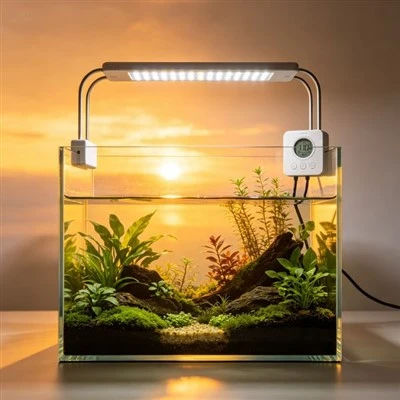
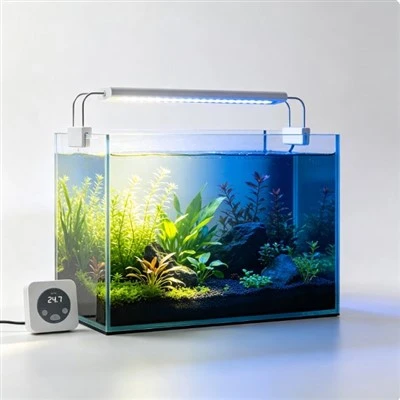
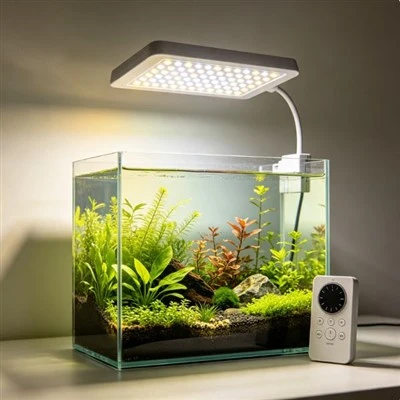
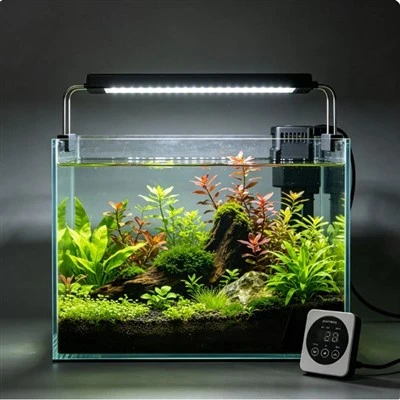
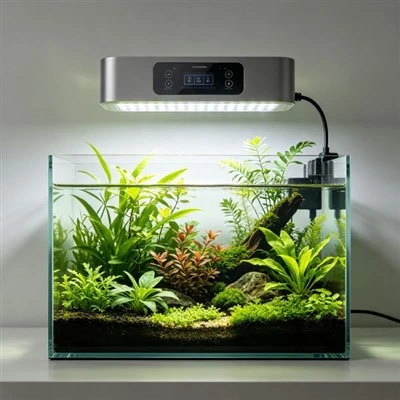
A feeding ring creates a fixed point in an aquarium. Food arrives there, the keeper's hand approaches there, surface flow changes around it, and fish learn that this small circle predicts an important event. If the ring happens to sit under the brightest section of the lamp, a group waiting below it can easily be described as "choosing the light." That may be true in part, but the position contains several overlapping cues. Before changing the fixture, separate the repeatable feeding routine from the visual conditions around it.
Watch the tank before giving any sign that food is coming. Do not pick up the food jar, open the lid, or stand in the usual feeding place. From a distance, note how many fish occupy the ring area during a quiet period. Then record what happens when the keeper enters, when the container appears, when the lid moves, and when food touches the water. These stages reveal whether the gathering begins in response to the lamp, the person, a sound, or the first food. One session is suggestive; several sessions at comparable times are more useful.
Flow deserves attention because a ring is not merely a visual target. It can retain floating food that would otherwise drift toward an overflow or collect behind plants. Fish may station below it because particles descend there or because the current allows easier feeding. Observe fine particles or a tiny amount of normal food rather than adding extra just for a test. Check whether the filter outlet, air-driven circulation, or surface skimmer pulls food toward one edge. Any adjustment must preserve necessary circulation and safe equipment operation.
Access can differ among individuals. Confident or larger fish may occupy the center while smaller ones wait at the edge, in nearby shade, or lower in the water. A single cluster therefore does not prove that every animal prefers the same brightness. Record who reaches food and whether any individual is repeatedly excluded. Appropriate feeding distribution depends on species and tank arrangement; more rings or a different delivery method may help in some setups, but changes should follow reliable care guidance. Lighting should not be used to conceal competition that needs a husbandry solution.
Between meals, look for other reasons the location is attractive. Floating plants may form cover beside the ring. A leaf, branch, or dark background may provide security below it. The area might be warmer near equipment, quieter than the filter end, or simply part of a usual patrol route. Photograph the surface from above when it is safe to do so, and sketch the ring, outlet, shelter, and brightest zone. The map often shows that "under the light" is also "beside cover" and "where food settles."
A familiar household example makes the learning cue clear. At 7 p.m., an owner switches from work clothes, opens a particular cupboard, and walks toward the aquarium. The fish gather below the ring before the food container is visible. One evening the lamp is manually dimmed, yet the same sequence still brings the group to the surface. This does not measure a precise light preference. It demonstrates that time, sound, and human movement predict feeding strongly enough to explain much of the gathering.
To examine the lighting component, keep meals, flow, and ring position steady while comparing ordinary moments within the existing program. Does the group remain there long after feeding, including when the room is empty? Does it gather before dawn when the display light is off but the keeper enters? Does a bright reflection from a window occur at the same location? These questions reduce assumptions without forcing stressful or unsafe experiments. Do not move the ring every meal or repeatedly startle fish simply to produce a cleaner comparison.
Stable lighting makes the record easier to interpret. A timer prevents unknown schedule changes, and a neutral viewing setting can help identify fish and leftover food. If the fixture allows gradual transitions, use them according to its instructions rather than switching channels unpredictably. Avoid leaving high-intensity inspection light on beyond the needed period. The aim is consistent observation, not proving that one spectrum attracts fish. Color appearance to human eyes also does not tell us what every species perceives or why an individual chose a particular spot.
The feeding ring itself requires maintenance. Residue, biofilm, trapped leaves, and damaged suction parts can change its position or water movement. Clean it using aquarium-safe methods and inspect its attachment. Remove uneaten food as appropriate for the setup, because accumulated feed affects water quality regardless of the lamp. If fish suddenly crowd at the surface with rapid breathing or other abnormal signs outside the feeding context, check filtration, temperature, circulation, and water parameters promptly rather than explaining the event as anticipation.
For a product designer or buyer, repeatable timer control, smooth dimming, and an even neutral inspection mode are more useful here than claims about triggering feeding. A lamp cannot ensure fair food access or teach a healthy routine. Its useful role is to keep observation conditions consistent so the owner can see who eats, where particles travel, and whether residue remains. Mounting flexibility may help prevent glare over the ring, provided the approved position and clearance are maintained.
Gathering beneath a feeding ring is best treated as a learned and environmental pattern with several possible contributors. Observe before the approach, break the routine into stages, map flow and shelter, and check access for each fish. Only after those factors are understood should brightness be adjusted for a clear, limited reason. A routine can be so reliable that it looks like a preference for a place or color. Careful records preserve that distinction and lead to better feeding decisions than a quick conclusion about the light.