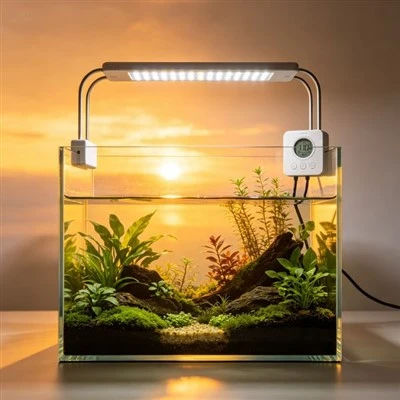
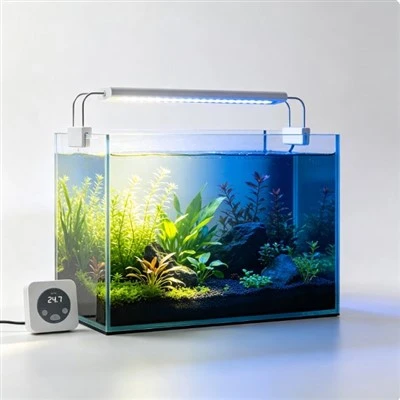
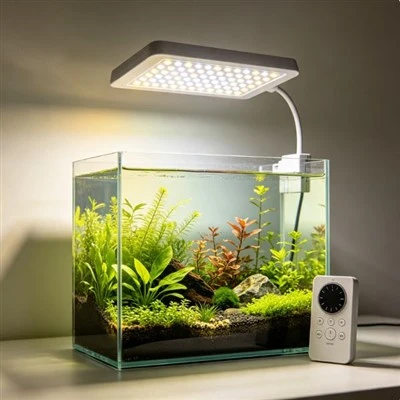
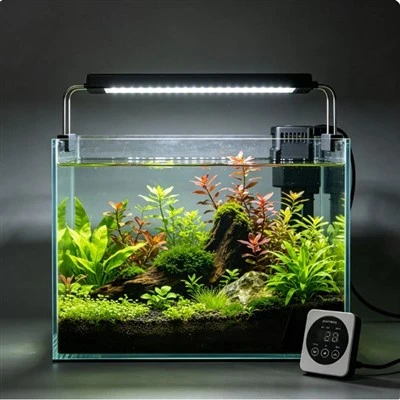
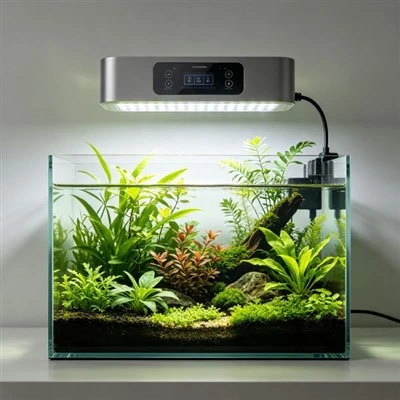
A security camera can show a bright monochrome aquarium after the room appears completely dark. Its infrared emitters produce radiation outside the range people normally see, and the camera sensor is designed to detect it. That does not prove every aquarium animal is insensitive to the wavelength or intensity in use. "Invisible to humans" is an observation about people, not a universal biological safety statement. Night monitoring should have a clear purpose, known camera specifications, and the least illumination necessary for that purpose.
Find the camera's actual illumination information. Record the model, emitter wavelength or range, number of emitters, automatic night-mode behaviour, distance to the aquarium, aiming angle, and whether the infrared source can be disabled. Marketing phrases such as "no-glow" or "night vision" are incomplete. Ask the manufacturer for specifications if they are absent. Also identify the animals and consult relevant dependable evidence rather than assuming that fish, crustaceans, amphibians, and corals share one spectral sensitivity.
Separate recording from illumination. Many cameras can record passively under available light, while others automatically switch on their own emitters. Disable the infrared illumination through the documented control and compare whether the camera still meets the monitoring goal. A low-sensitivity image may be sufficient to confirm that a pump indicator remains on, while detailed behavioural recording might demand a different research-grade approach. Do not increase emitter power simply to obtain an attractive night video.
Glass and water create reflections that can mislead the viewer. Infrared light may bounce from the front panel straight back into the lens, producing a white haze or bright spot while the interior remains unclear. Moving the camera slightly off-axis, outside splash range, may improve the image more than adding intensity. Test the mounting safely and keep the same exposure. Do not attach a camera to the aquarium glass or light fixture unless both products explicitly support that load and environment.
Imagine a camera placed squarely in front of a tank. At night, its screen is almost white because the emitter ring reflects from the glass. The owner moves the camera to an approved shelf at a shallow angle and disables the built-in illumination for comparison. Room spill provides enough image to confirm water movement. This outcome reduces unnecessary infrared exposure and glare while meeting the limited purpose. It does not show that passive recording will work in every room.
Define when monitoring is active. Continuous all-night illumination should not be the default merely because storage is available. Set a limited window tied to a real question, such as checking an intermittent equipment sound or observing a specific, professionally advised issue. Preserve the aquarium's intended dark period as far as the evidence and care plan require. If behaviour is being studied formally, use an appropriate protocol that accounts for the observation method rather than treating a consumer camera as biologically neutral.
Distance and angle influence exposure even when the wavelength is fixed. A close emitter aimed directly through the panel is not equivalent to a distant reflected source. Record any zoom, digital enhancement, or automatic gain because a brighter image on screen may result from camera processing instead of stronger illumination at the tank. Do not infer the camera's radiant output from picture brightness. If quantitative exposure matters, obtain suitable specifications or measurement support from a competent specialist.
The camera must also respect the aquarium's physical environment. Place it outside spray and condensation, maintain ventilation, support its adapter, and route its cable without crossing wet work areas. Do not position it where maintenance staff can knock it into water. If the camera shares a metal stand or cabinet with wireless aquarium controls, verify that neither system loses necessary connection in the final arrangement. Essential local control of the aquarium light should remain available.
Review recordings cautiously. A fish moving differently in one clip does not establish an infrared effect; feeding, flow, sound, temperature, social interaction, and many other factors may vary. Compare matched periods and seek species expertise if the observation matters. Do not market a clip as proof that an infrared source is safe, calming, or completely invisible to animals. The responsible statement is limited to the camera model, settings, geometry, and what was directly observed.
Equipment labels and controls should make the emitter state obvious. An app icon alone may be ambiguous, so verify with the manual and camera status rather than looking for a red glow. Test what happens after power loss or firmware changes, since automatic night mode can return. Keep a written setting for caregivers. If a camera or supply becomes damaged, wet where it must stay dry, unusually hot, smoking, or burning-smelling, disconnect it safely and seek qualified support.
A suitable monitoring product publishes its wavelength, operating modes, emitter-disable control, power requirements, and environmental limits. It allows passive or reduced-illumination use when the task permits. The best nighttime setup is not the one with the most detailed dramatic footage; it is the one that answers a defined question while making the fewest unsupported assumptions about the animals. Human invisibility is a reminder to verify, not a reason to stop thinking about light.
End every monitoring period with a decision. If the recording answered the question, return the camera to passive use or remove the unnecessary emitter schedule. If it did not, review placement, specifications, and the observation design with suitable expertise instead of simply recording for more nights. Retain only the clips and settings needed to compare the event, noting that camera gain and compression can change appearance. A defined endpoint keeps a temporary investigation from becoming permanent illumination by default. Include the aquarium-light schedule in the camera log. That small detail prevents visible spill from a late room or display event from being mistaken for infrared performance and helps another reviewer reconstruct the true night conditions.