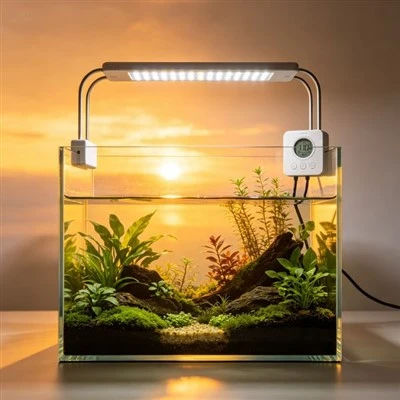
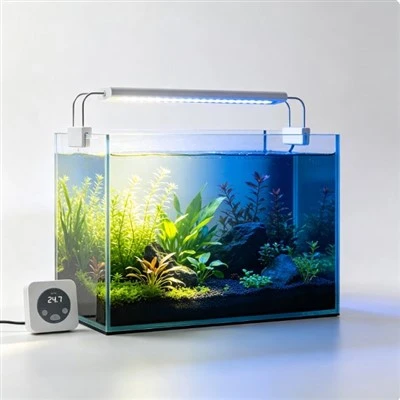
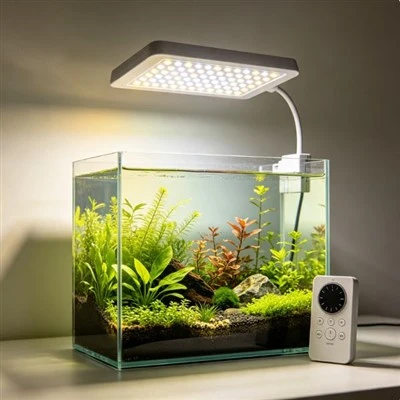
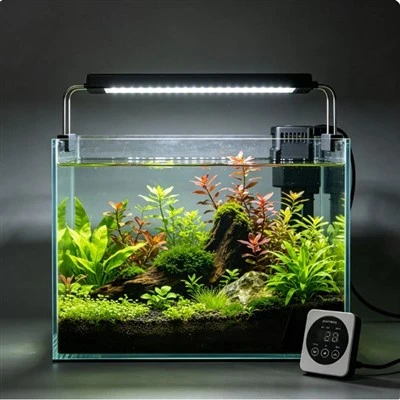
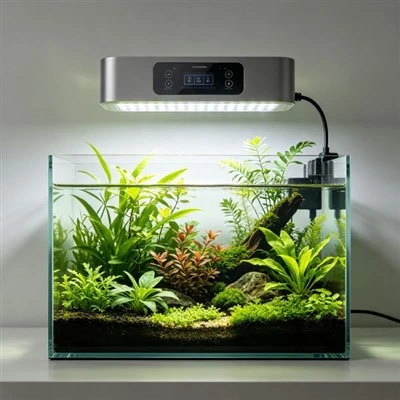
Magnetic aquarium mounts can make a light easMagnetic Aquarium Light Mounts: Understanding the Glass between the Magnetsy to position without drilling, yet the word "magnetic" does not describe how strongly every installation will hold. The two halves attract through the aquarium panel, and that attraction generally changes as the distance between them changes. Glass thickness, protective liners, alignment, magnet design, surface friction, fixture load, and cable pull all affect the result. A mount that feels firm on a thin nano tank may slide on a thicker display even though the outer parts look identical.
The rated panel-thickness range is the first purchasing check. Measure the actual wall at the intended position or use verified tank documentation; do not infer thickness from volume alone. Curved, laminated, acrylic, double-wall, or reinforced sections may require special consideration. Compare the result with the mount manufacturer's explicit range for the exact model and orientation. If the tank falls outside that range, adding loose magnets is not an acceptable solution. Select a compatible engineered mount or another approved support.
Alignment matters because offset halves do not share the same magnetic path or contact area. Mark the intended location, keep both faces clean, and bring them together using the instructed method. Powerful halves can snap suddenly and pinch fingers or chip a hard surface. Keep hands, magnetic cards, sensitive devices, and people with relevant medical-device concerns away according to the safety instructions. Never allow a magnet to strike bare glass from a distance. Installation should be slow and controlled.
Protective pads serve several roles. They can prevent scratches, increase friction, and encapsulate the magnet from the environment, but they also add separation. A missing, doubled, swollen, or substituted liner changes the system. Use the specified pads and inspect them for wear, trapped grit, hard deposits, or movement. Do not add tape or rubber to increase grip unless the manufacturer approves it. A homemade layer may appear helpful while reducing attraction or retaining moisture against the mount.
Test the load before placing livestock at risk. Install the fixture in the exact orientation, route the cable with safe slack, and apply only the checks described by the supplier. Observe whether the mount creeps over an extended normal operating period. A small alignment mark can reveal slow sliding. Do not hang extra controllers, shades, or tools from it. Their weight and leverage were not part of the rated assembly. If the fixture moves, support it safely, disconnect it, and reassess compatibility rather than tightening a non-existent fastener.
Cable force often explains why one direction is unstable. A lead pulled behind a cabinet can draw the outer half downward, while opening a lid can push it sideways. Route the cable so ordinary use does not load the magnet. Confirm that a drip loop, where applicable, does not become a hanging weight. Check again after cleaning or moving the aquarium, because furniture shifts can remove the slack. A secure magnetic pair can still slide when an external force repeatedly overcomes surface friction.
Corrosion protection should be documented, not guessed from paint or plastic appearance. Magnets and metal hardware may deteriorate if an enclosure cracks or if the product is used beyond its stated exposure. Inspect seams, pads, fasteners, swelling, discolouration, and residue with power disconnected. Do not sand, drill, or open encapsulated parts. If damage exposes underlying material or moisture enters a prohibited area, stop using the mount and contact the supplier for the correct replacement.
Temperature can influence liners, adhesives, friction, and the surrounding installation even if the magnets remain strong. Keep the light's ventilation and clearance within instructions and do not place the assembly against a heater, hot pipe, or enclosed canopy surface without approval. Record the room and panel condition during commissioning. A mount tested briefly on a cool empty tank may behave differently after cables, lids, and normal heat sources are in place. The complete configuration is what matters.
Removal requires as much care as installation. Slide or separate the halves in the directed manner while supporting the fixture; do not pull one part straight off and let the other fall. Clean any trapped particles before repositioning. Store strong magnets with their supplied spacers and away from children or vulnerable objects. If one half falls into the aquarium and it is not designed for immersion, isolate equipment safely and follow the product and livestock response instructions.
An honest product page states compatible material and thickness, fixture orientation, supported load, included liners, environmental protection, cable-routing expectations, and safe handling. It should not show a magnet holding an unrelated heavy object as proof of aquarium suitability. Ask for the exact test configuration and model. Clear limitations help a buyer choose correctly and reduce the temptation to strengthen an unsuitable mount with uncontrolled parts.
The final installation should remain aligned during feeding, lid movement, cleaning, and ordinary cable handling. Periodic checks should show no creeping, pad damage, corrosion, or panel marks. If the tank or fixture changes, compatibility must be checked again. Magnetic mounting is valuable because it is adjustable and clean, not because magnetism overrides distance and load. Respecting the glass between the halves turns a clever attachment into a dependable part of the aquarium.
Plan for the consequence of a slip even after compatibility is confirmed. Keep the light positioned so a small movement does not send a sharp edge against the panel or place a cable in water. Use only a manufacturer-provided or engineering-approved retention feature, and do not let it become a substitute for the rated magnet. During maintenance, support the fixture before separating the halves and tell helpers that the inner piece can fall. A strong static hold does not eliminate risk during the moment someone opens a lid, pulls a cable, or releases one magnet.