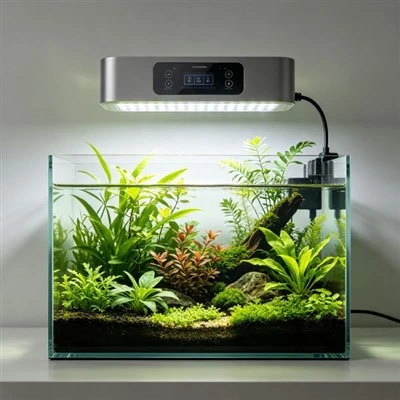
A USB plug makes a small aquarium light feel universal. It may fit a phone charger, laptop, hub, or power bank, but physical fit does not prove electrical or environmental compatibility. Different USB systems can provide different voltages, current limits, negotiation protocols, and fault behaviour. Cable resistance and connector quality also matter. Near an aquarium, the location of the supply and connection is just as important. The safe starting point is the light's label and manual, followed by the exact approved supply-not a drawer full of adapters that happen to accept the plug.
Record the required input in full. Note the connector type, voltage, current or power requirement, any protocol named by the manufacturer, polarity where relevant, and the approved adapter model. "USB-C" describes a connector family, not a promise that every source will operate every device. Some products request power electronically; others use a fixed basic input. Do not assume that a high-wattage charger will always negotiate correctly or that a low-power computer port can meet startup demand. Ask the supplier when the requirement is incomplete.
The supply's printed output table must be read, not inferred from brand or size. A multi-mode charger may list several voltage-current combinations, while a simple adapter lists one. Match it only through the product instructions. Do not use an unmarked charger or one with damaged pins, cracked housing, unusual heat, noise, or odour. Certification marks and local plug compliance should be verified through the appropriate product documentation rather than copied as a generic sales claim.
Cable quality can determine whether a setup that works briefly remains stable. A long, thin, damaged, or poorly made cable may create voltage drop under load, leading to flicker, resets, reduced output, or connector heating. Use the supplied or specified lead and avoid chaining unapproved extensions. Route it with slack, protect it from sharp cabinet edges, and keep connectors accessible for inspection. A cable should not support the weight of the controller or adapter. Replace damaged parts rather than wrapping them in tape.
A familiar example is a light that runs from one wall charger but restarts when connected through a low-quality desk hub. The connector fits in both cases. The owner records the exact sources, cables, controller settings, and fault timing, then returns to the approved adapter. Stable operation there points to the alternative power path as the variable to investigate. It does not prove that every hub of that type is unsuitable or that the lamp itself is flawless; it creates a useful, bounded troubleshooting result.
Power banks add portability but also operating rules. Their rated energy, conversion losses, automatic shutoff threshold, charge state, and allowed environment affect runtime. Do not promise a number of hours by dividing two large label figures without accounting for the complete system. Test only through an approved connection, record the light setting, and treat the result as specific to that bank and condition. Keep the bank in its permitted dry, ventilated location-never on a wet tank lid merely because no wall outlet is nearby.
Timer and controller recovery should be tested with the intended USB supply. Some systems lose the clock, return to a default setting, or stay off after power is restored. Conduct a safe short interruption during commissioning, then verify time, intensity, colour, and next scheduled event. Document the result for anyone who uses a switched outlet or backup source. If predictable recovery is essential, choose a product that states and demonstrates the required behaviour instead of assuming that USB power makes control memory universal.
Moisture boundaries remain strict even at lower voltages. The adapter usually connects to mains power, and USB connectors can corrode or short when wet. Place supplies, hubs, and joins away from splash and condensation, use drip loops where applicable, and handle them with dry hands. Do not seal a connector in a plastic bag or apply grease unless the manufacturer provides that method; such improvisation can trap moisture or heat. Low-voltage output does not make the whole installation waterproof.
Observe fault signs without opening the product. Repeated resets, flicker, discolouration, connector looseness, unusual heating, or an unstable touch controller should be recorded with the exact source and cable. Test only safe manufacturer-permitted alternatives. A wet or charred connector, cracked adapter, smoke, odour, or rising temperature is reason to isolate the USB system and refer it for competent assessment. Do not probe a powered USB connector above water or bypass protective components.
Product documentation should make compatibility easy: required input modes, included supply, cable length, connector orientation, maximum supported chain if any, controller recovery, and environmental limits. If the adapter is optional, list verified choices rather than saying "use any phone charger." A buyer also needs to know whether the stated wattage is input power at a particular mode or an LED component figure. Clear definitions prevent both poor performance and exaggerated energy claims.
USB can be a genuinely convenient way to power a nano aquarium light when the entire path is specified. The reliable setup has a known adapter, sound cable, dry connections, predictable controls, and enough routed length without tension. Convenience ends where guessing begins. Reading the labels takes minutes, while replacing a mysterious charger by trial and error can create flicker, heat, missed schedules, and avoidable risk beside the aquarium.
In a shared household, label the approved charger and keep it with the light. Otherwise, a person may borrow it for a phone and replace it with a physically similar unit. Add the cable and supply model to the aquarium record, and check them after travel or cleaning. If the product is sold without an adapter, the seller should provide an exact compatibility table and local plug guidance rather than transferring the entire electrical decision to a first-time buyer.