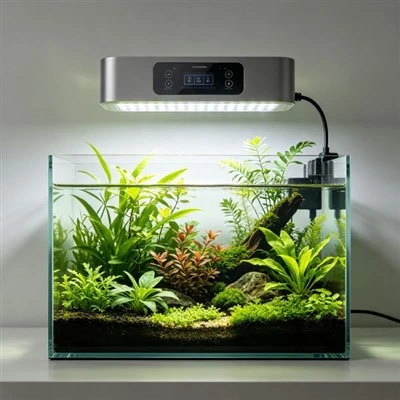
A cup of tissue-culture aquarium plants looks compact and flawless on a shop shelf. The plants have grown in a protected, nutrient-containing medium under controlled conditions, often with leaves formed for that environment. After they are rinsed, divided, planted, and submerged in a home aquarium, some old growth may weaken while new submerged growth develops. Owners frequently respond by turning the light up. Light matters, but it works within a larger transition involving plant identity, handling, anchoring, water conditions, nutrient availability, carbon supply, flow, and the time needed to produce a different leaf form.
Correct identification comes first because "tissue culture" describes a production method, not one set of care needs. A low-growing foreground species, a stem plant, and a crypt-like rosette may require different planting depth, spacing, and patience. Keep the label and verify the scientific name through dependable plant-care information. Check whether the aquarium's temperature, water characteristics, and intended maintenance suit that plant. A powerful fixture cannot make an unsuitable species appropriate for every tank, and photographs of mature displays do not reveal the conditions or time used to grow them.
Handle the cup deliberately. Follow the supplier's instructions for removing the culture medium, and use clean tools suitable for aquarium work. Gel left in a dense clump can make division and planting difficult, while rough rinsing can damage fine roots. Separate portions only as recommended for the species. Plant crowns, rhizomes, stems, or roots at the correct depth instead of burying every piece alike. Good contact with the substrate helps some small portions remain in place, but crushing them with tweezers or packing them into one hole reduces the value of careful lighting.
For the first days, choose stability over a daily search for the perfect percentage. Set a moderate, repeatable photoperiod based on the plant, tank depth, fixture coverage, existing daylight, and the wider nutrient and carbon plan. There is no universal intensity number that transfers between lamps because optics, mounting height, water clarity, and control scales differ. If a meter is used, measure at the relevant plant plane and document the method. If it is not, begin conservatively and evaluate healthy new growth, algae, and overall plant condition across time.
The relationship between light and resources explains why "more" can disappoint. Increasing usable light can increase the plant's demand for carbon and nutrients, while the aquarium may not supply them in balance. That does not justify guessing a deficiency from one damaged leaf or dosing an unmeasured cocktail. Follow a coherent fertilization and carbon approach appropriate to the system, and keep changes recorded. Water changes, substrate choice, livestock plans, and circulation all affect availability. A stable moderate lamp program often creates a clearer diagnostic window than alternating between low and maximum output.
Picture a newly planted carpet divided into twenty small plugs. During the first week, several pale original leaves become translucent, and two plugs lift after routine maintenance. The owner assumes the light is weak and doubles the daytime setting. Algae then appears on exposed substrate, while the loose plugs continue to drift. Replanting them correctly, restoring a moderate schedule, and monitoring for fresh rooted growth addresses the visible problems more directly. The example does not prove every leaf loss is normal transition; persistent decline still calls for a review of species needs and tank conditions.
Track old and new tissue separately. Date a close photograph from the same angle, note which leaves came from the cup, and look for new roots, shoots, or submerged-form leaves. Remove decaying material carefully when appropriate so it does not obscure the plant or collect debris, but avoid repeatedly uprooting healthy portions for inspection. A single "before and after" image under different color channels can be misleading. Use a neutral viewing setting, consistent camera exposure if possible, and ordinary room conditions to make visual comparisons more reliable.
Flow should move water through the planted area without uprooting fragile pieces. Areas behind stone, wood, or a dense cluster may receive less circulation and a different light angle than the open foreground. Map those local differences before judging the entire tank by one plug. If only a shaded corner fails while the same species grows elsewhere, placement deserves review. If every portion declines, broaden the investigation to identification, preparation, planting, water, nutrients, carbon, and contamination. One pattern rarely establishes a single cause by itself.
Resist biological promises attached to equipment. A fixture with smooth dimming, a dependable timer, documented coverage, and secure mounting can make a gradual plant program easier to manage. It cannot guarantee that tissue-culture plants will never "melt," root within a stated number of days, or form a carpet. Manufacturer maps and measurements are helpful only when their test distance and conditions are known. Match the useful footprint to the planted area and preserve access for trimming, rather than chasing the highest advertised output.
Maintenance timing can protect the new planting from avoidable setbacks. Plan water changes, glass cleaning, and filter work so hands and hoses do not repeatedly dislodge small portions. After a plug is moved, note that event instead of interpreting its next damaged leaf as a lighting response. Check that floating plants or newly grown stems have not changed the shade pattern above the tissue-culture area. As the aquarium fills in, the useful setting may need review, but gradual adjustments tied to documented growth are easier to understand than sudden corrections made after every imperfect leaf.
The transition succeeds through consistent husbandry more than reactive brightness changes. Identify the plant, prepare and place it correctly, provide a balanced environment, and judge progress from healthy new submerged growth rather than the perfection of old cup-grown leaves. Keep enough time between adjustments to learn from them, and seek experienced plant advice if decline continues. Light is essential to aquatic plant growth, but it is one input in a living system. Treating it that way turns an uncertain first week into an observable process instead of a contest between dim and bright.