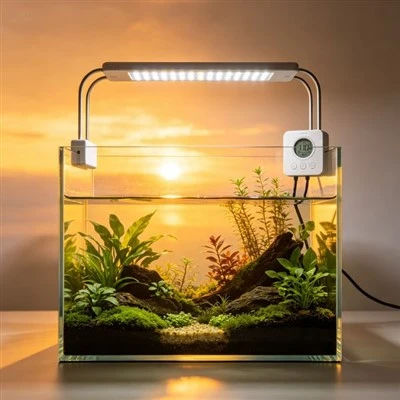
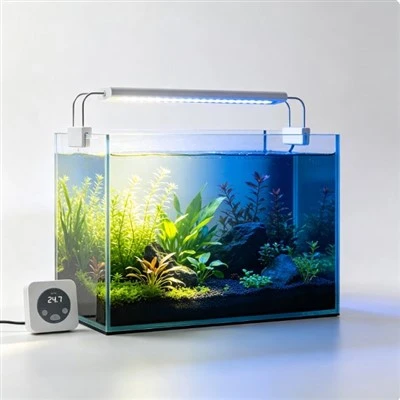
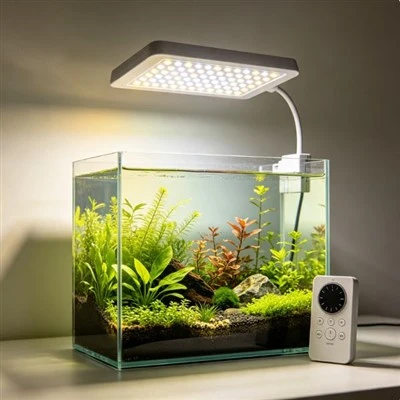
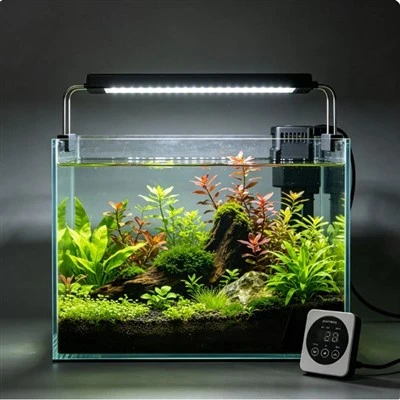
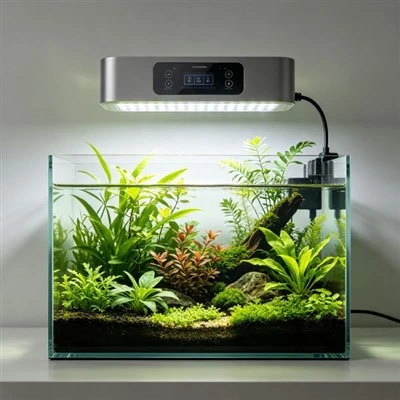
A school that fills the middle of an aquarium in the morning may tighten into a compact group later in the day. Owners often notice the lamp at the same moment: perhaps it has just brightened, dimmed, or changed color. School spacing is influenced by many interacting conditions, including species, perceived threat, feeding, water movement, social composition, cover, room activity, reflections, and light. A tight group is not automatically distressed, and a scattered group is not automatically relaxed. The useful task is to describe when and where the change occurs before giving it a single cause.
Make observations at matched clock times for several days. Record the number of visible fish, the approximate space occupied by the group, swimming direction, depth, distance from cover, and any individuals separated from the rest. On the same line, note feeding, maintenance, people entering the room, doors closing, pumps changing mode, and the lamp stage. A short video taken from the same position can preserve details that memory misses. Avoid tapping, waving, or moving décor to provoke a response. Ordinary events provide better evidence and do not add unnecessary disturbance.
Imagine a long aquarium beside a family-room door. At sunset, the fish form a tight cluster near the far end, which seems to coincide with the lamp's evening ramp. Reviewing video shows that the door slams when someone returns from walking the dog at nearly the same time. On quiet evenings, the group remains more dispersed through the same lighting transition. The result does not prove vibration is the only factor, but it prevents an immediate rewrite of the light program. Adding a soft door stop and comparing another week addresses a plausible trigger without altering several variables.
Water flow creates another spatial pattern. Schooling fish may align in a current, avoid a turbulent outlet, or gather where feed is carried. A recently cleaned filter, redirected nozzle, blocked intake, or new circulation pump can change that field. Check equipment operation and watch fine suspended particles to understand direction without adding debris. Flow requirements vary by species and system, so use dependable guidance rather than assuming stronger or weaker is universally better. If the whole group suddenly occupies an unusual layer with abnormal breathing, verify temperature and water quality promptly; lighting adjustments are not life-support corrections.
Social context can make identical illumination produce different spacing. Group size, maturity, a new individual, aggression, or the presence of another species may alter how the school uses open water. Note chasing, repeated exclusion, injury, or one fish consistently left behind, but do not infer an emotional state from distance alone. Review whether stocking and habitat are suitable for the species. Dense cover at only one end can compress a group when people pass, while balanced refuge may offer choices. Hardscape must remain stable, and "more hiding places" should not eliminate needed swimming area or maintenance access.
Reflections are easiest to misread after room conditions change. During the day, windows may wash out the front panel; at night, a bright aquarium in a dark room can reflect viewers, furniture, and the fish themselves. Walk past at normal speed and look from several angles, including the usual seated eye level. Curtains, a suitable background, or modest room lighting may reduce glare, but keep electrical and ventilation clearances intact. Do not cover a fixture with homemade material or place objects where they can fall into the water. A visual remedy must remain physically safe.
Position within the tank can be mapped rather than described vaguely. Divide the visible length into three or four zones and note where the group spends each observation period. Add the brightest patch, strongest current, feeding point, nearest shelter, and busiest room side to the sketch. If clustering consistently follows one of those features, that relationship becomes testable. The method does not turn a home aquarium into a laboratory, but it makes "they always bunch up under this light" more precise. It may reveal that the group is actually at the downstream edge of a current or beside its only shaded retreat.
Allow a new baseline after any legitimate husbandry change. Adding compatible group members, pruning a large plant mass, changing an outlet direction, or moving the aquarium within the room can reshape the entire pattern. Comparing the next day with a six-month-old memory is unreliable. Write down the change, leave unrelated settings steady, and collect observations at the same daily points. If an individual repeatedly fails to join the group or shows physical signs, treat that as a separate welfare question rather than averaging it into the school's overall shape. Qualified advice may be needed even when the remaining fish appear unchanged.
If evidence continues to point toward the lamp, preserve the schedule and alter one feature modestly. An abrupt switch may be replaced by an approved gradual transition, or an excessive contrast may be reduced while keeping a care-appropriate day-night cycle. Compare the same times over multiple days, not the first few seconds after touching the controller. Fish can respond to the keeper approaching or to the change itself. Record whether the distribution returns to baseline and whether feeding, respiration, and interactions remain normal. No single channel setting can be promised to produce a desired school formation.
Reading a school well means accepting that its shape is contextual rather than a score shown by the fish. A cluster after a door slam, alignment in current, gathering before food, and persistent compression around inadequate shelter can look similar in one photograph but call for different responses. Stable lighting and fixed observation times make those causes easier to separate. When a sudden change accompanies respiratory difficulty, disease signs, injury, or abnormal water tests, seek appropriate help. Otherwise, patient comparison usually teaches more than repeated adjustments made to create the attractive formation an owner expects.