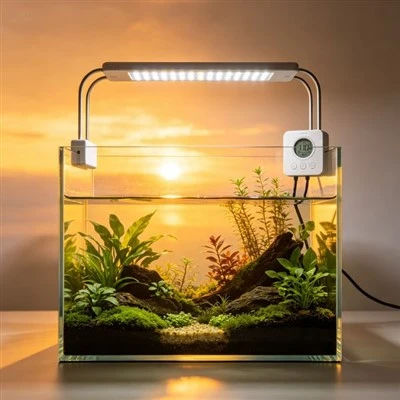
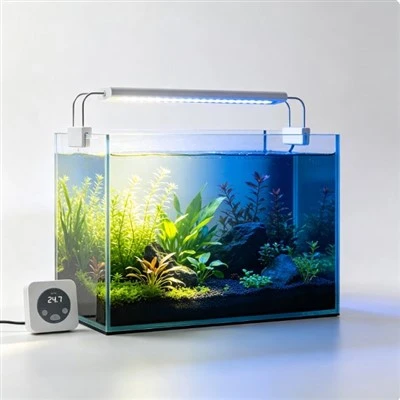
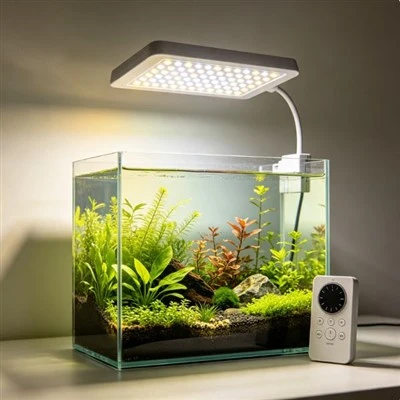
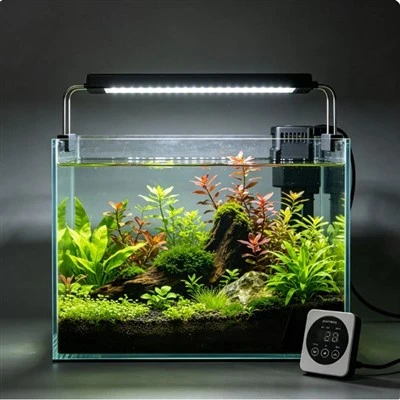
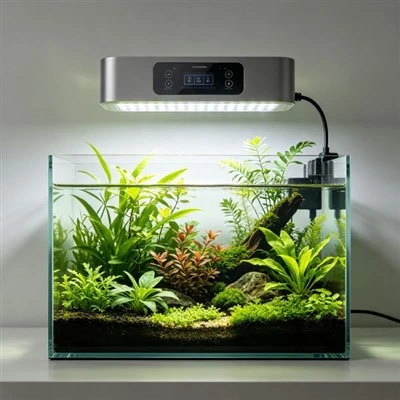
Tiny bubbles collecting on aquarium leaves can make a planted tank look exceptionally active. They are often called pearling, and many owners use them as a quick score for the light: more bubbles must mean better growth, while no bubbles must mean failure. The observation is real, but the conclusion is too simple. Oxygen produced during photosynthesis can form visible bubbles when local conditions favor it, yet bubbles may also be dissolved gases coming out of newly added water, air trapped during maintenance, or gas adhering to a rough leaf. Visibility depends on circulation, saturation, surface texture, and camera angle as well as the lamp.
Timing gives the first useful clue. Record when the bubbles appear relative to lights-on, a water change, carbon-system operation if used, filter maintenance, and changes in circulation. Photosynthetic oxygen may become more visible after the light has been running, but a freshly filled aquarium can show bubbles on glass, heater surfaces, wood, and leaves almost immediately. If every hard surface sparkles just after a water change, calling the leaf bubbles a plant performance test would ignore the rest of the tank. Repeating the observation on an ordinary day helps separate those situations.
Location matters just as much. A dense stem tip near the surface may receive strong light and show bubbles, while an older shaded leaf below does not. A filter outlet can carry bubbles away from one area or hold them against another. Some leaves provide edges or textured surfaces where gas attaches easily. Sketch which species and plant parts carry bubbles, which direction the current moves, and whether bubbles originate from a cut stem, damaged area, or broad leaf surface. A steady stream from an injury is not interpreted in the same way as scattered beads across healthy new foliage.
Photographs can improve the record if they are taken consistently. Use the same viewing position, approximate time, and neutral light setting, and note any automatic camera exposure changes. A blue-heavy display may make bubbles shine dramatically without increasing their number. Side lighting and a dark background can also turn nearly invisible gas into bright points. The photograph documents what could be seen under those conditions; it does not measure oxygen production. For measured dissolved oxygen, suitable calibrated equipment and correct sampling are required, and even that reading represents a time and place in a changing system.
Consider a planted aquarium after its weekly water change. Within minutes, fine bubbles cover the glass and the leaves of a slow-growing plant, although the lamp has only just switched on. By the afternoon most bubbles have disappeared from the glass, while several actively growing stems begin releasing new visible bubbles near their tips. The two events look similar in a still image but have different timing and distribution. A log reveals the distinction. Neither event, by itself, proves that the plants are healthy, that carbon is balanced, or that the fixture is superior.
Long-term plant condition is a better guide than one sparkling hour. Look for sustained new growth appropriate to the species, intact emerging leaves, secure roots or attachment, manageable algae, and a growth rate that fits the intended maintenance. Review nutrients, water conditions, planting, circulation, and carbon availability alongside light. Increasing intensity merely to force visible pearling can raise demand and may worsen imbalance. Absence of bubbles is also not proof of inadequate light; oxygen can remain dissolved or disperse without forming beads that the viewer can see.
If a carbon-dioxide system is present, resist using bubbles as permission to increase dosing. Carbon management has safety implications for aquarium inhabitants and should follow a coherent, measured method with appropriate monitoring. Changes in circulation can alter both delivery and visible bubble behavior, making appearance an especially weak dosing guide. Keep the lighting and carbon schedule recorded separately, check equipment function, and adjust only with reliable system-specific guidance. Rapid breathing or unusual surface use by animals requires prompt life-support and water assessment, not a celebration that plants are pearling strongly.
Stable lighting helps precisely because it makes comparisons less chaotic. A dependable timer, repeatable intensity control, and documented fixture position allow the owner to ask whether a pattern recurs under similar conditions. Useful product information includes mounting distance, coverage method, control increments, and how settings are restored after a power interruption. It should not promise a certain number of bubbles or equate a visible effect with guaranteed plant health. Different aquariums can use the same fixture and show very different gas behavior because the biological and physical conditions differ.
Maintenance can create misleading local bubbles in other ways. Trimming opens stems, repositioning plants traps pockets of air, and cleaning an outlet may send microbubbles through the tank. Note those events before comparing photographs. Check for equipment drawing air unintentionally if a sudden cloud of bubbles appears, and follow the equipment instructions rather than assuming the plants caused it. Conversely, do not repeatedly squeeze leaves or alter flow to make bubbles visible. Observation should not damage the plant or destabilize the conditions being observed.
Temperature changes add another reason to keep context. Gas solubility changes with temperature, and replacement water may differ from the aquarium even when it is prepared carefully. Record measured temperatures rather than describing the water as warm or cold. This does not let a home observer calculate the source of every bubble, but it prevents a visible burst after maintenance from being credited automatically to a new lamp setting. Stable environmental records are more informative than the size of the brightest cluster on a single leaf.
Pearling is enjoyable and sometimes informative, but it is one visible outcome, not a grading system. Record timing, recent water changes, species, plant part, circulation, carbon routine, temperature, and the location of bubbles throughout the aquarium. Then judge the planting from healthy development over weeks and from a balanced care program. A lamp can provide repeatable light; it cannot make every generated molecule become a photogenic bead. Treating bubbles as context rather than a score preserves their value without asking them to prove more than they can.