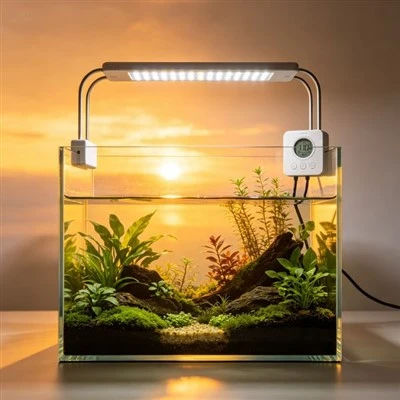
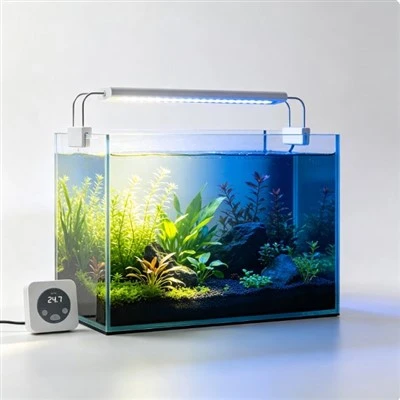
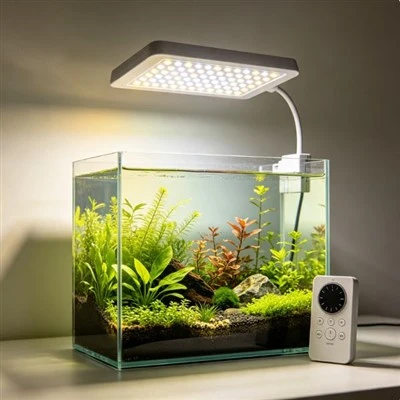
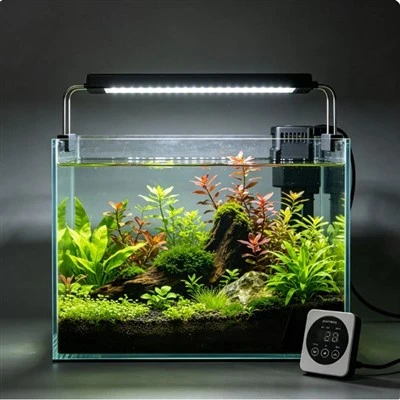
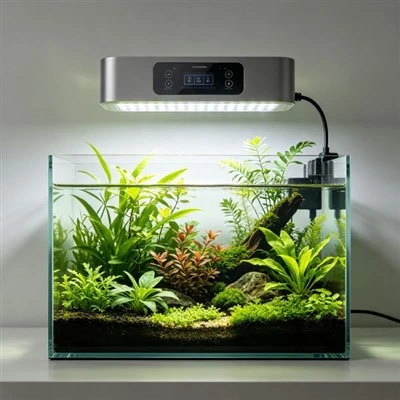
Leaves that lie almost flat in the morning may stand upright by midday or fold toward evening. Seen for the first time, the change can look like wilting, heat damage, or an attempt to escape the lamp. Some aquatic and amphibious plant species naturally alter leaf or leaflet position over a daily cycle, while flow, buoyancy, handling, new growth, and conversion between growth forms can produce similar movement. Before changing intensity or photoperiod, identify what moved, when it moved, and whether the pattern repeats. Position is an observation; it is not a diagnosis on its own.
Plant identity is essential because movement that is ordinary for one species may be unusual for another. Keep the nursery label, confirm the scientific name from dependable sources, and compare the actual submerged form rather than only an emersed sales photograph. Note whether the whole plant changes, individual leaflets fold, a stem bends, or one damaged leaf droops. A newly opened leaf often changes angle as it expands. An older leaf loosened during maintenance may also rise or sink differently even though the lighting program has remained identical.
Use fixed-time photographs to turn a vague impression into a sequence. Choose a camera position and take an image before the display light starts, shortly after the transition, around the middle of the programmed day, near lights-off, and later under brief neutral room illumination if needed. Do not leave the aquarium lamp on during the normal dark period merely to obtain a photo. Keep camera exposure as consistent as practical and include a stationary hardscape edge in the frame. Three or four days of repeated timing are more revealing than dozens of pictures from one unusual day.
Record the complete light environment. Window daylight may begin hours before the aquarium timer, and a bright room lamp may remain on after it ends. Smooth ramps can make "lights-on" a long transition rather than a single moment. Write down fixture settings, mounting position, shading from floating or taller plants, and any recent pruning. Controller percentages are not universal measurements across products. If intensity at the plant plane is measured, keep the instrument, location, and method consistent so later comparisons represent a real change rather than a different procedure.
Flow is a frequent mechanical explanation. A leaf can appear upright when an outlet pushes from below, then settle when a pump changes mode or becomes partially blocked. Newly trapped gas can increase buoyancy, and a stem released from another plant may spring toward the surface. Observe fine particles near the leaf and verify whether timed pumps or feeding modes coincide with the posture. Do not bend a living leaf repeatedly to test its stiffness. Instead, stabilize normal circulation, clean equipment as directed, and compare the plant before and after legitimate maintenance.
In a home office aquarium, a group of delicate leaflets closes near 6 p.m. The owner shortens the photoperiod because the plant appears exhausted. A written schedule later shows that closing begins at almost the same clock time even on a day when the lamp starts an hour later, while the leaves reopen the next morning. This pattern suggests a repeatable daily movement worthy of species-specific research, not immediate evidence of excessive brightness. It still does not prove the plant's overall care is correct; growth, color, roots, and new tissue must be assessed separately.
Distinguish reversible posture from tissue damage. A leaf that resumes its earlier position is different from one that becomes translucent, torn, soft, or detached. Look for healthy new growth, algae, discoloration, root condition, and whether the same plant behaves differently in another part of the tank. Review temperature, water parameters, nutrients, carbon strategy, planting, and recent disturbance. If posture changes accompany broad decline, investigate the whole environment. Increasing or decreasing light alone may conceal the timing while leaving the underlying problem untouched.
Canopy development can change the pattern gradually. As taller stems branch or floating plants spread, lower leaves may receive a moving patchwork of light. A leaf may also rotate as a stem grows toward open space, so its angle from last month is not a fixed baseline. Record pruning and new shade on the same timeline as posture photographs. If trimming is necessary for normal plant care, use clean tools and preserve enough foliage for the species. Do not strip upper growth solely to expose a lower leaf for a lighting experiment.
Human viewing angle can create an apparent movement too. Refraction through water and glass changes the apparent position of submerged objects, and a camera held higher on one day may make the same leaf look more upright. Keep the lens at a marked height and distance, or include a side reference line outside the glass. Check the plant directly from more than one angle before concluding that it shifted. This simple control is especially useful for broad leaves whose edges overlap, because a small camera movement can reveal or hide a large section without any biological change.
When a lighting adjustment is justified, make it modest and document the reason. Preserve the rest of the schedule, then compare the same plant at the same clock times over several days. If the fixture supports gradual transitions, use settings within its instructions. Do not continuously edit the program to force leaves into the position that looks best to a viewer. Natural posture may not match a catalog photograph, and a plant is not healthier merely because every leaf faces upward under a particular color channel.
Reliable timers, smooth control, and a neutral inspection mode are useful because they support repeatable observation. Product claims should stop there. A lamp cannot guarantee a certain leaf angle or use movement alone to identify plant health. The most responsible conclusion comes from a sequence: correct identification, fixed-time records, stable light and flow, comparison of old and new tissue, and attention to the wider care system. Once the pattern is visible across days, adjustments become informed choices instead of reactions to a single pose.