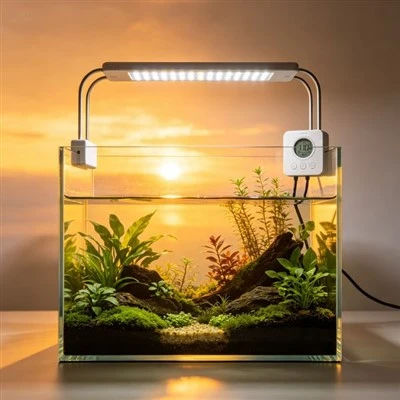
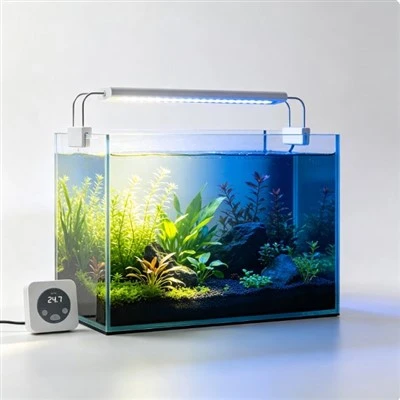
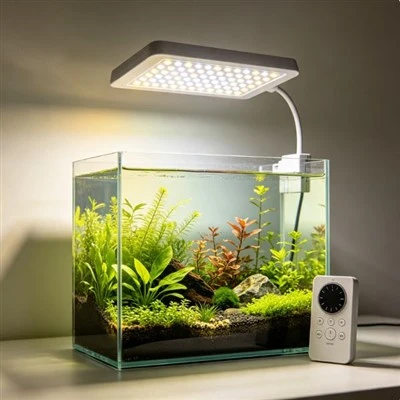
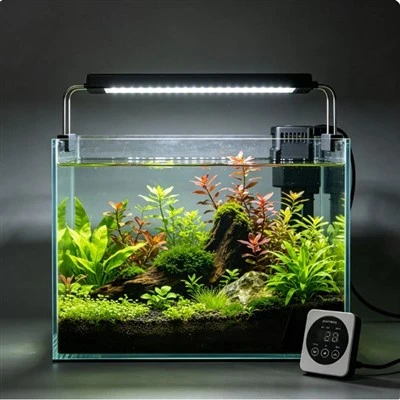
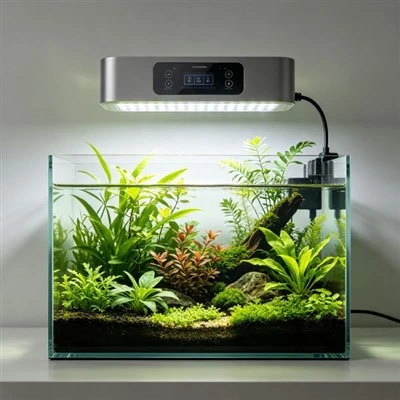
Snail Eggs above the Waterline: Lighting for Inspection while Limiting Added Heat and Airflow
An egg mass on the glass or lid above the waterline often surprises an aquarium owner. The natural response is to bring the light closer, leave it on longer, or move the eggs into a more convenient view. Those actions can change heat, humidity, airflow, and exposure around a structure whose needs depend on the snail species. Some aquatic snails place eggs above water, while others deposit different-looking eggs underwater. Identification and species-specific reproductive guidance therefore come before any lighting decision. The lamp's useful job is limited: it can help with brief observation without becoming an unmeasured environmental treatment.
Start with a description rather than a guess. Record the mass's color, approximate size, texture as seen without touching, height above the water, and attachment surface. Photograph it beside a ruler held outside the enclosure if that can be done without disturbance. Identify the adult snails from reliable sources, remembering that trade names can be imprecise. Do not handle, submerge, mist, scrape, or relocate the mass simply because a forum photo looks similar. An action suitable for one species or incubation method may be harmful or irrelevant for another.
The air immediately below a lid can differ from the room. Evaporation, water temperature, lid fit, ventilation gaps, and circulation all shape local humidity. A nearby fixture may warm the cover or move air through cooling vents, even when the aquarium water thermometer looks unchanged. That does not mean every light will dry or overheat eggs; distance, power, housing design, room conditions, and enclosure geometry vary. It means water temperature alone cannot describe the above-water microenvironment. Follow fixture clearance rules and established care guidance rather than moving equipment by feel.
A simple inspection log prevents unnecessary manipulation. Note the date first observed, location, normal photoperiod, fixture distance, lid condition, visible condensation elsewhere, room temperature, and any permitted environmental measurements. Take later photographs from the same angle under a short neutral setting. Changes in color or texture should be interpreted through species-specific references, not a universal calendar. Avoid shining an intense spot continuously for photographs. Camera flash and white balance can alter appearance, so images are useful records but not precise measures of moisture or viability.
Consider an egg mass attached beneath a clear lid near the aquarium's rear corner. From the front it looks dim, so the owner tilts the main light backward and runs it into the night. The new position places more heat near the lid and creates glare, yet the view remains poor because condensation scatters the light. Returning the fixture to its approved position and using a brief normal daytime inspection from the side produces a clearer photograph with less disturbance. The eggs' outcome is still not guaranteed; the change merely improves observation discipline.
Population planning belongs in the same conversation. Depending on species and local rules, successful reproduction can create more snails than the aquarium can appropriately support or rehome. Research adult size, care, compatibility, legal restrictions, and responsible placement before deciding whether to manage an egg mass. Never release aquarium snails, eggs, plants, or water into natural waterways. Lighting should not be marketed or used as a way to promise hatching. Reproduction involves biological and environmental factors beyond a fixture, and responsible ownership includes the possible result.
Routine tank access must remain safe. Do not wedge the lid open with a lamp bracket, route cables across a wet opening, or reduce escape prevention to obtain a better view. Keep dry-location controllers, plugs, and power supplies away from condensation and splash. If the fixture or connector becomes wet contrary to its instructions, disconnect safely and seek product guidance. Any temporary inspection light used near water must be suitable for that location and secured against falling. An ordinary phone flashlight held at a distance may be enough when used safely and briefly.
Avoid treating visible condensation as a humidity prescription. Droplets on one section of lid show that surface reached conditions for condensation; they do not directly quantify the air around the eggs. Likewise, a dry-looking cover does not prove the mass lacks appropriate moisture. Measuring tools have limitations and can disturb a small enclosure, so their use should follow a sound method. If reliable species guidance recommends a particular setup, reproduce it within the safe design of the aquarium instead of improvising with heat from a lamp.
Seasonal room changes can alter the enclosure without any deliberate adjustment. Air conditioning, winter heating, an open kitchen window, or a fan moved across the room may change temperature and airflow around the lid. Add those events to the record, particularly if the fixture uses active cooling or sits close to a ventilation path. Do not block product vents to protect the egg mass from air movement. If the approved fixture position conflicts with species-specific enclosure needs, redesign the safe placement or seek suitable equipment rather than modifying the lamp.
When advice is needed, send useful evidence. Include clear images of the adults and mass, tank and lid dimensions, measured water and room temperatures, fixture location, normal schedule, and the date first noticed. State what has and has not been touched. This allows an experienced keeper, veterinarian, supplier, or local aquatic organization to distinguish identification from incubation guidance. Avoid copying a treatment based only on egg color, because lighting and camera processing can alter color and unrelated species may produce superficially similar structures.
The most defensible approach is restrained. Identify the species, document the mass without handling it, maintain a stable care-appropriate light-dark cycle, and keep the fixture at its approved clearance. Use brief neutral light for inspection, watch the lid and electrical components for condensation, and seek experienced advice before changing the mass or its environment. A clear view is valuable because it supports records; constant brightness is not. By separating observation from incubation, the owner avoids turning an aquarium light into a tool it was never designed to be.