Last spring I walked through a new exhibit wing three weeks before opening. The curator, Maria, had the original concept renderings rolled up under one arm. She pointed up at the ceiling.
"The fixtures we installed are almost 40mm thicker than what's in these drawings," she said. "Every test photo has this dark bar running across the top of the tank. It's not what we sold the board on."
That's usually how the conversation starts. Not with a question about brightness or spectrum, but with a fixture that simply doesn't fit the space it was meant to disappear into.
The Two Problems Nobody Budgets For
Brightness and color temperature get most of the attention during planning. In practice, two other issues cause far more late-stage headaches.
Sightlines. Rimless tanks and close-viewing galleries are standard now in newer exhibit design. A thick fixture overhead throws a visible shadow line, breaks the "open water" illusion, and shows up in almost every visitor photo taken from below. I've seen design teams spend a full month on rockwork and aquascaping, only to have a bulky light rail undo it in the final walkthrough.
Clearance. A lot of public aquarium buildings are 20, 30, sometimes 50+ years old. Ceiling heights were never designed around modern fixture depth, and custom acrylic lids often have tolerances of just a few millimeters. A standard fixture doesn't just look wrong in these spaces - it physically doesn't go in without cutting into the lid or reworking the mounting brackets.
This is the gap that slim-profile LED fixtures were built to close.
Why Thin and Bright Don't Usually Go Together
Fitting enough LEDs and optics into a shallow housing is a real engineering trade-off, not a marketing claim. Heat is the limiting factor - less body depth means less room for a heatsink, and LEDs lose output (and lifespan) fast once they run hot.
When I'm speccing a fixture for a tight space, the process is almost always the same: measure the actual clearance first, then work backward to figure out what power density is realistic without pushing thermal limits. The fixtures that hold up long-term tend to share three things - efficient chip layouts, aluminum housings sized for passive cooling, and optics tuned to recover some of the PAR lost to the shallower depth.
A lot of budget options skip straight to "how thin can we make this" and end up with either dim output or a fixture that dims further within a year as the diodes degrade. The better commercial-grade options are engineered around the thermal problem from the start, not compressed down from a thicker model after the fact.
Case: A 34-Inch Planted Display With No Room to Spare
One aquarium wanted a wall-embedded freshwater planted tank with a flush acrylic lid - no visible hardware at all. The clearance above the waterline was 34mm. Every fixture their design team had shortlisted needed at least 45–50mm, which meant either raising the lid (killing the flush look) or cutting a recess into the ceiling panel.
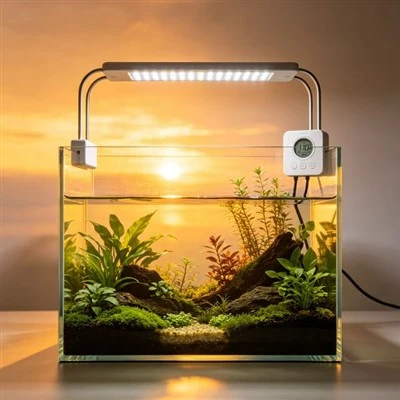
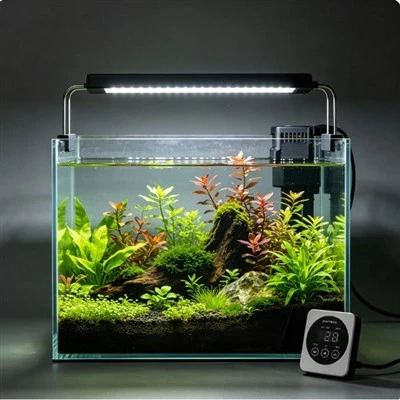
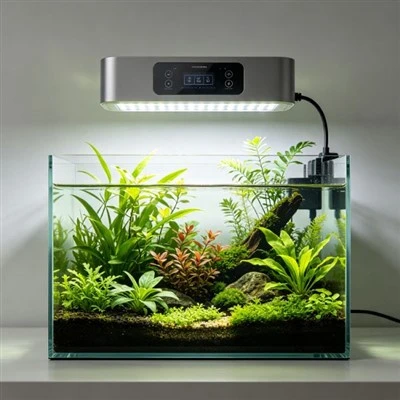
We fitted the exhibit with an ultra-thin planted-tank LED fixture built for exactly this clearance range, with a spectrum weighted toward the red and blue bands plants actually use rather than a generic full-spectrum output. The lid sat flush as designed. Plant growth over the following ten weeks matched what the horticulturist expected from a standard-depth fixture at the same PAR target - no compromise on that front. The exhibit opened on the original schedule.
Case: Six Storefront Cylinders on a Retail Strip
A separate project involved six narrow cylinder tanks used as street-facing displays for a retail chain. The existing fixtures were creating a visible hot spot near the waterline and made the tanks look top-heavy from outside - not the effect you want when the whole point is stopping foot traffic.
Swapping to a slim fixture (roughly half the depth of the originals) let the design team drop the mounting height by about an inch and rebalance the proportions of the whole display. Installation ran under three hours per tank since no custom bracket work was needed. In the follow-up check eight weeks later, the store reported a noticeable uptick in people stopping at the windows, and maintenance staff specifically mentioned the housing no longer looked "like it belonged in a server room" - a direct quote from one of the site notes.
Neither project needed more light. Both needed less visible hardware doing the same job.
Where This Goes Wrong
The most common mistake is optimizing for thinness alone. Buyers chase the lowest-profile option on the spec sheet, then find six months in that heat has already caused dimming or early failure - thin housings need better thermal engineering, not less of it.
The second mistake runs the other way: assuming "thin" automatically means "underpowered," and over-compensating by choosing a fixture that's too weak for the tank's actual PAR requirements. Plants stretch, corals bleach out. The fix is straightforward but often skipped - confirm the fixture physically fits first, then match its rated PAR output to the tank's actual needs, not the other way around.
FAQ
Does a slim fixture lose much output compared to a standard-depth one? Some, but well-engineered models close most of that gap through better chip efficiency and optics. Expect a small trade-off, not a dramatic one, if you're buying from a manufacturer that publishes real PAR data rather than just lumens.
How much clearance do I actually need before considering a slim fixture? As a rough guide, if your usable clearance is under 45mm, a standard-depth fixture likely won't work without modifying the lid or ceiling. Measure the tightest point, not the average - lids are rarely perfectly flat.
Can a thin fixture support a planted tank long-term, or is it a short-term fix? Yes, provided it's built for planted use specifically - meaning a spectrum tuned for photosynthesis, not a general-purpose reef or freshwater light that happens to be thin.
What actually causes overheating in low-profile fixtures? Undersized aluminum bodies, poor airflow above the housing, and cheap driver components are the usual culprits - in that order. A fixture with a well-designed heatsink and a few millimeters of ventilation clearance above it will generally run fine.
What should a public venue check before ordering fixtures for a permanent installation? CE and RoHS certification at minimum, plus local electrical code compliance for the installation. For a permanent exhibit, ask for a supplier reference from at least one other commercial installation of similar scale - spec sheets don't tell you how a fixture holds up after 18 months of daily runtime.
Do slim fixtures generally have a shorter lifespan? Not inherently. Lifespan comes down to thermal management, not body depth. A well-built slim fixture with adequate cooling can outlast a poorly designed thicker one.
About the Author
I've spent the past several years working with public aquariums and commercial retail displays on lighting specification - mostly solving the same problem in different buildings: how to get real performance out of a fixture that also has to disappear. All recommendations here reference fixtures carrying CE and RoHS certification.
Getting Started
If hardware is fighting your exhibit's sightlines or won't fit your ceiling clearance, start with two numbers: the tightest clearance point above the tank, and the PAR target for whatever you're growing or displaying. Those two figures rule out most of the guesswork before you even look at a spec sheet.
If your project fits the profile described above - planted display, rimless tank, or a retrofit into an older building - send over your clearance measurements and target PAR range. I can tell you fairly quickly whether a slim-profile fixture is a realistic fit or whether the space needs a different approach entirely.